Physical Address
304 North Cardinal St.
Dorchester Center, MA 02124
Physical Address
304 North Cardinal St.
Dorchester Center, MA 02124


A plain-English guide to wallet watching, wallet trackers, scams, and safer read-only setup checks.
Wallet watching means monitoring public crypto addresses without private-key access. You can check balances, transfers, token movements, labels, alerts, and portfolio changes from a read-only view.
In practice, wallet watching can mean a watch-only view of your own address, a dashboard tracking many wallets, or a trader following whale and smart-money activity. Visibility is useful. Control is not.
Wallet watching in crypto means using a public address, watch-only wallet, tracker, explorer, or alert tool to follow wallet activity without holding the private key.
Think of it as looking through a window. A public address can show received funds, outgoing transfers, token balances, approvals, NFTs, or counterparties. It cannot prove ownership, expose a seed phrase, recover assets, or make a wallet spendable.
Most people use it in three common ways:
These overlap, but the risk profile shifts by intent. Monitoring your own wallet is a safety habit. Watching a trader wallet is market research. Paying a stranger to “activate” a high-balance watch-only wallet is how a bad day starts.
Wallet watching works because public blockchains record transactions anyone can inspect. A tool reads that public identifier, translates raw activity, and turns it into balances, transfers, token movements, labels, or alerts.
The flow is simple. You start with a public address, ENS-style name, or Bitcoin extended public key. Then you load that identifier into a blockchain explorer, watch-only wallet, portfolio dashboard, or alert tool. The tool shows visible history, not private control.
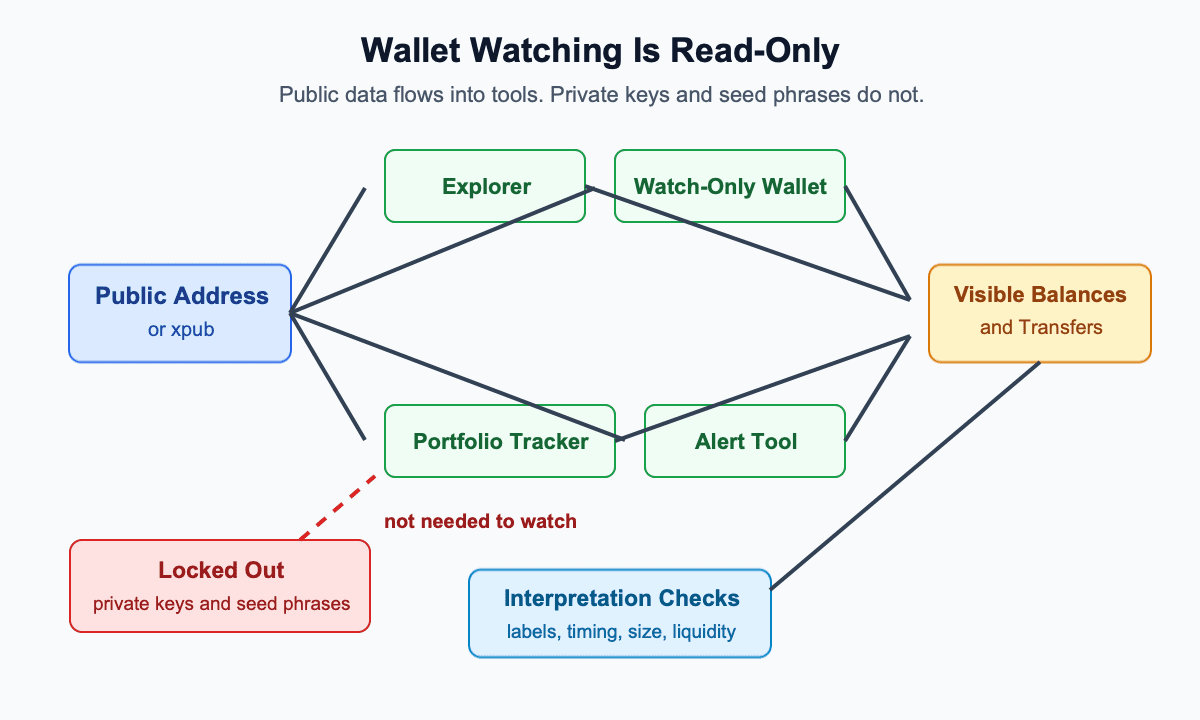
_Wallet watching starts with public data, while private keys stay outside the monitoring flow._
For example, watching a Bitcoin cold-storage address for new deposits is mostly a records-and-safety task. Watching a Solana trader wallet for fresh meme-coin buys is noisier. Speed, liquidity, bots, and wallet labels can all distort the signal.
That is a pattern you can use: track purpose first, then tool.
Good wallet watching separates data from interpretation:
Alert tools add convenience, not certainty. Etherscan’s Watch List can notify users about activity tied to watched Ethereum addresses, but the alert still needs human interpretation. A transfer happened. The reason still needs checking.
Watch-only wallets are one version of wallet watching, but the terms should not be mashed together. A watch-only wallet is usually a wallet-app view of an address. Wallet watching is the broader habit of monitoring addresses across tools.
MetaMask Support uses watched accounts as a read-only way to follow account activity in MetaMask Portfolio. Trust Wallet Support warns that view-only access does not allow transactions, withdrawals, or moving funds.
| Term | What It Means |
|---|---|
| Watch-only wallet | A wallet-app view that shows an address without the private key |
| Watched account | A monitored account inside a wallet or portfolio interface |
| Wallet tracker | A tool that follows one or more public addresses |
| Portfolio tracker | A dashboard that groups balances, chains, and positions |
| Blockchain explorer | A public search tool for transactions and addresses |
| Whale tracker | A tracker focused on large wallets or large transfers |
| Smart-money dashboard | An analytics view that labels wallets by observed behavior |
| Exchange wallet label | A tool label suggesting an address belongs to an exchange |
The table’s trap is the first row. A watch-only wallet can display real balances from an address you do not control. That is normal. It is also why scammers love screenshots of rich view-only wallets.
If a tool only needs a public address, it should not need your seed phrase. If a stranger says a fee will turn a watch-only wallet into spendable access, close the tab and keep your funds where they are.
People use wallet watching because crypto activity is scattered across chains, apps, exchanges, treasuries, and self-custody wallets. Watching an address gives you a running view without logging into every product or trusting every social update.
Legitimate use cases usually start with visibility:
Project-wallet monitoring is where wallet watching gets sharper. A sudden liquidity move can connect to a hard rug warning, while slow insider selling can resemble a soft rug warning.
Wallet history can also add context when a project leans on anon dev clues instead of clear accountability. That does not make every anonymous team suspicious. It does make wallet behavior worth checking before trust gets expensive.
Trading research is a different lane. Some users watch wallets to study how another trader sizes entries, exits, and failed ideas. That can teach process. But copying another user’s actual conviction play without knowing their bankroll or hedges is still cosplay with gas fees.
Wallet watching has also moved beyond token trading. Prediction-market users may watch public wallets to see how active traders position before an event. That can be useful context, but it still shows public actions after they happen. It does not show private reasoning.
Wallet watching can show what moved on-chain, when it moved, and which addresses were involved. It cannot reliably tell you why the move happened, who made the decision, or whether the next price move will follow.
That gap is where most bad wallet-watching habits begin. A whale deposit to an exchange may be a sale setup, collateral movement, custody reshuffle, market-maker operation, or internal transfer. One screenshot cannot sort those motives.
| What You See | What It Might Mean |
|---|---|
| Exchange deposit | Possible selling, collateral movement, custody change, or internal operation |
| Exchange withdrawal | Possible self-custody, market-making movement, or long-term holding |
| Token buy | Fresh position, wallet test, bot activity, or public signal chasing |
| Token sell | Risk reduction, failed trade, profit taking, or automated rebalancing |
| Wallet-to-wallet transfer | Owner reorganization, OTC settlement, team movement, or address hygiene |
| Claim or airdrop | Reward collection, sybil activity, farming, or routine cleanup |
| Contract approval | App use, token risk, old permission, or careless signing |
| Bridge transfer | Chain move, arbitrage, liquidity search, or app requirement |
| New wallet funding | Fresh strategy, burner setup, bot wallet, or project-linked activity |
| Repeated small transfers | Address testing, dusting, spam, or operational routing |
The table is a translation aid, not a verdict machine. A watched move becomes useful only after you check labels, wallet history, timing, liquidity, position size, and whether the same signal is already all over X.
Late copying is the classic mistake. Public alerts can leave a wallet follower with late bagholder risk if liquidity is thin and the original wallet entered much earlier. A visible flow can also look like a crypto rotation signal when money moves between themes, but that does not prove the rotation is durable.
Size needs context too. A tiny wallet buying a token is not the same as a long-running wallet adding a small test position. If you turn one alert into full port risk, the watched wallet is no longer the main problem.
Crowded wallet watching can quickly become PVP trading pressure. If everyone tracks the same wallet, bots and faster traders may front-run the obvious move. By the time the alert reaches a beginner dashboard, the clean entry may already be gone.
The biggest wallet-watching risk is confusing visibility with control. Seeing a balance does not mean you own it, can recover it, or can spend it.
That confusion powers many watch-only wallet scams. A scammer shows a high-balance wallet, gives you a view-only import, and then claims you must pay an activation fee, gas fee, tax, or recovery charge to move the funds. The visible balance may be real. Your access is not.
The fraud backdrop is real: the FBI said Americans submitted 181,565 complaints involving cryptocurrency in 2025.
Use this checklist before trusting any wallet-watching setup:
Address poisoning adds another layer of confusion. Attackers may send tiny transfers from lookalike addresses, hoping you copy the wrong address later. Small unwanted transfers are not always dangerous by themselves. But they can make wallet history messy enough to misread.
Privacy cuts both ways. Watching a public wallet is legal in the general sense of observing public-chain data, but linking addresses to people can expose patterns, counterparties, salary flows, donations, and trading behavior. A reused address can become a doxxed wallet risk if social posts, ENS names, NFTs, or project roles connect the dots.
Labels deserve skepticism. A dashboard may mark an address as an exchange, fund, insider, or smart-money wallet, but labels can be incomplete or stale. Use labels as clues. Then check the actual transaction path before acting on them.
Alert fatigue is the quieter trap. If you watch too many wallets, every ping feels urgent. That turns a monitoring setup into a slot machine for your attention, minus the free drinks.
Start wallet watching with one clear reason and one public address. A narrow setup is easier to verify than a dashboard full of wallets you barely understand.
Pick the use case before picking the tool. Own-wallet monitoring, whale research, tax records, treasury checks, and scam investigation all need different notes. A portfolio dashboard can help with your wallets. A public explorer is often better for a one-off address check.
Use a read-only method first:
Different goals need different notes. For your own wallet, record deposits, withdrawals, counterparties, and transaction reasons. For a public whale wallet, record prior behavior, liquidity, timing, and failed signals. For a project wallet, record deployer links, treasury movements, token approvals, and unexplained transfers.
Do not paste seed phrases, private keys, or recovery words into any wallet-watching tool. Do not sign transactions just to watch a public address. If a site asks for control-level access for a read-only task, the tool is asking for the wrong kind of access.
Then review outcomes. If the alert helped you understand a transfer, keep it. If it only made you chase candles, remove it. A clean watchlist beats a noisy shrine to other people’s wallets.
Wallet watching can help with address-level records, but it does not calculate taxes by itself. It gives you a clearer transaction trail that tax software, bookkeeping notes, or a professional can reconcile later.
For U.S. users, the IRS digital assets page highlights recordkeeping around purchases, receipts, sales, exchanges, fair market value, and basis. Wallet watching can support those records by showing which address held or moved an asset.
The same IRS page links Revenue Procedure 2024-28, which covers transitional guidance for allocating unused basis to digital assets in wallets or accounts as of Jan. 1, 2025. That is a tax-records point, not a reason to rely on a wallet tracker as tax advice.
Keep the boundary clear. Wallet watching can help you notice missing transactions, identify duplicate imports, and separate self-transfers from disposals. It cannot decide your cost-basis method, filing position, or local tax treatment.
Related wallet watching terms help you avoid treating every transfer as a trade signal. Most of them name risk, timing, or identity clues.
Use these concepts as checks, not as slogans:
Other common terms belong in the same mental drawer: public address, private key, seed phrase, blockchain explorer, exchange inflow, exchange outflow, whale wallet, smart money, airdrop, token approval, bridge transfer, and address poisoning.
The useful habit is to name the concept before reacting. “Whale moved tokens” is a headline. “A labeled wallet bridged a small position after several failed trades” is analysis.
Wallet watching means monitoring public crypto wallet activity without controlling the wallet. You can see balances, transfers, labels, approvals, and alerts when the chain and tool support them.
It is useful for visibility, records, and research. It does not show private keys, private intent, or guaranteed trading signals.
No. A watch-only wallet is one way to do wallet watching.
Wallet watching is broader. It can include explorers, portfolio trackers, alert tools, analytics dashboards, and watch-only wallet views.
No. A watch-only wallet cannot send crypto unless the user also has the private key, seed phrase, or proper signing access.
That is why activation-fee claims are a red flag. A view-only wallet may show real funds, but the view does not create spend permission.
No. Watching a wallet does not prove ownership.
Anyone can monitor many public addresses. Ownership depends on control of the private key or signing method, not whether an app can display balances.
Whale wallet alerts are reliable for showing that a monitored transaction happened. They are not reliable for proving motive or predicting price.
Use alerts as prompts for more checking. Look at labels, wallet history, liquidity, timing, market context, and whether the move is already public.
Wallet watching can help organize address-level records, especially when you use several wallets. It can reveal transfers, dates, counterparties, and missing imports.
It is not tax software or tax advice. Use it as a recordkeeping aid, then reconcile the data with your chosen reporting workflow.
Start with one wallet, one reason, and one read-only method. That keeps the habit useful before alerts and dashboards turn it into noise.
Use this short plan:
Wallet watching is strongest when it slows you down. It shows activity, gives context, and helps you ask better questions. The moment it makes you chase strangers through thin liquidity, it is no longer research and has become tuition.
Keep the list small enough that every alert has a job. If you cannot explain why an address belongs on the list, remove it before it starts steering your decisions.