Physical Address
304 North Cardinal St.
Dorchester Center, MA 02124
Physical Address
304 North Cardinal St.
Dorchester Center, MA 02124

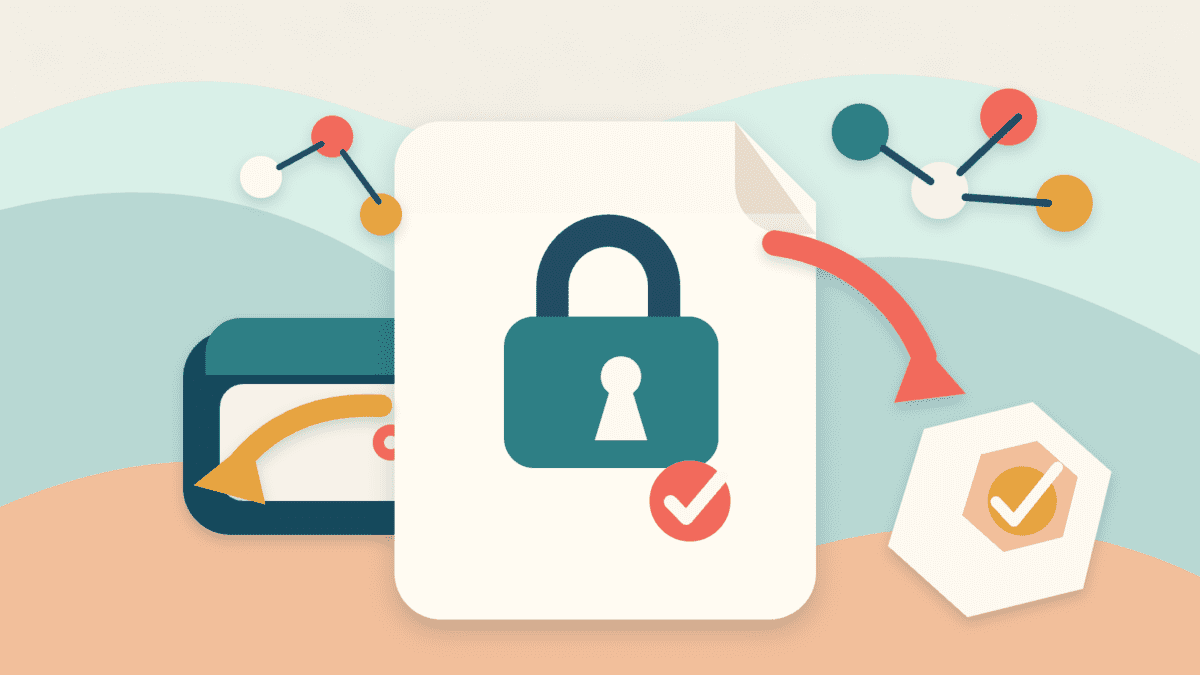
Claim contracts, airdrops, vesting, and wallet checks in plain English.
A claim contract in crypto is a smart contract that lets eligible wallets claim tokens, rewards, NFTs, refunds, or vested allocations under preset rules.
Most users meet one on an airdrop page, vesting dashboard, rewards portal, token migration site, or block explorer. The project sets the rules, the contract checks them, and an eligible wallet calls a claim function.
The risky part is not the word “claim.” It is the wallet prompt. A real claim contract can be normal distribution infrastructure, while a fake claim page can turn the same button into a drain. Same costume, very different ending.
A claim contract means a project is not pre-sending assets to every wallet. It places tokens, NFTs, rewards, refunds, or vested allocations behind a smart contract and lets each eligible wallet claim its share.
That setup appears in many places. Airdrops use claim contracts to let active wallets collect rewards. Staking or liquidity programs use them for periodic incentives.
Common claim contract use cases include:
The useful part is also boring. A claim contract is infrastructure. It is not a stamp of token value, legal rights, audit quality, exchange support, or team honesty.
So the first question is not “Is there a claim?” It is “What does this contract let my wallet do, and what exactly am I being asked to sign?” That is where a normal distribution tool and a nasty wallet prompt split paths.
A claim contract works by checking whether your wallet meets the claim rules, then sending the asset only if the check passes. The details vary by chain and project, but the flow is usually easy to recognize.
Most token claim processes follow this order:
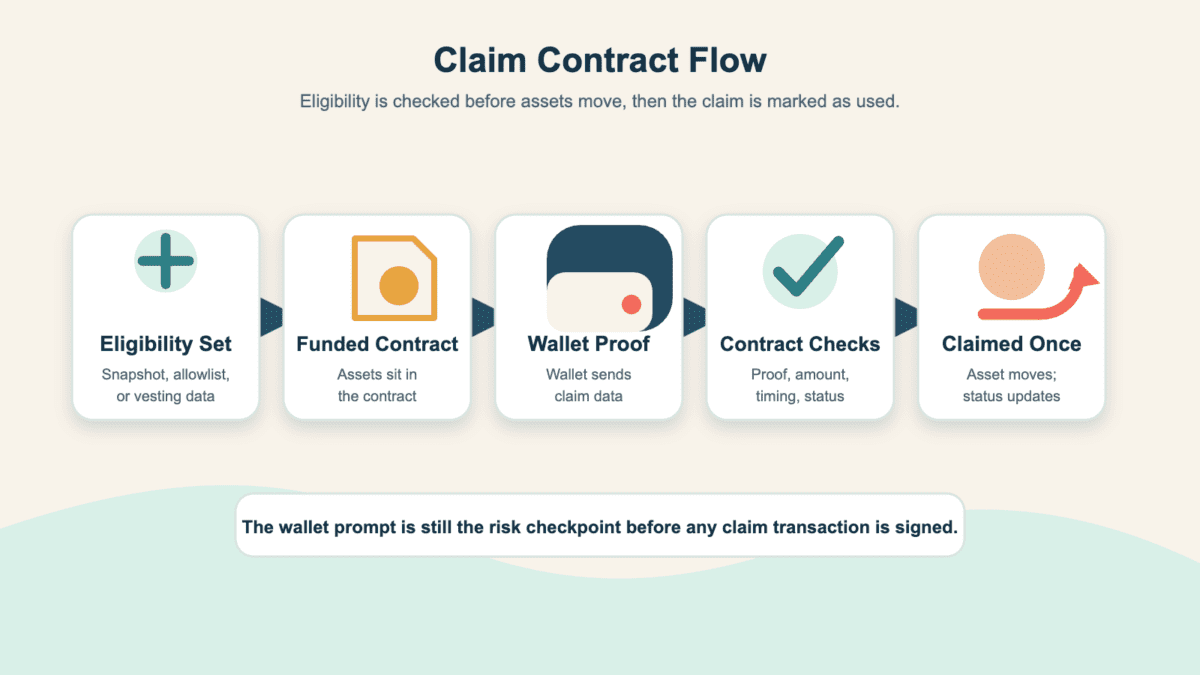
This setup can lower project costs because it avoids sending tokens to thousands of inactive wallets. It can also reduce messy dust distributions where tiny balances appear in wallets that never wanted them.
But the cost does not vanish. It often moves to the recipient. You may pay gas, connect a wallet, sign a message, or handle a claim deadline. That is why the wallet prompt deserves as much attention as the reward amount.
A claim contract often uses a snapshot and Merkle proof so it can verify many eligible wallets without storing the whole list on-chain. The contract stores a compact commitment to the list, then checks each wallet’s proof when it claims.
A snapshot is a record of who qualified at a certain moment. It might capture token holders, bridge users, app users, NFT holders, or presale buyers. The project turns that list into data the contract can verify.
In a Merkle claim, the main pieces are simple:
In Merkle distributor patterns documented by OpenZeppelin, the contract stores a root, verifies a proof, and marks a claim as used to prevent duplicate claims.
If your proof is wrong, the transaction should fail. If your wallet already claimed, the contract should reject another claim. That is the whole point: prove inclusion once, send the asset once, and stop double dipping before it gets cute.
Claim pages often confuse users because dashboards use several similar words for different states. The cleanest way to read a claim page is to separate what you were promised from what you can actually withdraw now.
| Term | What It Means |
|---|---|
| Allocation | The total amount assigned to a wallet or account. |
| Claimable | The portion available to withdraw now. |
| Claimed | The amount already withdrawn through the contract. |
| Unclaimed | The amount still available or still pending, depending on rules. |
| Locked | Tokens assigned but not yet transferable. |
| Unlocked | Tokens no longer restricted by the schedule. |
| Vested | Tokens earned over time under a release schedule. |
| Cliff | The first date when any vested amount becomes available. |
| Expired | A claim window that has passed. |
| Returned | Unclaimed assets sent back to a treasury or admin address. |
| Burned | Unclaimed assets permanently removed from circulation. |
A dashboard can show a large allocation while the claim contract releases only a smaller claimable amount. That is normal in vesting launches, presales, and reward programs.
The check is simple: do not read “allocated” as “available.” The available amount is the claimable amount under the current rules, not the marketing number at the top of the page.
Claim contracts and airdrops often overlap because airdrops need a way to distribute assets to eligible wallets. Some airdrops send tokens directly. Others make users claim from a contract.
A claimable airdrop is useful when the eligible list is large, the amounts vary, or the project wants each recipient to decide whether paying gas is worth it. It also fits airdrop farming, where users try to qualify for future rewards through activity.
The two common models look like this:
| Airdrop Model | What Changes for the User |
|---|---|
| Direct airdrop | Tokens appear in the wallet without a claim transaction. |
| Claimable airdrop | The user connects a wallet and calls a claim function. |
Direct airdrops are simpler for recipients, but they can waste project funds on inactive wallets. Claimable airdrops shift more work to the user, including gas, deadlines, and wallet safety checks.
Claim windows also matter. Some projects let claims stay open for a long time. Others recover, burn, or redirect unclaimed tokens after a deadline. If the deadline is not clear, wait for an official clarification before rushing through a strange wallet prompt.
Claim contract safety starts before the wallet connects. A clean claim is one where the source, chain, contract address, token address, and wallet action all match what the official project published.
A real claim may ask you to pay gas and call a claim function. A risky claim may ask for an unlimited token approval, a permit signature, a transfer you did not expect, or access that has nothing to do with receiving assets.
Use this checklist before signing:
Verified source code is useful, but it is not magic armor. It helps you see what code is deployed, but it does not prove the contract was audited, immutable, fairly managed, or economically safe.
Also check what the admin can still do. Pause functions, upgrade proxies, owner withdrawals, blacklist controls, or emergency recovery rules can all change the trust picture. If the prompt surprises you, stop there. Crypto rarely rewards heroic clicking.
A claim contract is the on-chain logic. A fake claim page is a malicious front end that can imitate the look of a real campaign while asking your wallet to approve something dangerous.
Scams exploit that gap. They use copied branding, fake airdrop announcements, unsolicited tokens, social-media links, and urgent deadlines. The button may say “claim,” but the action may be an approval, transfer, or signature that helps drain funds.
Common signals split quickly:
| Normal Claim Signal | Red Flag |
|---|---|
| Official URL from the project | Lookalike domain or shortened link |
| Claim function with expected asset | Approval for unrelated tokens |
| Public contract and token address | No address, or a changing address |
| Gas-only wallet action | Seed phrase, password, or recovery words |
| Clear deadline and terms | Urgent countdown with vague rules |
The FBI IC3 warned in June 2025 that criminals used airdrop-style rewards, phishing URLs, and wallet-connection tricks to steal cryptocurrency from non-custodial wallet users. It also describes a seed phrase as 12 to 24 words, which is why any claim page asking for those words is asking for wallet control, not eligibility proof.
Unsolicited dust or random tokens can be bait toward fake claim pages. Seeing a token in a wallet is not the same as owning safe value, and it is not a reason to follow a link from the token memo or description.
Some fake claims overlap with hard rug behavior when the contract or approval path causes sudden losses. Others are plain phishing. Either way, no legitimate claim needs your seed phrase.
A claim contract releases assets when claim rules are met. A vesting contract focuses on time-based release rules, such as cliffs, monthly schedules, and future token releases.
The two can overlap. A token launch may use a vesting claim, where your wallet has an allocation but only part of it is claimable at the token generation event. Later portions become available over time.
| Contract Type | Main Job |
|---|---|
| Claim contract | Checks eligibility and sends the amount currently available. |
| Vesting contract | Controls when locked tokens become available over time. |
This split explains why claim pages sometimes disappoint people. The dashboard may show the full allocation, while the claim function releases only the vested portion. The rest may stay locked behind a cliff, linear vesting schedule, or revocable plan.
For token holders, the useful check is timing. Ask how much is claimable now, how much releases later, and whether insiders, team wallets, or investors follow the same schedule. The contract type tells you the mechanism, not whether the launch is fair.
A claim contract can change token supply timing because many wallets may claim around the same window. That can create early sell pressure, thin liquidity, and messy price action after a launch.
The risk is not only that retail wallets claim. Team, investor, treasury, and market-maker allocations may have different rules. A token can advertise an instant claim for public buyers while larger allocations follow their own release schedule.
Watch these market signals:
This is where exit liquidity risk enters the picture. If many early recipients sell into thin demand, late buyers can become the bid that lets others leave.
That does not mean every claim launch is bad. It means “claimable” is not a market-quality label. A trader still needs to check liquidity, release schedules, wallet concentration, admin controls, and whether the post-claim crowd is likely to hold or sprint for the door. Nobody wants to become a bagholder because they confused distribution mechanics with demand.
A claim contract proves only what its code and rules can prove. It can show that a wallet is eligible, that a proof passed, that a claim was recorded, or that assets moved from the contract.
The wider project can still be unsafe. A project can run a real claim contract and still have weak liquidity, bad token design, unclear legal rights, aggressive insider releases, or a team that drifts into soft rug territory after launch.
Do not use the existence of a claim page as proof of these things:
The legal point deserves a clean line. In tokenized assets, “claim” can also mean a legal claim to some underlying right or cash flow. A smart-contract claim is different. It may distribute a token, but it does not prove what rights that token represents.
Checking a claim contract means confirming the route, the address, the action, and the risk before you sign. The goal is not perfect certainty. The goal is to avoid obvious traps and unclear permissions.
Start with the official source. Use the project’s main website, verified social account, Discord announcement, app dashboard, or documentation. Then confirm the exact chain, contract address, token address, and claim deadline.
Run through the checks in order:
Next, open the contract on the relevant explorer. Etherscan supports source-code verification for deployed contracts, which helps users inspect whether published source code is tied to the contract address.
Team visibility is one signal, not a guarantee. Doxxed teams can still make bad choices, and anonymous teams can still write clean contracts. The point is to stack signals until the claim makes sense.
If one check fails, slow down. If several fail, skip it. A real allocation should survive a few minutes of verification, and a fake one often depends on you not taking those minutes.
Claim contracts sit near several crypto terms that are easy to blur together. Airdrops describe the distribution event. Claim contracts describe one way the assets are released.
Use these nearby terms as separate checks:
The clean habit is to read each term as a separate check. One tells you who can claim. Another tells you when. Another tells you whether the wallet action is safe. Together, they stop “free tokens” from becoming a very expensive typo.
A claim contract in crypto is a smart contract that checks whether a wallet is eligible and releases tokens, NFTs, rewards, refunds, or vested allocations when the wallet claims. It is a distribution mechanism, not proof that the asset is valuable or safe.
A legitimate claim contract should only perform the claim action you approve, but a fake claim page or malicious approval can drain funds. Read the wallet prompt, check the contract address, and never enter a seed phrase.
No. An airdrop is the distribution event, while a claim contract is one tool used to distribute assets. Airdrops can be sent directly or made claimable through a contract.
A Merkle proof is a compact proof that your wallet belongs in an eligible list without putting the whole list on-chain. The claim contract checks the proof against the stored Merkle root before sending assets.
Your allocation is the total assigned amount, while the claimable amount is what the claim contract lets you withdraw now. Vesting, cliffs, release schedules, claim windows, or previous claims can make those numbers differ.
Yes, sometimes. Claiming through a block explorer can reduce fake-front-end risk only when you have verified the chain, contract address, function, proof data, token address, and expected wallet action.
Start with verification, not the button. A claim contract can be routine, but the wallet interaction is still real money touching real permissions.
Give yourself a short pause before the transaction. A fake claim page wants speed, urgency, and a half-read prompt. A legitimate claim should still make sense after you check the boring details.
Use this order before you claim:
If the claim is worth real money, check it from two paths: the official announcement and the block explorer. If those paths disagree, the right answer is not “maybe.” It is “not yet.”
The best claim is boring: correct page, correct chain, expected function, limited permissions, and no pressure theatrics. If the flow feels rushed or vague, let someone else provide the cautionary screenshot.