Physical Address
304 North Cardinal St.
Dorchester Center, MA 02124
Physical Address
304 North Cardinal St.
Dorchester Center, MA 02124


A clear guide to DA layers, rollup data, Ethereum blobs, alt DA, and L2 risk.
A DA layer is a data availability layer, the part of a modular blockchain stack that lets rollups publish transaction data so others can verify what happened.
You will see the term near Ethereum blobs, Celestia, EigenDA, Avail, L2 fees, and rollup safety. It sounds like deep plumbing, and it is. But the user-facing question is simple: where did the rollup put the data, and what extra trust does that choice add?
Cheap data is useful. Cheap data with mystery assumptions is just a discount with small print.
A DA layer in crypto is infrastructure that publishes transaction data and helps others check it was available when verification needed it. DA stands for data availability. The full phrase prevents confusion with DAI, software data-access layers, or generic storage.
For rollups, the DA layer is where the batch data goes. The rollup may execute transactions elsewhere, post commitments to a settlement chain, and use a DA layer so verifiers can inspect or reconstruct the transaction data behind those commitments.
A DA layer does not execute trades, custody funds, run an oracle, or settle disputes by itself. Its job is narrower and more boring in the best way: make the data visible enough that independent parties can check the rollup.
A simple rollup example helps. The rollup batches many user actions, posts a compact record on a base chain, and sends the needed transaction data to a DA source. If a watcher needs to verify balances, challenge fraud, or rebuild state, the data has to be available.
A DA layer is not where the app experience happens. It helps show the app experience was not built on hidden data.
Rollups need a DA layer because outside parties must be able to verify each batch. A rollup can feel fast and cheap while still leaning on a data source for safety.
Ethereum.org describes the data availability problem as proving the underlying data exists without forcing every node to download all of it. Its rollup section also notes that independent verifiers using blob data have to query it and raise challenges within about 18 days before that data is deleted from Ethereum L1.
That is the tension. Rollups process activity away from the base chain, then need enough public data for independent checks.
A rollup batch is not just a headline number or final balance. It contains transaction data that lets monitors reconstruct state. Optimistic rollups need data so challengers can dispute bad transitions. ZK rollups still need data so users and systems can understand balances, exits, and new state.
The data can be posted to Ethereum calldata, Ethereum blobs, an external DA network, or a committee-backed design. Each option changes cost and trust.
The checks are simpler than the vocabulary:
Missing data turns verification into trust by default. A rollup operator might post a summary that looks neat, but outside parties need the underlying data to confirm it.
If data is withheld, users may not know the true state. Watchers may be unable to challenge a bad transition. New nodes may struggle to sync. Exit paths can become messy when the DA layer, DA bridge, proof system, and sequencer all have their own assumptions.
So a DA layer is part of the rollup’s security story. When the data path is unclear, the fee discount deserves suspicion.
A DA layer works by receiving rollup data, making it available for checks, and giving verifiers confidence that the data behind a commitment actually exists. The math can get heavy fast. The workflow is easier.
First, a user acts on an L2. Then a sequencer batches actions, the rollup posts or commits data to a DA source, and verifiers check that enough data exists to reconstruct state.
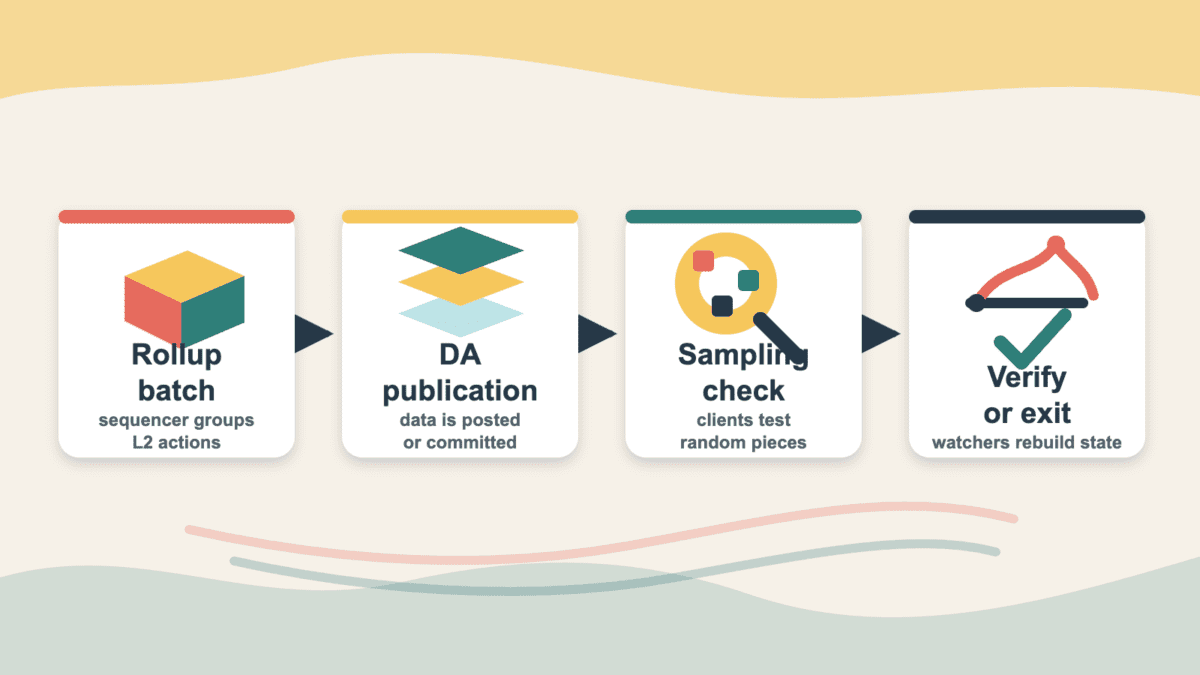
Posting data gives outside parties something to check. A commitment is a compact cryptographic promise about that data. The commitment is useful only if verifiers can gain confidence that the promised data is actually available.
Ethereum blobs use commitments for temporary rollup data. Other DA systems may use Merkle trees, namespaced Merkle trees, KZG commitments, attestations, or provider-specific designs. The job is the same: connect a short proof-like object to real data that can be checked.
Data availability sampling lets light clients check random pieces of data instead of downloading the whole block. The goal is high confidence that data exists, not magic certainty.
Sampling usually works with erasure coding. The data is expanded with redundancy, so missing pieces become harder to hide. If enough random checks succeed, the network gains confidence that the data is available.
Here is the plain-English version of common DA layer terms:
| DA Layer Term | Plain-English Meaning |
|---|---|
| DA layer | The place rollup data is published for verification. |
| Blobspace | Temporary Ethereum data capacity used by rollups. |
| Data availability sampling | Random checks that test whether data exists. |
| Erasure coding | Redundant data that helps detect missing pieces. |
| DA bridge | The link that connects a rollup to its DA source. |
| Data retrievability | The ability to fetch historical data later. |
Use the table as translation before provider pages start stacking acronyms.
A DA layer is not permanent storage because availability and retrievability are different promises. Availability asks whether data existed for verification. Retrievability asks whether historical data remains easy to fetch later.
The Celestia retrievability guide makes the split clear: once data is published and made available, rollups and applications still need their own plans for historical storage. Ethereum draws a similar line between blob availability windows and long-term history.
Users need that distinction because “data was available” does not mean “every past byte will be served forever by the same network.” DA helps verification. Archive nodes, providers, rollup operators, and indexers may handle longer-term history.
DA layer choices differ by trust model, cost, throughput, and fit. Ethereum blobs, external DA layers, and data availability committees all try to solve the data problem, but they do not give users the same assumptions.
Ethereum blobs are Ethereum-native data availability for rollups. External DA layers such as Celestia, EigenDA, Avail, and NEAR DA are specialized networks or services. Committees are smaller groups that attest to data availability.
The Ethereum-native camp argues that rollups should keep DA close to Ethereum security. The alt DA camp argues that specialized networks can offer more throughput or lower data costs. The argument can get very ETH boomer very quickly, but the real question is cleaner: what does the user now trust?
Use this comparison before accepting any “cheapest DA” claim:
| DA Option | Main Tradeoff |
|---|---|
| Ethereum blobs | Strong Ethereum alignment, but blob fees and capacity still move with demand. |
| External DA layer | More specialized capacity, but extra DA-layer and bridge assumptions. |
| Data availability committee | Simpler and sometimes cheaper, but more trust in a smaller group. |
| Full calldata | Strong on-chain availability, but often more expensive. |
| Validium-style external data | Lower base-chain data costs, but safety depends on off-chain data access. |
No option is universally safest or cheapest. Cost, settlement, bridge design, current demand, and the rollup’s proof system all matter.
DA debates should not become team sports. A rollup using Ethereum blobs may still have sequencer or proof-system risks. A rollup using external DA may still be well designed. The label starts the check. It does not finish it.
A DA layer changes what sits behind an L2 fee quote and what assumptions support the bridge. Most users will not select a DA layer directly. They notice it through prices, congestion, withdrawals, and risk pages.
Lower DA costs can help rollup economics. If a rollup pays less to publish data, it may have more room to offer cheaper transactions. But the wallet quote also includes app fees, sequencer pricing, bridge costs, gas markets, and subsidies.
For tiny balances, total cost can still decide whether an action makes sense. A cheaper DA path may not help if the bridge fee, swap fee, or leftover dust eats the trade.
The split is simple:
For crypto wallets and bridge decisions, do not judge L2 safety from the fee popup alone. Check where the chain posts data, what bridge you are using, and whether the exit route still works during stress.
For everyday use, DA affects the background. For large balances, it becomes a custody-adjacent check.
DA layer risk depends on the exact rollup design. The word “rollup” does not automatically tell you whether data goes to Ethereum blobs, calldata, an external DA layer, a committee, or a hybrid setup.
The risk starts with data withholding. If necessary data is missing, watchers may not verify state, users may not reconstruct balances, and exits may depend on fallback procedures. After that, the extra parts matter: DA bridge, sequencer, proof system, challenge window, committee membership, validators, and operator incentives.
A DA bridge deserves special attention. It connects the L2 to the DA source and may define how the settlement chain learns that data was available. A weak DA bridge can turn a strong DA layer into a weaker real-world setup.
Before trusting a rollup’s DA setup, check these items:
Data availability committees need extra skepticism. A known group may be cheaper and simpler, but users depend on that group staying honest, online, and able to serve data when disputes arise.
Restaking-aligned DA adds another layer of analysis. Security can depend on validator incentives, slashing design, operator behavior, and the bridge that reports availability. A normal wallet flow rarely shows those details.
Check the DA setup before moving serious funds. If the answer is hidden behind marketing phrases, keep the test deposit small.
A DA layer means different things for ETH holders, L2 token holders, and DA-provider token buyers. Do not mash those into one trade.
For ETH, blobs can support cheaper rollup activity while changing the fee-burn debate. Lower data costs may help L2 adoption, but cheaper capacity can also reduce near-term fee pressure when demand is light. That is not bullish or bearish by itself.
For L2 projects, DA can affect margins. If data posting becomes cheaper, an L2 may reduce costs, subsidize users, improve throughput, or keep more spread. The user still has to check whether cheaper data made the chain safer, not just cheaper.
For DA-provider tokens, the token thesis needs the most discipline. A network can be useful while the token still faces supply releases, fee-capture uncertainty, liquidity limits, and competition.
Ask these questions before turning DA into a token thesis:
DA can become a crypto meta because it gives markets a clean story: modular chains need data, DA networks sell data, tokens ride the theme. That story can pull capital through crypto rotation from ETH, L2s, and infrastructure names.
Still, a narrative coin is not proof of value capture. Buy late because one provider chart looked impressive, and you may become exit liquidity for someone who read the supply schedule first.
You can check which DA layer an L2 uses by reading its risk analysis, project documentation, explorer data, and DA dashboard entries. Do not rely only on a logo grid.
L2BEAT is useful because its DA view includes columns such as proof system, DA layer, DA bridge, risks, and type of data. Live dashboards can update quickly, so use them as current checks rather than static memory.
Project documentation can fill in the design details. Look for the data-posting path, proof system, sequencer status, DA bridge, settlement chain, and recent DA migrations.
Use this quick checklist:
Then ask whether the chain’s claims match its setup. “Ethereum-aligned” should mean more than vibes. “Alt DA” should name the added assumptions. “Cheapest DA” should explain what got cheaper.
This is also where you avoid stale takes. DA markets, blob capacity, provider usage, and rollup migrations can shift. A dashboard check beats a screenshot from six months ago.
DA layer examples are best grouped by category. Ask what kind of DA assumption the rollup or appchain uses.
Ethereum blobs are the best-known on-chain DA option for Ethereum rollups. Celestia is a modular DA network. EigenDA is tied to restaking-style infrastructure. Avail is modular DA infrastructure. NEAR DA and Tezos DAL show that DA can be chain-specific.
Here is a neutral map of examples:
| Example | What To Know |
|---|---|
| Ethereum blobs | Ethereum-native temporary data availability for rollups. |
| Celestia | Modular DA network built around data publication and sampling. |
| EigenDA | DA service aligned with restaking-style security assumptions. |
| Avail | Modular DA infrastructure using its own design and validator set. |
| NEAR DA | External DA option connected to NEAR infrastructure. |
| Tezos DAL | Chain-specific data availability layer for Tezos Smart Rollups. |
Provider examples should come after the concept. Otherwise the topic turns into a vendor tour with a glossary attached.
A DA provider can be technically relevant, commercially early, token-heavy, or hard to compare. Those are different statements.
Related DA layer terms help you read risk pages faster. Start with data availability: the assurance that data needed for verification was published.
Blobspace is Ethereum’s temporary data lane for rollups. Calldata is a more expensive on-chain data path. A validium uses validity proofs while keeping data off Ethereum, often with external DA assumptions.
A DA bridge connects the rollup to the DA source. Data retrievability is the ability to fetch historical data after the verification window. A data availability committee is a smaller group that stores or attests to data.
The modular stack also uses three other layer terms. The execution layer runs transactions, the settlement layer handles proofs or disputes, and the consensus layer handles network agreement. The DA layer is the data-publishing piece inside that stack.
The next useful CryptoProcent pages depend on the problem in front of you:
DA is about verifiable publication of data. It is not an oracle, not a file-storage app, and not a guarantee that an L2 is safe.
Start DA layer research with the rollup you plan to use. Abstract DA rankings are less useful than checking the data path behind your bridge, wallet, or trading venue.
Look for the current setup, not the launch announcement. Rollups can migrate DA providers, change proof systems, adjust challenge windows, or update risk disclosures. A stale screenshot can make a careful user look confident for the wrong reason.
Do these checks before making the DA layer part of a real decision:
For token research, avoid turning one chart into a conviction play. Ask who pays fees, what asset captures them, whether demand is subsidized, and how easily rollups can switch providers.
For user safety, keep the workflow direct. Test with a small amount, read the risk page, confirm the exit route, and check what happens if the DA provider, bridge, sequencer, or committee stalls.
DA is a security and cost assumption, not a magic cheap-fee button.
DA layer means data availability layer in crypto. It is the part of a modular blockchain or rollup setup that makes transaction data available so verifiers can check state changes. It usually refers to rollups, Ethereum blobs, external DA networks, and data availability committees.
No, a DA layer is not the same as a Layer 2. A Layer 2 usually executes user activity and posts proofs, commitments, or data to another system. A DA layer provides the data path that helps the L2 prove its batches can be checked.
Rollups need a DA layer because outside parties need access to transaction data to verify state. Optimistic rollups need data for challenges. ZK rollups still need data so users and systems can understand balances, exits, and state updates. Without available data, a rollup can become faster to trust than to verify.
No, a DA layer is not the same as data storage. Data availability means data was published for verification. Storage or retrievability means historical data can still be fetched later. Archives, operators, or external providers may handle longer-term history.
Ethereum blobs are Ethereum-native temporary data availability for rollups. Alt DA usually means an external DA layer such as Celestia, EigenDA, Avail, or another specialized provider. Alt DA can offer different cost or throughput tradeoffs, but it adds provider and bridge assumptions.
Yes, a DA layer can fail or become part of a failure path. Data can be withheld, a DA provider can have downtime, a DA bridge can be weak, or a committee can fail to serve data. The exact risk depends on the L2 design, proof system, sequencer, and exit path.


