Physical Address
304 North Cardinal St.
Dorchester Center, MA 02124
Physical Address
304 North Cardinal St.
Dorchester Center, MA 02124


Intent settlement makes routes easier, not risk-free.
Intent settlement is the crypto process that checks whether a solver delivered the outcome you signed, then finalizes the fill, refund, or payment.
Your wallet may call it something else. You may see “intents,” “solvers,” “gasless swap,” “cross-chain fill,” or “route handled for you.” The formal term earns its keep because settlement is where the smooth interface meets real money.
Good intent settlement lets you sign the result you want while someone else handles the route. Bad intent settlement can turn the trade into a delayed fill, unclear refund path, hidden spread, or support maze with too many logos and not enough answers.
Intent settlement in crypto validates and finalizes an intent-based transaction. The intent states your desired result. Settlement checks whether that result was actually delivered.
That result might be simple: swap ETH for at least a set amount of USDC. It might be messier: move stablecoins from one chain to another, pay destination gas, and finish before a deadline. Either way, the important part is that you signed constraints, not a blank permission slip.
Use this split:
Most users meet intent settlement through wallets, DEX aggregators, cross-chain swap tools, gasless trading flows, or apps that hide route selection behind one quote. That can be useful. It can also make the route harder to inspect.
The phrase is not infrastructure trivia. It tells you where to look when asking, “Who decides whether my trade was valid, and what happens if nobody fills it?”
The word “settlement” also keeps the hype honest. A nice quote screen may suggest the route is solved, but settlement is the part that proves the route satisfied your signed terms. Crypto has enough magic buttons already. This one still needs a receipt.
That receipt is the part a user can actually audit. The app may choose the route, but the signed terms should still show the output token, recipient, floor, deadline, and failure path.
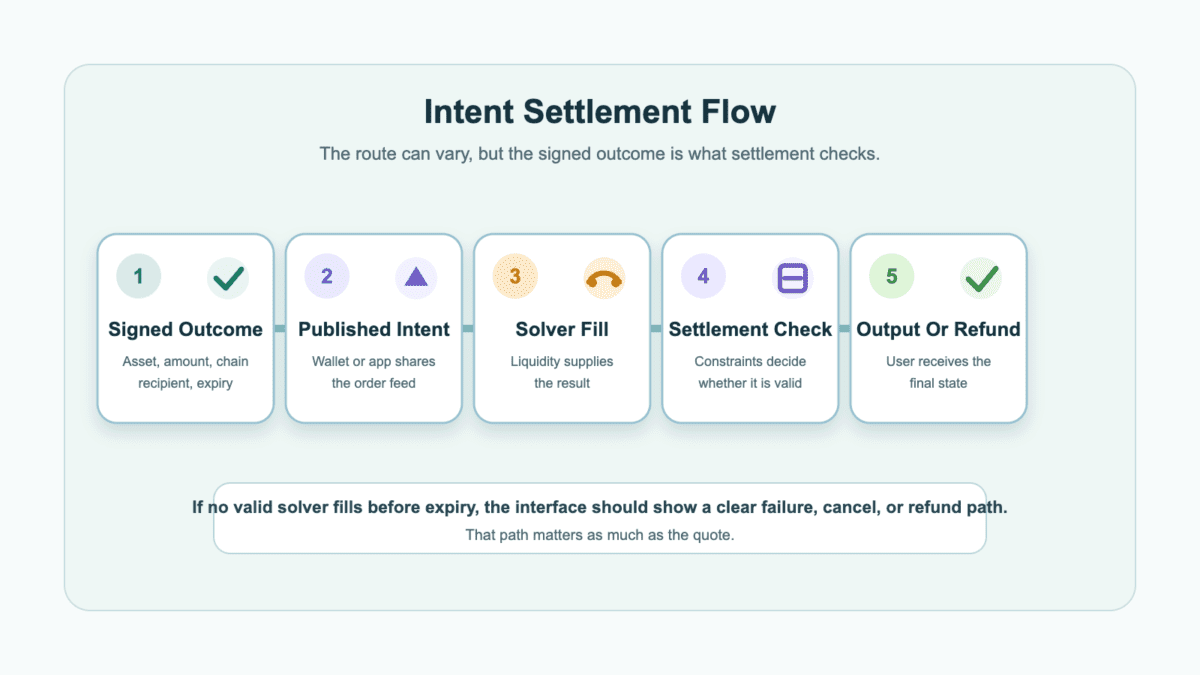
Intent settlement works by turning your desired outcome into a signed order, sending that order to solvers, and checking the final fill against your constraints. The route may change behind the scenes, but the signed result should not.
Start with the wallet prompt. You choose the asset, destination, recipient, minimum received, deadline, and sometimes the provider or route type. Then you sign an intent or order message, which tells the system what counts as acceptable.
After signing, the order usually moves through an intent pool, order feed, auction, routing network, or app-controlled backend. Solvers or fillers inspect the order and decide whether they can fill it at a profit.
Here is the basic flow:
| Actor Or Layer | What It Does |
|---|---|
| User | Signs the desired outcome, constraints, recipient, and expiry. |
| Wallet Or App | Shows the quote, collects the signature, and publishes the order. |
| Solver | Finds a route, supplies liquidity, or competes to fill the order. |
| Liquidity Source | Provides pool liquidity, inventory, bridge-like rails, or market-maker quotes. |
| Settlement Contract | Checks whether the fill matched the signed constraints. |
| Destination Chain | Records the output, refund, or final state after execution. |
The settlement check is the line in the sand. If the solver delivers the wrong token, misses the minimum output, sends funds to the wrong recipient, or fills after expiry, the system should reject that as invalid.
Cross-chain routes add another layer. A filler may send funds on the destination chain first, then recover payment after source-chain settlement confirms the order. The swap can feel fast because someone else fronts liquidity.
No-fill behavior deserves attention too. If no solver wants the route, the token is unsupported, the chain is congested, or the price moves too far, the order may expire or require a refund path. That is not always a bug. Sometimes the safer answer is no trade.
Before signing, focus on the constraints that settlement will enforce:
The details are not decorative. If the signed floor is weak, the settlement layer may enforce a bad deal perfectly.
Traders use intent settlement because routing can be annoying, expensive, and easy to mess up. One signed outcome can replace several manual choices when liquidity, gas, bridges, and timing collide.
The most obvious use case is cross-chain movement. Instead of choosing a bridge, swapping gas, waiting for a claim, and checking the destination token, you sign the desired output. Solvers compete to make that result happen.
Intent settlement can help in a few common situations:
Gasless trading is another draw, but it does not mean the route is free. A solver, relayer, or sponsor may handle gas in exchange for spread, fees, incentives, or settlement payment. The cost can move from an explicit gas line into the quote.
MEV claims deserve caution. Intent settlement can reduce some public mempool exposure because the user signs an outcome instead of broadcasting a simple swap path. But the value does not vanish. Searchers, solvers, market makers, and auction design can still decide who captures surplus.
Large or complex trades benefit most when solvers truly compete. A simple route against deep liquidity may not need that extra layer. A cross-chain route with several possible paths might, especially when better execution, gas abstraction, or fewer steps justify the new trust assumptions.
Intent settlement may not help when the best route is already obvious. A tiny same-chain swap on deep ETH/USDC liquidity may be faster, clearer, and cheaper through a normal AMM or DEX aggregator.
It can also disappoint when solver competition is thin. If only one solver wants the order, the system may still work, but it will not feel like a true auction. You may get convenience without much price pressure.
Use this split before assuming the intent route is better:
| Situation | Why Intent Settlement May Or May Not Help |
|---|---|
| Small same-chain swap | A direct AMM or aggregator route may be simpler and more transparent. |
| Cross-chain stablecoin move | Solvers may remove bridge chores and destination gas friction. |
| Illiquid token route | Weak liquidity can mean worse spread, no fill, or a stale quote. |
| Unsupported chain or token | The intent may fail, expire, or route through a poor fallback. |
| Large multi-step trade | Solver competition may improve execution if enough fillers participate. |
| Urgent trade | Expiry, finality, and solver response time can add delay. |
The bad fit is not always a safety problem. Sometimes it is just an efficiency problem. You added a solver layer, but the route had nothing interesting for solvers to improve.
Support quality decides how painful failure gets. If the app cannot show the provider, order ID, cancel path, or refund status, a failed intent can become a scavenger hunt. That is especially painful when the wallet interface is only one part of a third-party flow.
So judge the trade, not the label. Does it benefit from solver competition, gas handling, route complexity, or cross-chain liquidity? If not, the old route may be boring in the best possible way.
Intent settlement risks come from the gap between a clean outcome screen and the actors needed to deliver it. The signed constraints may be enforceable, but you still choose the app, quote, expiry, and approval.
Solver centralization is the first risk. A competitive solver market can improve fills. A narrow or permissioned solver set can concentrate pricing power, route access, censorship pressure, and liveness risk.
Pricing opacity comes next. The quote may hide spread, gas sponsorship, solver profit, bridge cost, or surplus capture. That does not make the route bad. It means “gasless” is not the same as “free,” which remains an undefeated lesson in DeFi.
Check these risks before signing:
MEV claims need care too. Intent settlement can reduce some exposed routing problems, especially when an order is matched or auctioned away from a public swap path. But solvers can still compete over surplus, private order flow, timing, and inventory.
Privacy is another tradeoff. An intent may reveal your desired output to solvers or order feeds before settlement. That can be fine for ordinary swaps. It can be less fine for large, thin, or strategy-sensitive trades.
> User-reported censorship, blocking, or pending-swap incidents are useful warning signals, but they are not proof that every intent settlement system has the same failure mode. Use them as a prompt to check fallback routes, support paths, and provider disclosure.
The biggest user mistake is signing weak terms and expecting settlement to rescue the trade. A contract can enforce minimum output, expiry, and recipient checks. It cannot turn a bad signature into a good one after the fact.
Intent settlement differs from bridges, AMMs, and DEX aggregators because it verifies an outcome instead of making the user choose every route step. The categories overlap, but the user experience changes.
A bridge moves value or messages between chains. An AMM executes against liquidity pools. A DEX aggregator searches routes across venues. Intent settlement lets solvers try to deliver a signed outcome and then checks whether the fill is valid.
Here is the cleaner comparison:
| Tool | What Changes For The User |
|---|---|
| Bridge | You choose a bridge path and accept its asset model, timing, and claim flow. |
| AMM | You trade directly against a pool, usually with visible price impact and gas. |
| DEX Aggregator | The app searches routes before building a swap transaction. |
| Intent Settlement | You sign the desired result and solvers compete to fulfill it. |
| Cross-Chain Intent System | Solvers or fillers may front destination liquidity before final settlement. |
The overlap is important. Some intent systems use bridge-like rails. Some solvers fill through AMMs. Some DEX aggregators add intent-based order flow. The labels help, but the route under the hood may borrow from all three.
The real difference is who handles route choice. With a bridge or AMM, you see more of the path. With intent settlement, you should see more of the result. That tradeoff works only when the result is specific, enforceable, and backed by clear records.
For a simple same-chain swap, visibility may be worth more than abstraction. For a cross-chain move with destination gas, fragmented liquidity, and multiple routes, a signed outcome can reduce user error.
The final check is boring but effective: compare the intent quote against a normal aggregator or bridge. If the intent route is not faster, clearer, cheaper, or safer for that specific move, the extra layer has not earned its keep.
ERC-7683 matters to intent settlement because cross-chain orders need a shared language that solvers can understand. Without that shared format, each protocol can force solvers into custom integrations.
The EIP-7683 proposal describes a solver-facing interface for intent protocols, where protocol-specific orders can be resolved into a common representation. In plain English, it helps solvers evaluate what an order requires and how payment should work.
That does not mean ERC-7683 makes every intent route identical. It does not guarantee:
It also does not remove user checks. A standard can help solvers parse orders, but users still need to inspect the app, signed constraints, provider support, and destination-chain result.
The useful takeaway is narrower: ERC-7683 is about improving how cross-chain intent orders are represented for solvers and fillers. It is not a promise that every app using intent language has the same risk model.
That distinction keeps the standard in its lane. Standards can reduce integration friction. They do not make liquidity deep, solvers honest, refunds clear, or wallet screens easy to read.
Use ERC-7683 as a vocabulary check, not a safety badge. If an app mentions the standard, still ask which chains it supports, how orders expire, who can fill them, and where settlement happens.
Evaluate an intent settlement app by reading the signed outcome like a receipt before the receipt exists. The quote is useful, but the enforceable constraints are what protect you.
Start with minimum received. That is the floor, not the optimistic number. If the floor is far below the displayed quote, the route gives solvers or market movement too much room.
Then check the route information the app exposes:
Wallet context deserves attention because many intent flows start inside crypto wallets. If the wallet screen shows one thing and the signed message allows another, slow down. The wallet should make the destination token, chain, amount, and approval scope clear enough to check.
For large transfers, compare the quote against a normal DEX aggregator or bridge. Then send a small test first. That is especially important before going full port across chains, where a delayed fill can trap your whole plan in one support queue.
Recordkeeping also deserves a minute. One visible intent can create several onchain events: source-chain authorization, solver fill, destination transfer, reimbursement, refund, or settlement payment. Your portfolio tracker or tax tool may not understand the abstraction.
Save the order ID, provider name, explorer links, and final transaction hashes. If anything gets stuck, those details decide whether support can trace the route or send you back to the same help page with a different logo.
Intent settlement sits near several crypto terms that often get mixed together. Keeping them separate makes the quote screen easier to read.
An intent is the outcome you sign. It should name what you want, not leave the route open forever. A solver is the actor that tries to fulfill that outcome. A filler is a common cross-chain term for the actor that delivers the destination-side result.
A settlement contract checks whether the fill matches the order. An intent pool or order feed distributes signed orders to possible solvers. An AMM supplies pool-based liquidity, while a DEX aggregator searches routes before execution.
Bridges move value or messages between chains. Some intent systems use bridge-like rails, but the user signs an outcome rather than each bridge step.
MEV is the value extracted from ordering, routing, or transaction visibility. Intent settlement can change where that value is competed over, but it does not erase it.
Two nearby ideas deserve extra care:
Finality is the point where a chain’s transaction is considered settled enough for the next step to rely on it. Cross-chain intent settlement cares about finality because a solver may fill one side before reimbursement catches up elsewhere.
The clean habit is to separate outcome, route, actor, and settlement. If a product blurs those four pieces, ask for more detail before signing.
No. A crypto intent is the desired outcome you sign, while intent settlement is the process that checks whether that outcome was fulfilled. The two belong together, but they are not the same layer.
No. A bridge moves value or messages between chains, while intent settlement verifies a signed outcome that solvers try to fulfill. Some intent systems use bridge-like rails under the hood, which is why the terms often blur.
A well-designed intent settlement system should prevent a solver from getting paid for an invalid fill. But the solver is not the only risk. Bad approvals, weak minimum outputs, unclear interfaces, and malicious apps can still hurt users.
Intent settlement can fail or delay when no solver wants the order, liquidity is thin, the chain is congested, finality takes longer, the order expires, or the route hits an unsupported token or chain. The app should show a clear failure or refund path.
Intent settlement can reduce some MEV exposure by hiding or auctioning the route instead of broadcasting a simple swap path. It does not remove MEV entirely. Surplus, timing, solver competition, and private order flow still matter.
Intent settlement can be non-custodial when you keep control of your wallet and settlement enforces signed constraints. That does not remove trust in the app, solver set, route disclosure, approvals, support path, or contract design.
Start with intent settlement when the route is complex enough to justify the extra layer. Cross-chain stablecoin moves, fragmented liquidity, gas abstraction, and multi-step swaps are better candidates than tiny same-chain trades.
Start by comparing routes. If a normal bridge or aggregator gives the same output with clearer records, the intent route has not proved much yet. If the intent route removes several manual steps and keeps the signed floor clear, it may earn the click.
Also check whether you can explain the route to yourself in one plain sentence. If you cannot, the app has not shown enough.
Before signing, do these checks:
You are not trying to avoid every intent-based app. You are trying to know what problem the app solves and what new assumptions it adds.
If the route is clearer, faster, and fairly priced, intent settlement can be useful. If the app hides the floor, provider, refund path, or signed details, do not confirm.
That final pause is normal DeFi hygiene. The app can handle routing after you sign, but you still own the signature.