Physical Address
304 North Cardinal St.
Dorchester Center, MA 02124
Physical Address
304 North Cardinal St.
Dorchester Center, MA 02124


Lore coin explained without the ticker confusion.
Lore coin is a Solana memecoin-style LORE token that should be identified by its token mint, not by the ticker alone.
LORE is a messy label across the web. The same ticker can lead to Solana token cards, LORE AI, Gitopia LORE, “What’s your lore,” and other lookalikes that make a familiar name feel safer than it is.
Lore coin usually refers to a Solana memecoin-style LORE result tied to the mint BYMCXiiA4om347ChR4t6bYHzkKJwnULLAg72BeDdpump. A Coinbase Lore listing helps confirm that Solana identity and, as viewed on June 20, 2026, listed Lore’s 24-hour trading volume at A$832.96.
That volume note helps size the market, but it does not make the token safe. The ticker alone is noisy, and a polished market card is not the same as deep liquidity or a clean exit.
The branding sits in the story-driven corner of crypto. You may see wizard imagery, AI-art language, social lore, and meme-culture framing around it. That can explain why people notice the token, but it does not prove demand, liquidity, or long-term value.
Read Lore coin as a small Solana token that needs contract-first due diligence. The story can be entertaining. The wallet prompt is less funny if you bought the wrong LORE.
The useful habit is simple: match the mint first, then study the market. If every page points to the same token, you can start checking liquidity, holders, sells, and social continuity. If the mint changes, you are no longer researching the same asset.
That order also keeps the article from turning into a price-card rewrite. Lore coin is less useful as a live-price curiosity and more useful as a contract-check lesson: the name gets your attention, but the mint tells you what you are actually looking at.
The first Lore coin check is identity, because several assets share the Lore or LORE label. A token name, ticker, logo, or chart title is only a surface clue. The token mint is the stronger identifier.
Start with copy-and-paste precision. One changed character can point you to a different asset, and a familiar ticker can hide that mistake until after the swap.
Use the table as a sorting tool before you compare prices or swap routes.
| Result Or Label | Contract-Led Check |
|---|---|
| Lore on Solana | Match the Solana mint BYMCXiiA4om347ChR4t6bYHzkKJwnULLAg72BeDdpump before relying on a price page. |
| LORE AI | Check for a different Solana contract and AI-agent branding. Do not merge it with Lore just because the ticker overlaps. |
| Gitopia LORE | Check Gitopia context and utility-token references. This is a separate project lane, not the same Solana meme token. |
| What’s your lore | Check the pool and token address. It is another Lore-branded Solana result, not proof that every LORE page is the same asset. |
| Official Lore Coin Search Noise | Verify the mint before trusting the label. “Official” in a title is not a contract check. |
The mistake is buying a ticker instead of a token. In Solana memecoin trading, a copycat can reuse a familiar word, similar logo, and almost identical ticker while pointing to a different mint.
A pool address also is not the same as a token mint. The pool shows where a pair trades. The mint identifies the token itself. If those two ideas blur, every later risk check starts from shaky ground.
The same rule applies to charts. A DEX chart may track one SOL pair while another page tracks a different pool or a different Lore-branded token. Before you compare candles, compare addresses.
Lore Coin works like a standard Solana token from a user view: a wallet can display it, a DEX route can quote it, and a tracker can chart it if the token and pool are indexed. That visibility does not make it widely supported.
On Solana, the “CA” people mention usually means contract address, or more precisely the token mint. If someone sends you a Lore coin CA, they are trying to point you to the exact asset instead of a ticker search.
The common path looks like this:
That is why a Lore coin page can appear inside Phantom, Jupiter-style routes, Raydium pools, or DEX trackers before the token has broad credibility. The page is showing data and routing. It is not vouching for the token.
The same split shows up when people confuse pool pages with token identity. A SOL pair can be the trading venue, while the mint is the asset. If you copy the pool address where a token mint is expected, the rest of the research gets weird fast.
Solana’s meme coin trenches language fits this environment. Speed is part of the culture, but speed also rewards sloppy checks. A correct CA is the minimum ticket into the room.
For Lore coin, check identity first, route second, and wallet approval last. That order feels slower than clicking a swap button. Good. It should.
Lore Coin liquidity tells you whether the quoted price can survive your actual order. A token can show a price and still be hard to sell if the pool is thin, inactive, or dominated by a few wallets.
Market cap is often the least useful number for a tiny memecoin. Pool liquidity, recent sells, and price impact tell you more about the trade. If a small sell quote moves the price hard, the chart price may be mostly decorative.
Use these checks before you assume the token is sellable.
| Check | Bad Sign |
|---|---|
| Liquidity Versus Order Size | Your planned trade is large compared with the pool. |
| Recent Sell Transactions | Buys appear often, but clean sells are rare or missing. |
| Repeated Same-Size Trades | Activity looks mechanical instead of broad and organic. |
| 24-Hour Volume Versus Pool Liquidity | Volume looks high while usable liquidity stays tiny. |
| Slippage Quote | The route needs extreme slippage to complete. |
Low liquidity can turn a holder into a bagholder risk case quickly. The wallet may still show tokens, but the market may not offer a sane exit.
That is the uncomfortable side of exit liquidity. If late buyers are the only demand, earlier holders can sell into them. When that demand disappears, the price can still display while real exits dry up.
A tiny test sell can be useful, but it is not a guarantee. Conditions can change minutes later. For small Solana tokens, “I could sell once” is a data point, not a lifetime warranty.
Lore Coin risk starts with the same problems that hit many thin memecoins: copycat contracts, low liquidity, concentrated holders, removable liquidity, and social hype that outruns evidence.
None of those risks proves Lore coin is bad by itself. They show where to look before a chart or token card starts making the decision for you.
> A clean token card can still hide ugly market structure. If the pool is thin, the holders are clustered, or trading looks scripted, slow down before signing anything.
Check the risk stack in plain order:
A hard rug is the obvious nightmare: liquidity vanishes or the token becomes functionally unsellable. But the slower version can hurt too.
A soft rug can look like fading attention, insider selling, abandoned socials, and a chart that keeps bleeding while holders wait for a comeback post that never lands.
Scanners help, but they are not magic. A tool can flag authority settings or holder concentration, but it cannot tell you whether future demand will exist. Crypto would be much easier if a green checkmark could do that job.
To verify Lore Coin before swapping, start with the exact token mint, then work outward to data pages, explorer details, liquidity, sells, holders, authorities, and social links.
Do not research by connecting your wallet first. Most checks can happen through public pages. Never paste seed phrases, approve unknown wallet prompts, or sign messages just to “verify” a token.
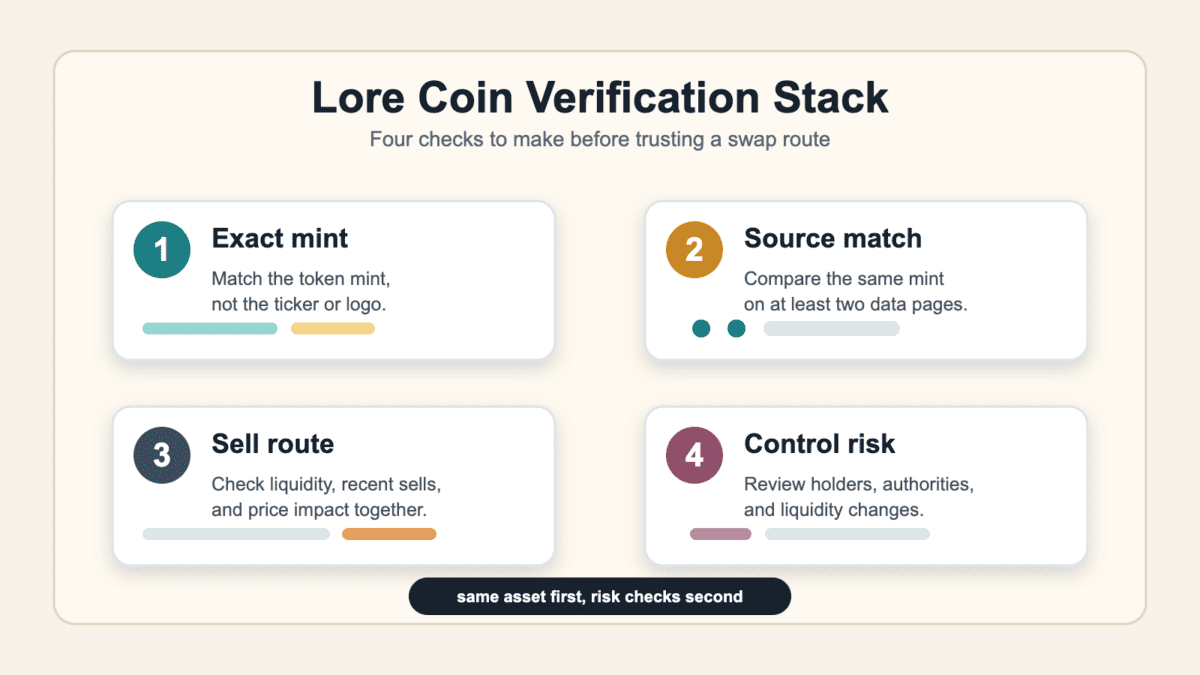
Follow a simple order:
Do not stop at “can I buy it?” Most thin tokens can be bought if a route exists. Ask whether you understand what would let you exit later. A route proves a quote exists; it does not prove the pool can absorb your sell.
If the data conflicts, stop. A mismatched mint, unclear pool, missing sells, or strange holder map is enough reason to wait. You do not get bonus points for solving every mystery box with real money.
Lore Coin is not automatically the same as LORE AI, What’s your lore, or Gitopia LORE. The shared word creates search confusion, but each asset needs its own contract, chain, and use-context check.
LORE AI belongs to a separate AI-themed token narrative. Gitopia LORE sits in a utility-token lane tied to Gitopia. What’s your lore is another Lore-branded Solana meme token. None of those identities should be folded into the Solana Lore coin mint covered here.
Keep the lookalikes separate:
The distinction has real trading consequences. If you read the wrong chart, you may judge liquidity that does not apply to your token. If you paste the wrong CA, you may buy a copycat while thinking you bought the asset you meant to research.
Names are marketing. Tickers are shorthand. The mint is the identity layer you can actually verify.
When in doubt, write down the exact mint beside the asset name. That small habit avoids a common memecoin mistake: researching one token, swapping another, and noticing only when the wallet balance looks strange.
A useful cross-check is language. If one page talks about AI agents, another talks about Gitopia utility, and another shows a Solana meme pool, they are not just different descriptions of the same thing. They are different paths. Follow the contract, not the vibe.
Lore Coin usually appears through the places small Solana tokens appear: DEX pools, wallet token cards, swap routes, price trackers, and market dashboards. That tells you where data exists, not whether the token is worth buying.
Availability depends on the exact contract, chain, region, route, and pool liquidity. A wallet may display a token while a swap route is thin. A tracker may show a chart while a normal sell quote looks ugly.
DEX pools and aggregators are plumbing. They can help a trade route through available liquidity, but they do not judge whether that liquidity is healthy. A small token can look active on one screen and still punish a normal-sized order with brutal price impact.
Wallet token cards create a similar trap. Seeing Lore coin in a wallet interface can feel official because the page is polished. Really, it means the wallet or indexer found token data. That is helpful for navigation, not enough for trust.
Before using any route, check three things:
Read this section as a caution label, not a buy signal. “Available” and “safe” are different words, and crypto has made a small industry out of pretending they are cousins.
If you still continue, keep the position size small enough that a failed exit would be annoying, not life-changing. Thin tokens are not the place for heroic budgeting.
Start Lore Coin research by proving identity first, then checking whether the market is usable. Price comes after that, because the wrong token at a clean-looking price is still the wrong token.
Do the boring checks before social posts, comments, and chart reactions get a vote. Lore coin is exactly the kind of query where a trader can see the right word, the wrong mint, and a fast-moving price all at once.
Use this order:
The final step deserves attention. Skipping a token can be the correct research result. You are not required to buy every chart that learns how to glow.
The takeaway is simple: do not buy a LORE ticker. Verify a specific Lore coin token. Then decide whether the liquidity and risk are clear enough to touch.
If pages disagree, slow down instead of averaging the confusion. A mismatched mint, a missing sell route, or a holder map that makes no sense is enough to pause. You do not need a courtroom case to skip a memecoin trade.
If you cannot explain the token identity, liquidity route, and main exit risk in one minute, the trade is probably moving faster than your research. That is the market giving you useful information, even if it is not the answer you wanted.
No. Lore coin and LORE AI can appear under similar ticker language, but they point to different token identities and narratives. Check the contract address before using any chart, wallet page, or swap route.
Lore coin is best understood as a Solana memecoin-style token because its visible appeal comes from story, imagery, community attention, and trading interest rather than clear utility.
For the Solana Lore coin result covered here, check the mint BYMCXiiA4om347ChR4t6bYHzkKJwnULLAg72BeDdpump. Always compare it across more than one token page before swapping.
You may be able to cash out Lore coin if there is enough pool liquidity, recent sell activity, and acceptable slippage. A displayed price alone does not prove that your full order can exit cleanly.
Yes, Lore coin is risky for beginners because ticker confusion, thin liquidity, copycat contracts, and Solana memecoin speed can punish small mistakes. Beginners should verify first and keep position size modest.