Physical Address
304 North Cardinal St.
Dorchester Center, MA 02124
Physical Address
304 North Cardinal St.
Dorchester Center, MA 02124


Low float shows how little token supply is really trading.
Low float in crypto means only a small share of a token’s supply is currently circulating, released, or freely tradable.
That supply detail can change how a token trades. Low float can help a coin pump fast, dump hard, show a flattering market cap, and hide future token unlock risk behind a clean-looking chart.
Before buying, compare today’s tradable supply with future supply, liquidity, and real demand.
Low float in crypto means the public market is trading only a small slice of the token supply. The rest may be locked, vested, reserved, unreleased, treasury-held, staked, or otherwise not freely tradable today.
That makes low float a tokenomics condition, not a magic signal. A token can have low float because it is new, insiders are still vested, an airdrop has not fully claimed, or the project designed a small public release at launch.
There are two ways to read it:
The percentage usually tells you more. A token with 50 million tokens circulating out of 1 billion max supply has a 5% float. Another token with 50 million circulating out of 60 million max supply has a very different setup.
Low float also differs from stock-market float. In equities, float usually means shares available for public trading after restricted insider shares are excluded. Crypto borrows the idea, but the restrictions are messier: smart contracts, vesting schedules, token generation events, treasury wallets, staking rules, emissions, bridges, and allocations.
That is why low float is not automatically bullish, bearish, early, or fraudulent. It means the current price is being formed by a smaller tradable supply. You still have to ask who owns the missing supply, when it can move, and whether buyers can absorb it later.
Low float crypto moves fast because fewer tradable tokens are available to absorb buying or selling pressure. When attention hits a small float, price can move before deeper supply appears.
That is the attractive part. A fresh listing, social post, exchange rumor, airdrop claim, or sector rotation can send buyers into a market where sellers are thin. If the order book is shallow or the DEX pool is small, modest buying can push the quoted price far.
The attention loop can make the move look stronger than it is. A sharp candle pulls in chart watchers, then social clips, then late buyers. When normie inflow reaches a low-float token, the market can look like demand discovered the project. Sometimes it did. Sometimes it just found a thin door.
The reverse move is just as important:
Low float often appears in meme-coin and new-launch environments where speed is part of the game. In the crypto trenches, small floats, shallow pools, and loud narratives can meet in one very stressful tab.
That does not make every low-float move fake. It means the chart may be more sensitive than the story suggests. A 40% move on deep liquidity is different from a 40% move caused by a few buys into limited supply.
So read low float as a volatility amplifier. It can help price travel upward when demand arrives, and it can help price fall apart when demand leaves. Same engine, different direction.
Low float, low liquidity, low market cap, and high FDV are related, but they measure different parts of a token. Mixing them up is how a cheap-looking coin turns into an expensive lesson.
Float is about supply availability. Liquidity is about trade execution. Market cap is about current circulating valuation. FDV is about the valuation implied by a larger supply assumption.
Use this map before you judge a token:
| Term | What It Actually Measures |
|---|---|
| Low Float | A small share of total or max supply is circulating, released, or freely tradable. |
| Low Liquidity | Buyers and sellers cannot trade much without moving the price. |
| Low Market Cap | The current circulating supply is valued at a smaller dollar amount. |
| High FDV | The current price implies a large valuation if full supply is counted. |
| Low Volume | Trading activity is limited over a chosen time window. |
| Holder Concentration | A few wallets control a large share of supply. |
A token can be low float and liquid if market makers, deep order books, or broad holders support clean trading. It can also be low float and illiquid, which is where exits get ugly fast.
Low market cap is another separate idea. A token can have a small market cap because the project is tiny. It can also have a small market cap because only a small float is counted, while FDV already points to a much larger valuation.
That is the common trap. A user sees a $50 million market cap and thinks “early.” But if only 5% of supply circulates, the full-supply valuation can already be $1 billion at the same price.
Volume can mislead too. A token may show busy trading while actual depth is weak. On DEXs, pool reserves and slippage tell you more than a neat volume number. On CEXs, order-book depth and spread reveal whether size can exit without shoving the chart around.
Low float is the supply clue. Liquidity is the execution clue. FDV is the valuation clue. You need all three before the market cap starts making sense.
Low float high FDV worries crypto traders because a small public float trades today while the current price implies a much larger full-supply valuation. That setup can make a token look scarce now and expensive later.
The phrase often appears around TGEs, launchpads, airdrops, exchange listings, and VC-backed tokens. Public buyers get a limited float. Team, investor, treasury, community, and market-maker allocations may still sit behind vesting schedules or operational wallets.
Here is the clean example:
The token can look small by market cap and rich by FDV at the same time. Both are true because they count different supply views.
This is where public buyers worry about becoming exit liquidity for earlier or better-positioned holders. If future supply enters a weak market, the next buyers may be absorbing tokens from people with lower cost bases, shorter time horizons, or fewer reasons to stay.
In one study updated April 29, 2026, CoinGecko Research classified 21.3% of the top 300 crypto assets by market cap as low-float assets using its market-cap-to-FDV ratio bands. That is one methodology, not a universal cutoff. It is still a useful reminder that the low-float high-FDV debate is not just comment-section smoke.
Low float high FDV does not prove a scam. It raises the burden of proof. You want clear vesting, credible recipient incentives, real demand, deep enough liquidity, and a reason future buyers would still care after launch hype cools.
The warning sign gets stronger when the public float is tiny, FDV is large, unlocks are close, and the project cannot explain why demand should grow with supply. That is not a tokenomics model. That is a calendar with a price chart attached.
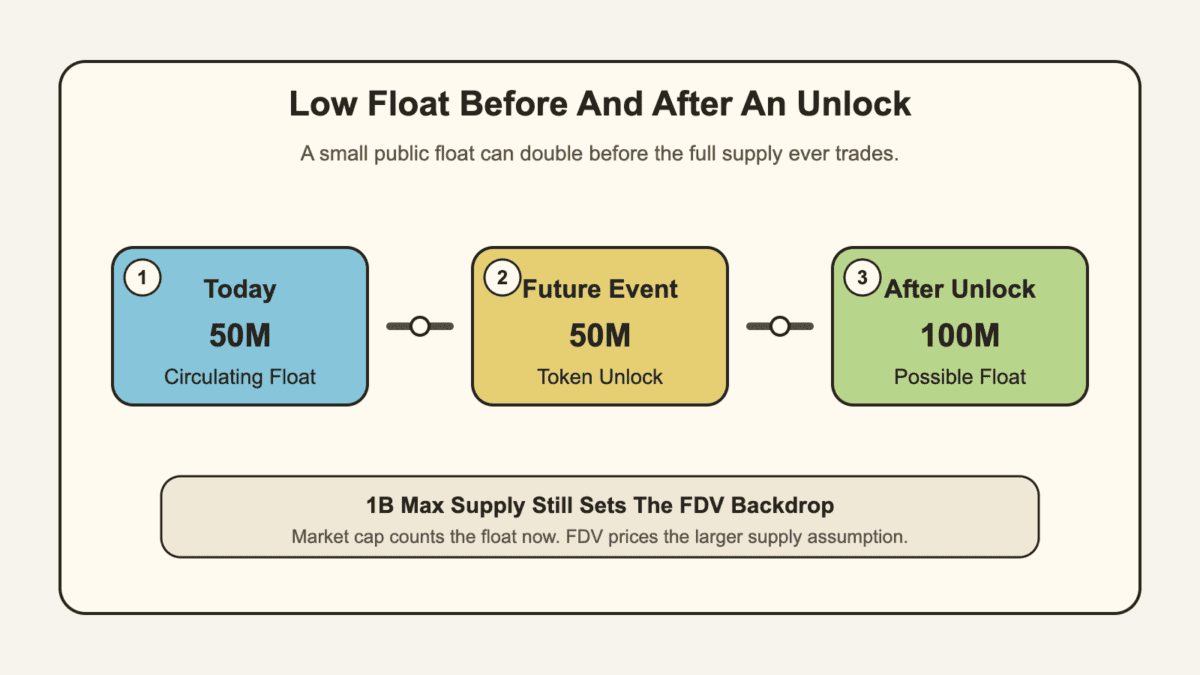
Token unlocks can change a low float trade by increasing the amount of supply that may become movable or sellable. Low float is a snapshot, and unlocks change the picture.
An unlock does not automatically create a dump. Recipients may hold, stake, hedge, use tokens for operations, provide liquidity, or sell gradually. But the market still has to price the risk that more supply can reach sellers.
The unlock size tells you little until you compare it with current float. If 50 million tokens circulate and 50 million unlock, the possible float can double before any new demand appears. A 5% max-supply event can be huge when today’s public float is only 5%.
Common unlock patterns look different:
| Unlock Pattern | What The Pattern Changes |
|---|---|
| Cliff Unlock | A large batch can become movable on one date. |
| Linear Vesting | Supply enters gradually, which can reduce shock but still adds pressure. |
| Emissions | Rewards or issuance expand supply over time. |
| Airdrop Claims | Users may receive tokens and sell, hold, or rotate. |
| Treasury Release | Project-controlled tokens can fund grants, operations, or liquidity. |
| Market-Maker Allocation | Tokens may support depth, but can still affect available supply. |
Recipient incentives shape the risk. A team allocation, private investor allocation, community reward, treasury release, and market-maker allocation do not behave the same way.
Price also depends on whether the event was expected. A known unlock can be partly priced before it happens. A surprise change, vague schedule, or large recipient group with unclear plans can hit confidence faster.
That is how low float creates bagholder risk for users who only watched the chart. They may buy after scarcity pushed price up, then hold through supply expansion when the demand side weakens.
Before reacting to an unlock headline, compare the unlock with current float, recent volume, order-book depth, DEX pool liquidity, holder concentration, and the reason buyers still want the token. The date is only one clue. The market’s ability to absorb supply is the trade.
To check a low float crypto before buying, compare today’s tradable supply with future supply, then test whether liquidity and demand can handle the gap. One dashboard number is never enough.
Start with the supply page, tokenomics chart, vesting schedule, unlock dashboard, block explorer, and the main trading venues. You are not trying to predict every candle. You are trying to avoid buying a fragile setup because the market cap looked friendly.
Run the checks in this order:
The released percentage is the first filter. If only 5% to 10% of supply is live, the token deserves more caution than one with most supply already circulating. That does not make it unbuyable. It means the missing supply must be explained.
Next, compare market cap and FDV. A large gap tells you the token’s current price is being formed by a small slice of supply. Then ask whether the future supply schedule is slow, transparent, and aligned with real use.
Liquidity comes after supply. If a token trades mainly through one DEX pool, check how much your trade would move the pool. If it trades on CEXs, check spread and depth near the current price. A token can show large volume and still punish exits.
Holder concentration is another clue. If a few wallets control much of the live float, the apparent supply may not be as distributed as it looks. That can make low float even more fragile because one wallet can become the market.
Do not stop at “low float equals early.” Sometimes low float means the public arrived before the real supply did. Your pre-buy routine should ask whether you would still want the token if it moved sideways through the next unlock.
Low float is not automatically bad because a small public supply can be part of a transparent launch, a gradual distribution plan, or a market that still has strong demand. The risk depends on structure and behavior.
A newer token may begin with low float because the project wants staged distribution. That can be reasonable when vesting is visible, unlocks are gradual, recipients are known, and liquidity is deep enough for normal trading.
Low float becomes less alarming when several things are true:
Fully circulating meme coins can remove one specific overhang: no large locked investor or team allocation waits behind the curtain. That can appeal to traders who dislike low-float VC launches.
But full float does not create safety by itself. A fully circulating token can still have weak liquidity, spoofed volume, concentrated wallets, aggressive insiders, no durable demand, or a chart held together by vibes and caffeine.
Use the same care with rug language. Disclosed tokenomics risk is not the same as a soft rug, where trust erodes through slow-drain behavior, evasive communication, weak delivery, or predatory control. Low float can sit near those risks, but it does not prove them.
So low float should start the review, not end it. If the structure is transparent, the unlocks are digestible, and demand can grow with supply, low float may be a volatility feature rather than a fatal flaw.
Start with low float crypto by doing the supply math before the chart persuades you. A fast pump is easier to understand after you know how much supply is actually live.
Use a small pre-buy routine:
That routine does not need to be perfect. It needs to slow down the easy mistake: reading a small circulating market cap as proof the token is undiscovered. In low-float crypto, the missing supply is part of the trade, even if it is not in the current market cap.
Then ask one blunt question: would this token still make sense if it did not pump soon? If the only answer is “someone else buys higher,” you are not evaluating low float. You are timing a crowd.
Let the answer change how you act:
Market orders, crowded exits, and low DEX reserves can turn a clean thesis into a messy fill. That is the part a pretty market cap will not tell you.
Low float in crypto means only a small share of a token’s supply is circulating, released, or freely tradable. The rest may be locked, vested, reserved, staked, or waiting for future distribution.
Low float can be good for sharp upside and bad for fragile exits. It can help price move fast when demand arrives, but it can also increase slippage, unlock risk, and future sell pressure.
There is no universal cutoff for low float in crypto. Many traders become cautious when only a small minority of supply is live, especially below roughly 10% to 20%, but the unlock schedule, liquidity, holder concentration, and FDV gap are more useful than one fixed number.
Low float is not the same as low liquidity. Low float measures how much supply is available, while liquidity measures how easily you can buy or sell without moving price. A token can have one risk, both risks, or neither.
Low float high FDV means a small public supply trades today while the current price implies a large full-supply valuation. It is a warning to check who owns locked tokens, when they unlock, and whether future demand can absorb them.
Token unlocks can expand a low float crypto’s tradable supply. If the unlock is large compared with current float, supply can grow quickly before new demand appears, which can pressure price if liquidity is weak.