Physical Address
304 North Cardinal St.
Dorchester Center, MA 02124
Physical Address
304 North Cardinal St.
Dorchester Center, MA 02124


POL risks to check before moving MATIC.
POL is the Polygon Ecosystem Token that replaced MATIC as Polygon’s gas and staking token after a 1:1 migration.
That short answer helps, but it is not enough if you hold old MATIC, see POL on an exchange, or are comparing Layer-2 tokens. POL keeps part of MATIC’s old job, adds a new economic model, and sits inside Polygon’s wider plan for Polygon Chain and Agglayer.
The main check is simple: know where your asset sits before you act. A Polygon PoS balance, an Ethereum-held MATIC token, an exchange balance, and a hardware-wallet display can all lead to different next steps.
POL in crypto is the Polygon Ecosystem Token, the upgraded token used for gas, staking, and validator rewards on Polygon Chain. It is the post-MATIC token at the center of Polygon’s current token model.
For a normal user, that means POL is what you may need to pay transaction fees on Polygon PoS, delegate to validators, or receive after a supported MATIC migration. For an investor, it means POL is not only a ticker change. It also brings emissions, treasury funding, and future roadmap claims into the token conversation.
The useful split is current utility versus future ambition. POL already handles live gas and staking roles on Polygon Chain. Broader use across Polygon’s aggregated network plans still depends on shipped products, governance, and real demand.
POL, Polygon, and Polygon Chain are related, but they are not interchangeable. POL is the token. Polygon is the broader project and network brand. Polygon Chain, often still discussed as Polygon PoS, is the chain where POL currently works as the native gas and staking token.
That distinction prevents several common mistakes:
So POL has two layers. It is a working token for Polygon today. It is also a bet that Polygon’s next phase can make the token more useful and more demanded over time.
POL changed the token name, live network role, and future economic design around Polygon, while keeping the migration ratio simple for eligible MATIC holders. The old token was MATIC. The new token is POL.
The confusion is fair. Some wallets, exchanges, charts, and support pages still show MATIC language because labels and custody systems do not all update at the same speed. That does not mean every MATIC balance has the same action path.
Use this table as a holder check, not as exchange-specific advice.
| POL Vs MATIC At A Glance | What It Means |
|---|---|
| Old token | MATIC was the previous Polygon token and ticker. |
| New token | POL is the Polygon Ecosystem Token after the upgrade. |
| Gas role | POL is now used for gas on Polygon Chain. |
| Staking role | POL is the token used in the updated staking and validator reward model. |
| Migration ratio | The planned conversion from MATIC to POL was 1:1. |
| Ethereum-held MATIC | It may need an official migration route instead of automatic conversion. |
| Exchange handling | Each venue can handle tickers, deposits, withdrawals, and staking differently. |
| Holder check | Confirm where the asset sits before moving, staking, or selling. |
The biggest practical change is not the ticker. It is that the token model now includes ongoing POL emissions and a broader role for future Polygon architecture.
That means “same value at migration” and “same economics forever” are different claims. The first describes the conversion ratio. The second depends on supply, demand, staking behavior, and governance.
Polygon migrated from MATIC to POL to move from an older token model toward one built for gas, staking, emissions, and future Polygon network roles. It was part of the Polygon 2.0 direction, not a random rebrand with a new coat of ticker paint.
The official Polygon Developer Docs list POL as the native token replacing MATIC, used for gas and staking on Polygon Chain, with ERC-20 compatibility, migration mechanics, bridge behavior, governance controls, scam warnings, and an effective 2% annual POL emission beginning after June 2025.
Those docs help draw a clean line between what is live and what is planned. The live part is clearer: POL is the gas and staking token on Polygon Chain. It also supports validator rewards and the treasury emission structure.
The future part is less automatic. Polygon’s Agglayer and broader multi-chain plans could give POL more roles if they ship, gain adoption, and connect real activity back to token demand. “Designed for” is not the same as “already captured by price.”
For holders, that difference is the point. The migration changed the token model and gave Polygon a cleaner base for rewards, treasury funding, and future coordination. It did not remove the need to watch supply, demand, custody support, and actual usage.
So the migration is best read as a token-system reset. It asks holders to trust that new supply, validator incentives, treasury spending, and roadmap execution will create more value than friction.
The MATIC to POL migration works differently depending on where the asset sits. A Polygon PoS balance, an Ethereum MATIC balance, an exchange account, a staked position, and a DeFi contract do not all follow the same path.
On Polygon PoS, many user-facing balances moved into the POL world through network and venue support. In self-custody on Ethereum, old MATIC may need an official migration route. On an exchange, the venue’s support page is the rulebook, even when a generic guide sounds confident.
Before taking action, map your holder state.
| Where Your MATIC Or POL Is Held | What To Check |
|---|---|
| Polygon PoS wallet | Whether the balance already appears as POL and whether gas transactions work normally. |
| Ethereum MATIC wallet | Whether you need the official migration route and enough ETH for transaction fees. |
| Centralized exchange | Ticker support, deposit network, withdrawal network, staking status, and action-required notices. |
| Staked balance | Whether the validator, exchange, or staking product has a separate migration schedule. |
| Hardware wallet | App labels, network selection, token display, and a small test transfer before size. |
| DeFi pool or contract | Whether the contract supports POL or still expects MATIC behavior. |
The table is a starting point. Exchange support pages override broad advice because venues control balances, deposits, withdrawals, and staking products.
The safest migration checklist is short:
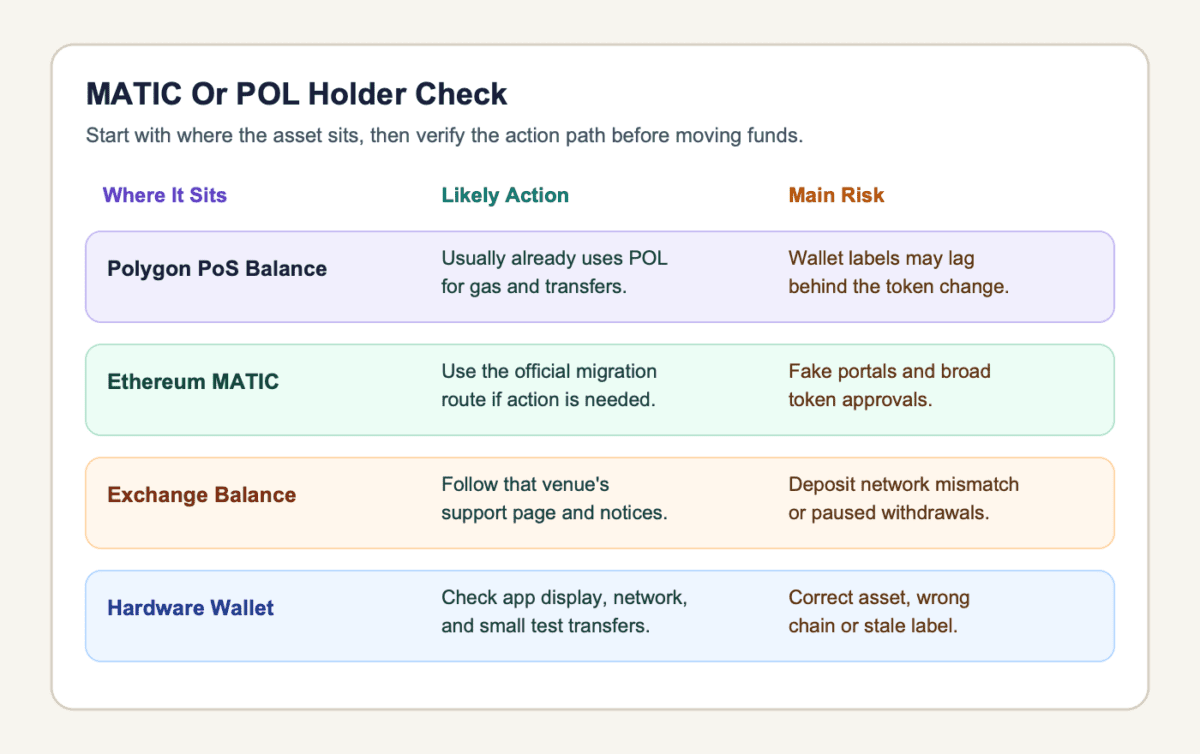
Fake migration links are the ugly part of every token upgrade. If a site asks for a private key, seed phrase, or suspicious unlimited approval, leave. Real migrations may require a transaction, but they do not require handing over wallet control.
POL does three practical jobs on Polygon today: it pays gas, supports staking, and funds validator rewards under the updated token model. A normal user usually meets POL when sending transactions, bridging, buying, staking, or checking an old MATIC balance.
Gas is the easiest part. When you use Polygon Chain, POL is the native asset used to pay transaction fees. Those fees are usually small, which is good for users, but low fees also mean gas demand alone may not create huge token demand.
Staking adds another role. Validators secure the network, and delegators can support validators through staking paths. Rewards come from the token model rather than from a magic yield machine hidden under the keyboard.
For everyday use, POL is often the token that keeps the account moving. You may need it to swap, bridge, claim, mint, or send funds on Polygon Chain, even when the main asset is a stablecoin, NFT, or another token.
POL can also appear in bridging and wallet flows. That is where labels get confusing. You may see ERC-20 POL on Ethereum, native POL on Polygon Chain, or old MATIC language in an app that has not fully updated its interface.
The live utility is real, and it is narrow enough to define. POL helps Polygon Chain function. Future roles across Agglayer or other Polygon designs should stay in the roadmap bucket until users can plainly use them.
That split matters for holders. Someone who only wants cheap Polygon transactions may keep a small POL buffer for gas. Someone holding POL as an investment has a larger question: whether staking, liquidity, app usage, and future network roles can create enough demand to outrun new supply.
POL gets value from demand to use, stake, hold, and price the token against competing crypto opportunities. Cheap gas helps Polygon users. It does not automatically make POL a strong investment.
This is where many token debates get sloppy. A network can be useful and still have weak token capture. If users spend tiny amounts of POL for fees, the chain may be busy while fee demand remains modest. Great UX, awkward chart.
Stronger POL demand can come from several places:
Weaker demand has its own signals:
So POL value needs demand math, not just branding. The token can have useful roles and still disappoint holders if supply grows faster than demand.
In a weak market, late buyers may feel like exit liquidity when the token narrative is stronger than actual demand. That does not prove POL is doomed. It proves the demand side needs more than slogans.
POL tokenomics start with a 1:1 MATIC conversion and add ongoing emissions for validator rewards and treasury funding. That is why inflation and dilution keep showing up in holder debates.
The initial POL supply matched MATIC at 10 billion tokens on a 1:1 basis at migration (Polygon Developer Docs, accessed June 2026). That kept the conversion simple. If you had eligible MATIC, the migration design did not multiply or shrink your balance during conversion.
The harder part comes after migration. POL has an ongoing emissions model. The official mechanics describe an effective annual POL emission beginning after June 2025, split across validator rewards and treasury funding under governance-controlled contracts (Polygon Developer Docs, accessed June 2026).
> Dilution Risk Is Not The Same As Guaranteed Price Decline > > New supply can pressure passive holders, but price also depends on demand, liquidity, staking behavior, treasury spending, and market appetite.
Passive holders care because new supply can reduce their share of the network if they do nothing. Stakers may offset some dilution through rewards, but they take staking-specific risks. Treasury spending can help holders only if it supports useful activity.
The phrase “infinite supply” can mislead here. POL does not have Bitcoin’s hard-cap framing, but emissions are not random. They run through contracts, governance, caps, and reward mechanisms. That still deserves scrutiny.
Here is the clean holder question: will new POL supply support enough useful activity to justify the dilution? If the answer is yes, emissions may fund security and growth. If the answer is no, passive holders carry the cost while the market yawns.
Staking POL means using the token to support validator security and earn rewards through an on-chain or custodial staking path. It can help offset emissions, but it adds lockup, validator, custody, and recordkeeping tradeoffs.
A validator helps secure the network. A delegator usually picks a validator and shares in rewards after fees or commissions. An exchange staking product may hide that complexity, but it replaces on-chain control with venue rules.
Start by asking what each staking path makes you give up.
| Staking Choice | What To Check |
|---|---|
| On-chain delegation | Validator history, commission, unstaking timing, wallet risk, and reward claims. |
| Exchange staking | Custody, terms, reward rate, unstaking window, account limits, and venue support for POL. |
| No staking | Dilution exposure, liquidity flexibility, and whether holding unstaked still fits your plan. |
Rewards are not free money. They may come from emissions, fees, or a mix of token-model incentives. If rewards come largely from new supply, staking can shift dilution from active stakers toward passive holders.
Also check liquidity. A staked token may not be quickly available during market stress. If an exchange does not clearly disclose unstaking or supported networks, that is not a tiny footnote. It is the part you read before chasing APR.
Save records for migrations, staking rewards, and sales. That is not tax advice. It is just how you avoid turning April into a forensic accounting side quest.
Buying, holding, or moving POL safely starts with venue and network checks, not a buy button. The important questions are where the token will settle, which network is supported, and who controls the keys.
If you buy through an exchange, confirm POL ticker support, deposit networks, withdrawal networks, and whether old MATIC deposits are still credited. A venue can support POL trading while limiting certain networks or pausing migrations.
Also check the exit route before buying. A visible trading pair does not guarantee that withdrawals are open on your preferred network. If the plan is self-custody, the withdrawal network counts as much as the price on the order screen.
Self-custody adds a different checklist. Your crypto wallets setup should show the right network, asset label, and transaction path before you send size. Hardware wallets can lag on display labels too, so test transfers are boring for a reason.
Use this quick safety pass before moving funds:
Do not assume ERC-20 POL, native POL, and old MATIC all behave the same in every app. The token standard, network, and venue support decide what actually happens.
If something looks inconsistent, stop at the support page. A slower transfer is annoying. A wrong-network transfer can become a support-ticket museum piece.
Keep basic records too. Migration transactions, staking rewards, exchange conversions, and sales can all matter later. You do not need to solve tax law before moving POL, but you do need enough history to explain what happened.
POL risks come from emissions, token-capture weakness, roadmap execution, Layer-2 competition, custody mistakes, and normal crypto market cycles. The phrase “is Polygon dead?” is usually price frustration wearing a dramatic jacket.
Start with dilution. POL emissions can fund validators and treasury work, but they also add supply. If demand does not grow with supply, passive holders can feel pressure even when the network itself keeps working.
Then look at token capture. Polygon can have active users, cheap fees, and useful apps while POL still struggles if fee spend, staking demand, and liquidity do not absorb supply. Useful network, weak token is a real crypto pattern.
Use the risk checklist before any price prediction:
Community language around a dead coin often appears when price underperforms for long enough. It is not analysis by itself. Translate the fear into checks: usage, liquidity, supply growth, developer activity, and actual token demand.
The same goes for underwater holders. A painful entry price does not prove POL has no future. It does mean the holder should separate sunk cost from the current thesis.
POL is not a simple yes-or-no asset. It is a token with live utility, a new supply model, and a roadmap that still has to prove how much value comes back to holders.
POL compares with other Layer-2 tokens through token capture, staking design, governance, liquidity, network activity, and roadmap reliance. Do not stop at chart shapes or Twitter volume.
ETH is the base asset for Ethereum, so it is not the same kind of bet as POL. ARB and OP lean more toward governance and Layer-2 network participation. Base has no native token, which makes direct token comparison awkward. Mantle and other scaling tokens bring their own treasury, staking, liquidity, and adoption questions.
Use this comparison table to keep the debate grounded.
| Comparison Check | What It Tells You |
|---|---|
| Current token utility | Shows whether the token is needed today or mostly tied to governance and narrative. |
| Fee capture | Helps explain whether network usage can create token demand. |
| Staking or rewards | Shows whether holders can offset emissions or must absorb them passively. |
| Supply schedule | Helps compare dilution, treasury funding, and market overhang. |
| Liquidity depth | Affects slippage, venue support, and large-holder exits. |
| Roadmap reliance | Shows how much of the thesis depends on future delivery. |
The market also moves in waves. Capital can shift from one Layer-2 story to another through rotation, even when the underlying products barely changed that week.
That is why POL should be compared as a token model, not just a Polygon brand label. Ask what the token does today, what supply does tomorrow, and what would make demand stronger than emissions.
Start with your actual POL or MATIC position, not the ticker on a chart. The right next step depends on custody, network, staking status, and whether you want to use Polygon or evaluate the token as an investment.
Use this order:
Then separate cleanup from conviction. Cleaning up an old MATIC balance is a custody task. Adding new POL exposure is an investment decision. Those actions can happen on the same day, but they should not use the same excuse.
If you only need Polygon for cheap transactions, you may need enough POL for gas and little else. If you are holding POL as an investment, the checklist gets stricter: demand, dilution, execution, liquidity, and competition.
That is the sane split. Use POL like a network token when you need it. Evaluate POL like an investment only after the supply and demand math stops sounding like wishful chanting.
No guide can tell you whether POL will outperform. It can keep the next step honest. Verify custody first, understand emissions next, and only then decide whether the token’s role in Polygon is strong enough for your own risk.
POL is not exactly the same as MATIC. POL replaced MATIC as Polygon’s updated gas and staking token, and the migration was designed around a 1:1 conversion for eligible MATIC.
The important difference is the post-migration token model. POL includes ongoing emissions, validator rewards, treasury funding, and future Polygon roadmap roles that go beyond a simple ticker rename.
You may need to migrate MATIC to POL if you hold old MATIC in self-custody, especially on Ethereum. If your balance is on an exchange or already on Polygon PoS, the answer depends on that venue or wallet setup.
Check the official support page for the place where your asset sits. Do not trust a generic migration link before confirming the network, ticker, and action-required status.
POL is used for gas, staking, validator rewards, and related token mechanics on Polygon Chain. Normal users may need it for transactions, while stakers use it through validator or delegation paths.
Future uses tied to Agglayer or broader Polygon plans should be separated from current utility. Current utility is live. Future token demand still has to be proven through adoption.
POL has ongoing emissions, so inflation and dilution are real topics to understand. New POL supply can support validator rewards and treasury funding, but it can also dilute passive holders.
That does not automatically mean the price must fall. Price depends on demand, liquidity, market cycles, staking behavior, and whether new supply funds useful network growth.
You can stake POL through supported staking paths, but the exact method depends on wallet, validator, exchange, and network support. Check where rewards come from, how unstaking works, who holds custody, and which validator terms apply.
Staking can offset some dilution, but it can also reduce liquidity. If you may need to sell quickly, do not ignore lockups or exchange-specific withdrawal rules.
An exchange may still show MATIC because ticker labels, migration support, staking products, deposit networks, and historical records update on different schedules. The label alone does not prove your balance is wrong.
Use the exchange support page as the final rulebook for that account. Confirm whether deposits, withdrawals, trading, and staking use MATIC, POL, or both during the transition.