Physical Address
304 North Cardinal St.
Dorchester Center, MA 02124
Physical Address
304 North Cardinal St.
Dorchester Center, MA 02124


Understand PolitiFi before political meme coin hype gets expensive.
PolitiFi is a crypto category for tokens inspired by politicians, elections, slogans, campaigns, and political headlines.
Most PolitiFi tokens behave like political meme coins, not official campaign tools or clean bets on election outcomes. They can move fast when a debate, lawsuit, rally, listing, or viral post grabs attention, then fade when the crowd rotates to the next loud ticker.
After that definition, the useful work is less exciting: check official status, the contract, liquidity, and whether the political event has already done its job.
PolitiFi in crypto means a loose group of political meme coins and political tokens. The category usually covers tokens inspired by politicians, elections, campaign slogans, political movements, parody names, civic causes, and sometimes geopolitical events.
The word blends “politics” and “finance”, but crypto users mostly use it as market slang. It is not a formal asset class. It does not prove that a campaign, candidate, party, or government has approved the token.
Here, branding can outrun the facts. A token can reference a real person and still be unofficial. A ticker can mimic a campaign slogan and still be parody. A chart can pump around an election and still have no connection to votes, donations, or policy.
PolitiFi often sits next to meme coins because attention is the main fuel. Buyers are usually reacting to identity, humor, outrage, speculation, and timing. That can make the category exciting, but it also makes it fragile.
Think of PolitiFi as a headline market with token wrappers. The token may trade on a DEX, appear in an exchange category, or trend in social feeds, but the core driver is usually the political story around it.
Useful first checks are simple:
If those answers are unclear, the political branding is decoration. It may still pump, but it has not earned trust.
PolitiFi tokens work like other on-chain tokens, but their demand is often shaped by social attention. A deployer creates a token contract, liquidity appears on one or more venues, and the market decides whether the political theme is tradable.
Many PolitiFi launches start on fast retail-heavy chains, where a token can appear quickly and trade through a DEX pool. Others later reach centralized exchanges, category pages, or wallet apps. A listing can improve access, but it does not verify the politics behind the token.
The contract is the asset. The name, logo, ticker, and slogan are branding around that contract. That is why contract-address checks are so important in PolitiFi. Copycats can borrow the same political reference within minutes.
Social spread does much of the early work. A joke, speech clip, court headline, campaign rumor, or viral chart can become the current crypto meta for a few days. Once traders believe the theme is hot, copycats and “related” tickers usually follow.
Utility is usually limited. Some tokens claim community roles, merch access, donation angles, voting features, or cause alignment, but many trade mainly as memes. Price discovery then follows attention, liquidity, holder behavior, and the next catalyst.
A typical launch path looks like this:
PolitiFi can be meme-led and still real enough to trade. The problem is that meme-led tokens give users fewer hard anchors. Without real utility, transparent supply, and clear official status, the chart can become the product.
Start with mechanics, not campaign vibes. Ask what you are buying, where liquidity sits, who controls supply, and whether the story can survive a quiet news day.
PolitiFi coins pump and fade because political attention is bursty. A headline can bring buyers fast, but the same crowd can leave once the event passes, the joke gets stale, or early holders find enough demand to sell.
The strongest moves often happen before the obvious event. Traders front-run debates, elections, court dates, exchange listings, sellable supply releases, speeches, and viral posts. By the time everyone sees the catalyst, the best entry may already be gone.
That creates a familiar trap. New buyers see a political story everywhere, assume the trade is still early, and buy into demand that earlier wallets were waiting for. That is how exit liquidity forms in a headline market.
Different catalysts can move PolitiFi in different ways:
| Catalyst | Why It Can Move PolitiFi |
|---|---|
| Debate or campaign event | Traders expect attention, memes, and search interest to rise before or during the event. |
| Court ruling or investigation | Legal headlines can give a token a fresh narrative, even when the token has no formal link. |
| Exchange listing | New access can bring buyers, but it can also give earlier holders a cleaner exit. |
| Token unlock | Extra sellable supply can pressure price if demand is not deep enough. |
| Influencer post | A large account can compress attention into minutes, which raises slippage and late-entry risk. |
| Election result | The outcome may end the story, shift it, or make the market sell the news. |
The table is not a trading calendar. It is a reminder that the catalyst and the exit path are different things.
Past rallies show how fast that attention can compress. CoinGecko Research reported that the PolitiFi category rose 782.4% between January 1 and August 25, 2024, while the broader meme-coin category rose 90.2% over the same period. That does not mean those gains repeat. It means political attention can pull demand forward fast enough that timing and liquidity decide the trade.
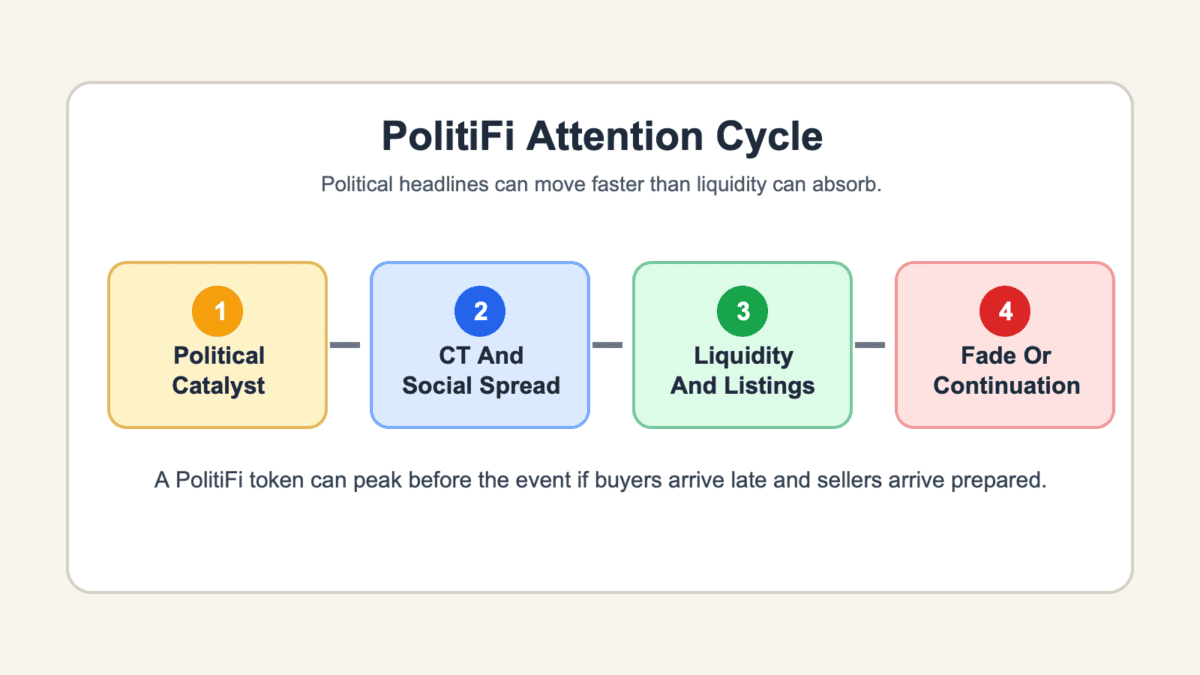
PolitiFi also fades when the market runs out of novelty. A misspelled candidate token may feel sharp for a week. Then a new headline appears, another ticker copies the joke, and liquidity fragments across fresh launches.
The timing check is blunt. If the token has already run hard, the event is obvious, social feeds are loud, and liquidity still looks thin, the trade may be closer to exit than entry.
PolitiFi coins are not official political assets unless the token’s own verified channels and the named person’s, campaign’s, party’s, or organization’s verified channels support that claim. A name, ticker, logo, or slogan is not enough.
This is the most dangerous confusion in the category. Political branding borrows trust from real-world names. Crypto tickers can make that trust look tradable, even when the token is only inspired by a person or event.
Use stricter language until proof exists. “Inspired by” is safer than “official”. “Parody” is safer than “campaign token” when the project uses jokes, misspellings, or exaggerated branding. “Claimed-official” is a warning label, not a pass.
A 2025 SEC staff statement described typical meme coins as speculative and often limited in function. It also said they were generally outside federal securities registration in the staff’s view, while buyers may lack federal securities-law protection and fraud can still face other enforcement.
That legal note does not make PolitiFi safe. It only shows why token-by-token facts matter. Political tokens can touch securities law, consumer protection, tax, campaign-finance rules, platform policies, and local restrictions depending on structure and location.
Before believing an official-status claim, check:
Be extra careful with donation language. Buying a PolitiFi token is not the same as donating to a campaign unless the structure clearly says so and local rules allow it. Token purchases usually go through markets, pools, fees, and sellers, not a simple contribution page.
Political identity makes the sales pitch stronger. It does not make the contract cleaner.
PolitiFi coins are easier to understand when you group them by what they borrow from politics. The category is wider than Trump-themed tokens, but Trump-related examples dominate many search results because they pulled heavy attention.
Avoid stale rankings. PolitiFi lists change quickly, and different exchanges classify the category differently. A better use of examples is to learn what to check before you assume the token means what its branding suggests.
| Type | What To Check |
|---|---|
| Official or claimed-official tokens | Verify the claim through both token channels and the named person’s or campaign’s verified channels. |
| Unofficial candidate-themed tokens | Check whether the token only borrows a name, slogan, mascot, or ticker for attention. |
| Parody or misspelled-politician tokens | Look for satire, copycat risk, thin liquidity, and jokes that may fade after one news cycle. |
| Political-cause or DAO-adjacent tokens | Separate civic coordination from pure meme speculation, then check governance and treasury details. |
| Geopolitical attention tokens | Check whether the theme is just a headline wrapper around a short-lived trade. |
The same token can blur categories. A candidate-themed coin may start as parody, gain a community, then get discussed as if it represents real political support. That shift can make the market story louder than the facts.
ConstitutionDAO-style civic tokens also complicate the bucket. A civic or DAO-adjacent token can involve political culture without being a candidate meme coin. In that case, governance, treasury rules, and stated purpose deserve more attention than the ticker joke.
The useful filter is affiliation plus function. Ask who is actually involved, what the token does, and whether holders have rights beyond trading the chart.
PolitiFi risks start with fake contracts, weak liquidity, concentrated holders, and political branding that looks more official than it is. The market can move fast enough that a small mistake becomes expensive before you can fix it.
Begin with the contract address. Search results, social posts, token tickers, and chart links can point to different assets using the same political reference. Check the chain too, because a ticker on Solana is not the same thing as a similarly named token on Ethereum or BNB Smart Chain.
Liquidity is the next filter. A token can show a high price move on shallow depth, then punish normal sell orders with wide slippage. Low-liquidity PolitiFi is especially rough because attention can vanish at the same time sellers arrive.
Use this checklist before a trade:
| Check | What It Tells You |
|---|---|
| Contract address | Whether you are looking at the intended token or a copycat. |
| Chain selection | Whether your wallet, gas token, and DEX route match the asset. |
| Liquidity depth | Whether a realistic buy or sell can execute without extreme slippage. |
| Holder concentration | Whether a few wallets can dominate price action. |
| Token unlocks | Whether new supply can become sellable near a catalyst. |
| FDV versus market cap | Whether the visible float hides future dilution risk. |
| Transfer and sell behavior | Whether honeypot or tax settings can block normal exits. |
| Deployer and admin powers | Whether insiders can change rules, mint, pause, or drain value. |
The checklist will not catch every scam. It does catch many avoidable mistakes before the chart starts yelling.
Rug risk deserves its own look. A fake PolitiFi token can become a hard rug if liquidity is removed, minting is abused, sellability is blocked, or holders are trapped by malicious contract rules.
Ordinary volatility is different from malicious design. A token can drop because attention fades. It can also fail because the contract, liquidity, or insider setup was hostile from the start.
Tax records are easy to forget during headline trades. Keep transaction notes, wallet history, and trade dates clean enough that a joke ticker does not become a boring paperwork problem later.
Traders usually access PolitiFi tokens through DEXs, centralized exchanges, or wallet swap interfaces. The route depends on the chain, listing status, liquidity, and whether the token is mature enough to reach larger venues.
Early PolitiFi launches often begin on DEXs. That means users need the right wallet, gas token, chain, token contract, and swap route. A bad chain choice can strand funds. A bad contract address can buy the wrong token entirely.
Centralized exchange listings are simpler for order entry, but they are not endorsements. A CEX listing can add liquidity and visibility, while also giving earlier holders a broader buyer base. That mix can help exits on both sides.
Before using any route, check the execution path:
Wallet choice becomes part of the trade because many PolitiFi tokens appear before exchange listings. Users comparing custody tools can start with CryptoProcent’s wallet setup coverage, then still check the exact chain and contract before swapping.
Slippage settings need restraint. Setting slippage too low can fail the trade. Setting it too high can let a thin pool fill at a much worse price than expected. The right answer depends on liquidity, urgency, and position size.
Do not let access become the strategy. If the only reason to buy is that you found the swap route, the trade is probably running ahead of the thesis.
PolitiFi is not the same as prediction markets because PolitiFi tokens do not usually settle against a defined political outcome. They can move on memes, liquidity, holders, listings, and social attention even when the political event goes the “right” way.
A prediction-market contract asks a narrower question. It may price whether a candidate wins, a law passes, or a specific event happens by a set date. The value is tied to a defined outcome and settlement rule.
A PolitiFi token is messier. It can pump because supporters are loud, dump because early wallets sell, rally on a listing, fade after an election, or move because a parody goes viral. The political result is only one possible input.
The difference is easy to see:
| Market Type | Main Exposure |
|---|---|
| PolitiFi token | Attention, liquidity, branding, holders, memes, listings, and event timing. |
| Prediction-market contract | A defined outcome with stated rules, timing, and settlement conditions. |
Buying tokens linked to both sides of an election does not automatically hedge anything. It may simply double exposure to meme-coin liquidity, social attention, and post-event decay.
That can still be a trade, but the thesis is different. If your thesis is “candidate wins”, a candidate-themed token may be a noisy proxy. If your thesis is “attention will spike before the event”, PolitiFi is closer to the actual trade.
The cleanest comparison is this: prediction markets ask what happens, while PolitiFi asks what the crowd will chase.
PolitiFi may not be worth touching when the story is loud but the trade structure is weak. A political headline can create urgency, but urgency is not a substitute for contract, liquidity, and exit checks.
The best skip signals are concrete. If official status is unclear, the contract address is hard to verify, or the token has several copycats with similar names, the risk is already too high for many users.
Liquidity also sets the ceiling on common sense. If a realistic sell creates ugly slippage, the chart is more decorative than useful. A green candle does not help if your exit breaks the pool.
Sit out when these red flags stack up:
There is no prize for forcing every political meme into a portfolio. Sometimes the best trade is refusing to become the late buyer in someone else’s screenshot.
If you still want exposure, narrow the plan. Decide what would make the token invalid, what size you can afford to lose, and what exit route exists before the crowd stops caring.
PolitiFi discussions use a lot of market slang because the category lives in fast social feeds. The useful terms explain either where the story spreads or where the trade breaks.
CT chatter means the crypto-native social conversation that can push a token into view before mainstream coverage notices. In PolitiFi, CT can turn a speech clip or candidate meme into a tradable narrative within minutes.
Meme coin trenches refers to the high-risk early trading environment where fresh tokens, copycats, thin liquidity, and wallet mistakes are common. Many PolitiFi launches live there before they ever reach a cleaner exchange interface.
Other terms help with the aftershock. A bagholder is the person left with a losing position after hype fades. A soft rug is the slower version of support disappearing. Holder concentration shows whether a few wallets can push the whole token around, and slippage explains why the displayed price may not be your exit price.
That language is most useful before the chart is already moving. If a token is “in the trenches”, assume the contract, pool, and wallet route need extra attention. If CT is already crowded with screenshots, assume the early window may be closing. If people are talking about bags, ask who still needs someone else to buy.
Use the vocabulary to slow the feed down. CT tells you where the story spreads. Trenches tells you where execution risk lives. Bagholder language points to the late-entry outcome.
Slang also helps separate social proof from trade quality. A loud political meme can feel validated because everyone is repeating it, but repetition is not liquidity, official status, or a sell route. The words are clues. The checks still have to happen on-chain and at the venue where you plan to trade.
None of those words replaces due diligence. The PolitiFi trade still comes back to the same basics: contract, liquidity, official status, timing, and exits.
PolitiFi coins are crypto tokens inspired by politicians, elections, slogans, political causes, campaigns, or geopolitical headlines. Most trade like meme coins, so their prices often react to attention rather than formal political utility.
No. Trump-themed tokens are highly visible, but PolitiFi can also include parody candidate tokens, campaign-slogan coins, political-cause tokens, DAO-adjacent civic tokens, and geopolitical attention tokens.
Some PolitiFi coins may claim official status, but users should verify that claim through the token’s official channels and the named campaign’s or person’s verified channels. A ticker, logo, or slogan is not enough.
PolitiFi legality depends on the token structure, location, exchange access, tax treatment, and any political-finance claims. Do not assume a token is legally simple because it looks like a meme.
PolitiFi tokens can react to political outcomes, but they are not clean prediction-market contracts. They can move on memes, listings, liquidity, holder behavior, and event timing instead of settling against one defined result.
Check the contract address, chain, liquidity depth, holder concentration, slippage, sellable supply, admin powers, and official-status claims. Then confirm that you can sell a small test amount before sizing up.