Physical Address
304 North Cardinal St.
Dorchester Center, MA 02124
Physical Address
304 North Cardinal St.
Dorchester Center, MA 02124


InfoFi meaning, examples, token risks, and post-to-earn traps.
InfoFi is crypto’s name for markets that price, reward, or trade information, attention, data, reputation, and predictions.
The idea sounds clean, but the first wave was messier. InfoFi became popular because crypto users already trade narratives, social attention, project data, and prediction signals. Some systems tried to reward useful insight. Others rewarded posting volume, reply spam, and AI slop with a wallet attached. So do not ask only whether InfoFi is “real” or “dead.” Ask which version you are looking at.
InfoFi in crypto means turning information into something users can score, trade, reward, or use as a market signal. It is short for Information Finance, but crypto uses the term in a narrower way than broad finance or data science.
In crypto feeds, InfoFi usually points to systems that value attention, mindshare, forecasts, creator reputation, project data, or market intelligence. A platform might rank high-signal accounts, reward useful research, sell analytics, price predictions, or create token exposure around information flows.
That range is why the term gets slippery. One person may use InfoFi for an analytics terminal. Another may mean a leaderboard that pays creators for useful posts. A third may mean prediction markets that turn public beliefs into prices.
A clean InfoFi definition has three parts:
That action can be trading a token, following a signal, buying data access, earning campaign rewards, or checking a project’s reputation. The same term can cover a research terminal, an attention market, a prediction venue, or a social reward app, but those products do not share the same durability.
The trap is assuming the label proves the model. A paid data product can survive without viral posting. A reward app that depends on one social platform may break when that platform changes access rules. Same label, very different risk.
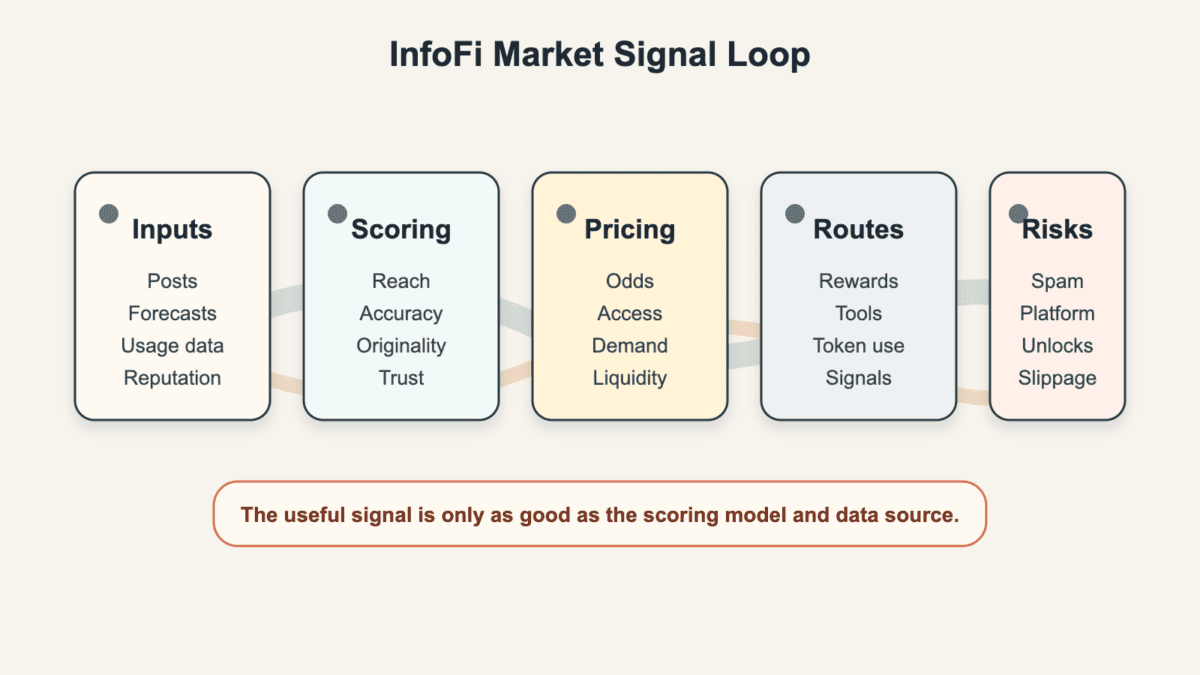
InfoFi turns information into a market by taking raw signals, ranking or pricing them, then routing value back to users, token holders, traders, or data buyers. The slogan is simple. The mechanism is where the edge and the mess both live.
Raw information can come from posts, predictions, on-chain activity, creator reputation, research notes, wallet behavior, or product usage. The InfoFi layer then decides what counts. It may score reach, accuracy, originality, engagement, verified outcomes, or demand from paying customers.
| Step | What Happens In InfoFi |
|---|---|
| Signal capture | The system collects posts, predictions, data, or activity. |
| Scoring or pricing | Algorithms, markets, or users rank what seems useful. |
| Value routing | Rewards, access, token demand, or trading signals follow. |
| Failure path | Spam, fake engagement, thin liquidity, or platform rules distort the output. |
Measurement shapes behavior. If the system pays for raw activity, people produce more activity. If it pays for accuracy, usefulness, and repeat demand, the market has a better shot at filtering signal from noise.
Attention and mindshare markets are the InfoFi lane most crypto users noticed first. They try to measure which projects, creators, or narratives are gaining attention before that attention appears in price, liquidity, or user growth. That connects InfoFi to the broader attention economy, where visibility itself becomes valuable.
Mindshare is useful, but it is not magic. A project can dominate timelines because users found something real. It can also dominate because paid posters, farming groups, or bots learned the scoring system. If the market cannot separate those two, InfoFi becomes a scoreboard for whoever can shout most efficiently.
Prediction, data, and reputation markets are the more durable InfoFi lanes. Instead of only asking who is loud, they ask who was accurate, what data has value, and which signals keep working after the reward campaign ends.
Prediction markets price beliefs about future outcomes. Data products sell cleaned or organized information. Reputation systems track whether accounts, analysts, builders, or campaigns have a history of useful output. Each version tries to make information easier to trust.
The strongest InfoFi products usually have a buyer beyond the reward farmer. If a trader, researcher, founder, or fund pays for better information, the product has a clearer reason to exist. If the only demand is earning points for a possible token, the loop is much easier to game.
InfoFi became popular on crypto Twitter because crypto already uses social feeds as market infrastructure. Narratives form there, projects launch there, airdrop clues spread there, and traders often see a token’s story before they read any formal document.
That made crypto Twitter a natural testing ground for InfoFi reward apps. Kaito Yaps and similar systems made a simple promise: contribute useful crypto attention, get scored, and maybe earn rewards later.
The pitch landed because it matched a habit users already had. People were already posting research threads, reacting to launches, tracking founder comments, and chasing early signals. InfoFi added scores and possible rewards to behavior that was happening anyway.
The appeal had three obvious pieces:
InfoFi also arrived as a crypto meta because the category itself became tradable. Once users saw tokens, leaderboards, and campaign points, InfoFi stopped being only a product idea. It became a story people could farm, promote, short, buy, or ridicule.
The loop fed itself. More posts made the category feel bigger. More attention made projects look more important. More visible scores made users post again. In a market where attention often moves before fundamentals, that loop was powerful and easy to abuse.
That mix explains the fast rise. InfoFi matched how crypto already behaves: social first, incentive heavy, narrative driven, and allergic to waiting politely for a quarterly report.
InfoFi reward apps ran into trouble because many early systems rewarded measurable activity before they could reliably measure useful insight. Once users learned what the leaderboard liked, the game changed from “be helpful” to “feed the machine.” Users posted more often, replied more often, copied popular takes, and used AI summaries to stay visible.
The deeper problem was platform dependency. An app could pay rewards on-chain while still depending on X data, API access, social graph rules, and moderation choices. When a centralized platform changes access or enforcement, the crypto incentive layer cannot simply vote the problem away.
> Warning: an InfoFi product can be decentralized in payments while centralized in the data it needs to function.
Reward design also shaped spam. If a system scores post count, reply velocity, likes, or mentions without strong quality filters, users optimize for those numbers. That does not mean all social rewards are doomed. It means the scoring model must punish cheap volume and reward proof of usefulness.
Better InfoFi systems need harder signals. Accuracy over time, original research, verified data, paid usage, reputation history, and real buyer demand are harder to fake than a pile of replies. They are not impossible to manipulate, but they raise the cost of nonsense.
The takeaway is simple: reward apps did not break the whole InfoFi idea. They exposed the weakest version of it. If the product depends on borrowed platform data and easy engagement metrics, the risk is not hidden. It is the business model wearing a hat.
InfoFi overlaps with SocialFi, attention markets, and prediction markets, but those labels are not interchangeable. The useful divider is what the market tries to value.
SocialFi usually starts with social networks and creator relationships. Attention markets value visibility, mindshare, or engagement. Prediction markets price expected outcomes. InfoFi is the broader wrapper when information itself becomes the thing being scored, priced, rewarded, or traded.
| Category | What It Turns Into A Market Signal |
|---|---|
| InfoFi | Information quality, attention, data, reputation, or predictions. |
| SocialFi | Social identity, followers, creator content, and community activity. |
| Attention markets | Visibility, mindshare, engagement, and narrative momentum. |
| Prediction markets | Probabilities around future events and outcomes. |
The categories can overlap in one product. A platform could rank social accounts, reward attention, and run markets around project narratives. That does not make every feature the same thing, and it does not give every feature the same risk.
SocialFi can overvalue followers. Attention markets can reward noise. Prediction markets can suffer from thin liquidity or bad resolution rules. InfoFi can inherit all three problems when it tries to combine them under one token.
For beginners, the useful move is to ask what the system measures first. If it measures posts, you are looking at attention incentives. If it measures forecasts, you are closer to prediction markets. If it sells structured data or reputation scores, the InfoFi claim may be sturdier.
Real InfoFi examples include crypto intelligence tools, attention markets, campaign analytics, prediction venues, data products, and reputation systems. The important part is not whether the project uses the label. It is whether information becomes more valuable, measurable, or tradable.
Some examples fit better than others:
Kaito is still the reference point for many users because it made InfoFi visible through Yaps, mindshare rankings, and later attention products. After the old Yaps loop, CoinGecko’s Kaito guide, updated May 7, 2026, lists six active or planned product lines around Studio, Attention Markets, Pro, API, Capital Launchpad, and Markets. That is a useful reminder that the category is broader than old Yaps farming.
Cookie DAO and Cookie.fun sit closer to data, campaign intelligence, and creator analytics. The useful version is not “post more, get paid.” It is better information about which campaigns, creators, agents, and narratives are actually producing attention that someone values.
Polymarket is not the same thing as a social reward app, but it is InfoFi-adjacent because it prices information through prediction markets. The broader lane may survive even if specific reward campaigns fade, especially when products feel like useful information infrastructure instead of a race to post “gm” with better formatting.
InfoFi token risks start with a blunt question: what does the token actually do? A strong story about attention does not automatically create demand for the token. It may only create attention for the chart.
An InfoFi token can look like a conviction play when the category is hot. But conviction needs more than a label. You need product use, paying demand, clear token utility, sensible supply, and a reason users keep showing up after rewards fall.
| Investor Check | What To Look For |
|---|---|
| Token utility | Access, fee use, staking, governance, or demand that is more than a slogan. |
| Product use | Traders, creators, projects, or funds using the product without only chasing rewards. |
| Data dependence | Clear access to the platforms, APIs, or data sources the product needs. |
| Reward pressure | Points, airdrops, or emissions that may create steady selling. |
| Liquidity | Enough depth to enter and exit without brutal slippage. |
| Unlocks | Future supply that could hit the market before demand matures. |
| Governance power | Real control over useful parameters, not ceremonial voting. |
| Revenue link | A believable path from attention or data to repeat paying customers. |
The table should not become a buy checklist. It is a filter. If a project fails several rows, the InfoFi label is doing too much work.
Reward design is the next check. If users earn tokens for posting, campaign work, or points conversion, those rewards can become sell pressure. That becomes dangerous when new buyers are the main source of liquidity and product revenue is still thin.
Three warning signs deserve a slower look:
Also check exchange availability and market depth, but do not let listing access replace analysis. A token can be easy to buy and still hard to exit well. When a reward narrative fades, late buyers can become exit liquidity for accounts that farmed earlier.
Governance claims deserve extra caution. A token that votes on campaign settings or product features may have real use. A token that only waves “DAO” around while demand depends on future hype is weaker. Voting rights do not create value by themselves.
The strongest InfoFi tokens should connect the token to a product people would still use without a leaderboard. If the answer is “nobody,” the token may be pricing a habit that disappears when the rewards do.
InfoFi still works where the product improves how users find, price, or verify information. The weakest version was paid posting without enough quality control. The stronger versions are less glamorous and more useful.
Paid research tools can survive if traders save time or avoid bad signals. Reputation scores can help if they reward accuracy over noise. Prediction markets can help when they have clear rules and enough liquidity. Creator marketplaces can work when the buyer pays for useful distribution, not empty engagement.
Ask one plain question: would anyone want the output after the rewards stop? If the answer is yes, the product may have value beyond farming. If the answer is no, the market is probably just renting attention until incentives run out.
The surviving InfoFi lanes look more like this:
InfoFi can also exist without X, but the design has to change. A product that depends on one platform’s social graph inherits that platform’s rules. A product that uses many data sources, on-chain behavior, paid subscriptions, and verified outcomes has more room to adapt.
That also changes what users should watch. A stronger InfoFi product should explain where its signals come from, how it filters manipulation, who pays for the output, and why the token is needed. Those checks are dull, which is usually where the useful answers hide.
That does not make it safe. It makes the risk clearer. InfoFi is most useful when it helps users sort signal from noise. If it only creates more noise with a token attached, crypto already has enough of that.
Start with the model before you touch the token. InfoFi can mean attention rewards, prediction markets, campaign analytics, reputation scoring, or data products. Each model has a different risk.
Then check what the product needs to function. If it depends on X, TikTok, Discord, Telegram, YouTube, or another centralized platform, ask what happens if access changes. If it sells data, ask who pays for it. If it rewards activity, ask how it detects spam.
This is especially important with old earning guides. A guide may describe a real campaign that no longer works, a points path that changed, or a product that moved beyond the original farming loop. Verify the current rules before you spend hours posting into a dead funnel.
Use this order of operations:
The best InfoFi habit is boring: separate the idea, the product, the token, and the farming advice. A strong idea can have a weak token. A useful product can have poor liquidity. A loud campaign can still be mostly noise.
If you cannot explain those four pieces separately, pause. You may be reacting to a category label instead of a product. That is how “early” turns into “late, but louder.”
InfoFi means Information Finance in crypto: systems that price, reward, or trade information, attention, data, reputation, or predictions. In everyday crypto use, it often refers to attention markets, social reward apps, data products, and intelligence tools.
The term is broader than “post-to-earn.” Post rewards were the noisy first wave. The more durable idea is that useful information can become a scored market input or paid product.
InfoFi is not the same as SocialFi, though the two can overlap. SocialFi focuses on social networks, creators, followers, and community activity. InfoFi focuses on information becoming valuable through scoring, pricing, rewards, or trading.
A SocialFi app may become InfoFi if it turns creator reputation, attention, or insight quality into a market signal. But a simple social token or community app is not automatically InfoFi.
InfoFi is still active, and Kaito remains a major example because it works around crypto intelligence, attention, mindshare, and market signals. But old Kaito Yaps-style earning advice may not describe the product as it works now.
Keep that split clear. Kaito can remain InfoFi while specific reward paths change, retire, or move into new products. Do not use stale guides as proof that a reward is still available.
You may be able to earn crypto from some InfoFi campaigns, but you should verify the exact product, rules, eligibility, and reward status first. Old post-to-earn guides can be outdated quickly.
Also check whether the activity has value beyond rewards. If nobody would use the product without points, the earning path may be fragile. That is not income. It is a campaign with timing risk.
InfoFi apps had problems with X because many reward systems depended on X data, API access, and social engagement signals. When platform access or rules changed, the reward system could lose the data it needed.
That is the platform-risk lesson. A crypto app can pay rewards with tokens while still depending on centralized social infrastructure. The blockchain part does not protect every input.
InfoFi tokens are risky because attention can fade faster than product demand. Token utility, liquidity, future supply releases, reward emissions, platform dependence, and weak governance claims all need careful checks.
The biggest red flag is a token whose only demand comes from people hoping the category gets hot again. If real users, paying customers, or durable data buyers are missing, the chart is carrying the whole story.


