Physical Address
304 North Cardinal St.
Dorchester Center, MA 02124
Physical Address
304 North Cardinal St.
Dorchester Center, MA 02124


A plain-English guide to basis yield, net carry, and hidden risks.
Basis yield is the annualized crypto return from spot-futures price gaps or funding payments.
It usually appears when a trader owns spot crypto or spot-like exposure, then shorts a related futures or perpetual contract. The goal is to earn the spread, not to guess whether Bitcoin or Ether goes up next.
That sounds tidy. The hard part is surviving margin, fees, custody, funding flips, and the awkward moments when the spreadsheet forgets that markets move.
Basis yield in crypto is the return a trader tries to earn from the difference between a spot asset and a related derivative. In a common setup, the trader buys spot BTC or ETH, then shorts a futures contract or perp that trades above spot. The yield comes from spread convergence, funding payments, or both.
The basis is the futures price minus the spot price. If a Bitcoin future trades at $103,000 while spot Bitcoin trades at $100,000, the basis is $3,000. When that premium is annualized and adjusted for the holding period, traders often describe it as basis yield.
The phrase can point to a few different ideas, so keep the map clean:
| Term | Plain Meaning |
|---|---|
| Crypto Basis Yield | Carry from spot-versus-derivatives gaps or funding payments. |
| Bond Yield Basis | A fixed-income quote convention, not the crypto spread trade. |
| Yield Basis | A specific DeFi protocol name, not every basis yield strategy. |
| Gross Basis Yield | The spread before trading costs, financing, tax, and slippage. |
| Net Basis Yield | What remains after costs and risk controls. |
That last row is the one users should care about. A headline APY can describe the gross opportunity while the account earns something smaller. Sometimes much smaller.
Basis yield only becomes useful after you know who pays it, where collateral sits, how the hedge is maintained, and what can force an early exit.
Basis yield works by pairing a long spot position with a short derivative position. The trader is not trying to be bullish or bearish. The target is the price gap between the two legs.
Here is a simple Bitcoin example using round numbers. Spot BTC trades at $100,000. A three-month futures contract trades at $103,000. A trader buys spot BTC and shorts the futures contract.
If the future converges with spot near expiry, the trader aims to keep the $3,000 gross basis. The basic formula is:
> Basis = Futures Price – Spot Price
To turn that into a rough annualized basis yield, divide the basis by the spot price, then adjust for the holding period. In this example, the gross spread is 3% over about one quarter. Annualized, that looks much higher than 3%.
But that is still gross, and gross numbers are where overconfident dashboards go to practice their smile.
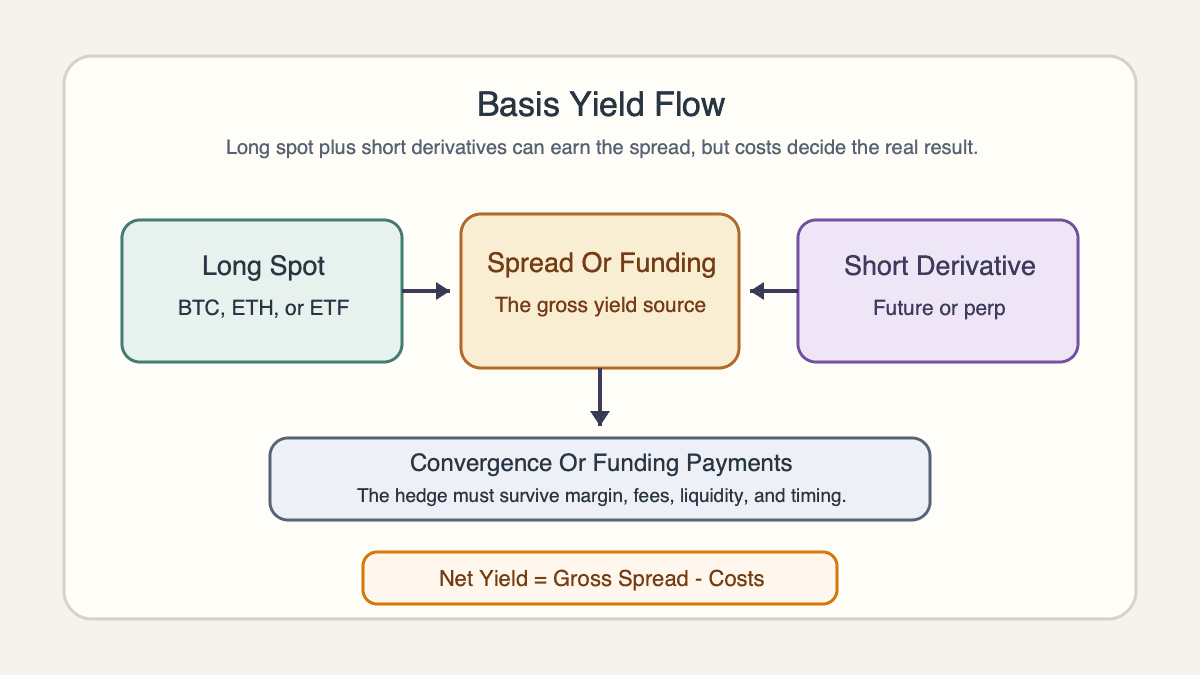
A cleaner way to read the trade is through the underlying basis trade. The trader carries two legs at once. If Bitcoin rallies, the spot leg gains while the short futures leg loses. If Bitcoin falls, the spot leg loses while the futures short gains.
That hedge reduces directional exposure. It does not remove costs. Trading fees, futures commissions, borrowing costs, funding paid, ETF expenses, slippage, taxes, and idle collateral all reduce the result. The useful number is net basis yield, not the prettiest annualized spread on the screen.
Basis yield exists because obvious spreads are not free to capture. Arbitrage traders can shrink the gap, but they still need capital, access, margin, custody, and time. In crypto, futures and perps can trade rich when traders want borrowed long exposure without buying spot.
That demand can push derivatives above the underlying market. Arbitrageurs step in by buying spot and shorting the derivative, but they cannot always do it instantly, cheaply, or at unlimited size. The spread often reflects frictions like these:
That is why crypto derivatives are central to the topic. Basis yield is not a hidden coupon. It is compensation for carrying a structured position across markets that do not move in perfect lockstep.
The spread can also widen before it narrows. A trader may be right that futures should converge with spot, yet still face losses on the short leg before expiry. If collateral is not in the right place, the trade can fail before the math has time to behave.
So the useful question is not “why has nobody taken this free money?” It is: what cost, constraint, or risk keeps the spread from being easy to reach?
Fixed futures basis yield and perpetual funding yield come from related ideas, but they behave differently. A fixed futures trade has an expiry date. A perp trade has funding payments and no standard expiry.
With fixed futures, the trader may buy spot and short a dated contract trading above spot. The futures price should move toward the spot or reference price as expiry approaches. That convergence is the anchor. The catch is path risk: the spread can move against the trader before that anchor arrives.
With perpetual futures, the contract stays open. Funding payments help pull the perp price toward spot. If funding is positive, shorts often receive payments from longs. A long-spot, short-perp trader may collect funding while keeping reduced price exposure.
A single basis yield label can hide different machinery:
| Yield Source | What Can Change First |
|---|---|
| Fixed-Expiry Futures Basis | The spread can widen before expiry, increasing margin pressure. |
| Perpetual Funding | Funding can shrink, vanish, or flip negative. |
| DeFi Vault Wrapper | Strategy rules, withdrawal timing, fees, and smart-contract risk can change the outcome. |
| Protocol-Specific Product | The return can depend on design details beyond the generic basis trade. |
The biggest mistake is treating floating funding like locked yield. A fixed future has a known expiry date. A perp funding strategy can look attractive at breakfast and far less charming by the next funding interval.
That difference changes the workload. Fixed futures need expiry, margin, and roll checks. Perp strategies need ongoing funding, liquidation, and venue checks. A vault may hide those tasks from the user interface, but someone or some code still has to do them.
Basis yield is market-neutral when the long and short legs are designed to offset price movement. It is not risk-free, because the account can still lose money through margin, funding, liquidity, custody, and execution. Delta neutrality means the position tries to reduce exposure to the asset’s direction.
If BTC rises, the spot leg may gain while the short futures leg loses. If BTC falls, the reverse may happen. That balance is useful, but it is only one part of the risk map.
The failure path usually starts with timing. Imagine BTC rallies sharply after entry. The spot leg is up, but the short futures leg has a mark-to-market loss. The futures venue asks for more margin. If the spot exposure sits elsewhere, it may not support the short leg quickly enough.
Here is where the risk usually hides:
| Risk Area | What Can Go Wrong |
|---|---|
| Margin | The short leg can demand collateral before convergence happens. |
| Liquidation | A venue can force-close one leg during a fast move. |
| Funding | Expected payments can flip into costs. |
| Custody | Assets may sit where they cannot support the stressed leg. |
| Liquidity | Entry and exit slippage can erase a thin spread. |
| Venue Risk | Downtime, withdrawal limits, or account issues can break the hedge. |
| Tax Timing | Gains and losses may not match neatly across legs. |
The collateral and margin mechanics decide whether the trade survives that path. This is why a hedged trade can still feel very unhedged at the worst possible minute.
Crowded exits add another layer. If many traders hold the same long-spot, short-futures setup, basis compression can push them toward the same door. The spread may close, but not in a polite line.
Anyone relying on a small net edge needs room for ugly exits. Market-neutral is still a useful description, but it needs the rest of the sentence: basis yield reduces directional price exposure when managed correctly, while the non-price parts of the trade can still lose money.
Basis yield helps explain why Bitcoin ETF buying and futures shorting can happen at the same time. A short futures position is not always a bearish bet. It can be the hedge leg of a basis trade.
In a spot ETF and futures setup, a trader may buy spot Bitcoin ETF exposure and short CME Bitcoin futures. The ETF side gives spot-like exposure. The futures short offsets price direction and targets the basis between the two. If the spread narrows, the trader may earn carry after costs.
| Headline Clue | Basis Yield Translation |
|---|---|
| ETF inflows and futures shorts | The long and short legs may belong to one hedged trade. |
| Futures shorts closing | A basis trader may be buying back the hedge leg. |
| Basis compressing | The spread is narrowing, so gross carry may be falling. |
CME Group OpenMarkets reported that CME Group Bitcoin futures open interest climbed from roughly 30,000 contracts in early 2024 to 45,000 in November 2024, then eased back to the low-30,000s by May 2025. That does not prove every short was a basis hedge, but it shows how futures positioning and regulated spot-like exposure became part of the same market structure.
That is the cleaner way to read headlines. ETF inflows can coexist with futures shorts because the combined trade may be hedged. A basis trader is not simply “long Bitcoin” through the ETF or “short Bitcoin” through futures. The trade is the pair.
Retail traders should be careful with the ETF version. Many users can buy ETF shares, but shorting futures requires the right account, margin process, contract knowledge, and risk controls. The concept can help explain flows. It should not be read as a casual copy-trade invitation.
A basis yield product or vault should be evaluated by tracing the yield source, collateral path, and failure mode. If the product cannot explain those clearly, the APY is not the first problem.
Start with the source of return.
Is the product earning fixed futures basis, perp funding, lending interest, trading fees, token rewards, or a mix? A vault that says “market-neutral yield” without showing the actual source is asking for trust before understanding. That is backwards in crypto, and usually expensive.
Use these checks before you trust a basis yield product:
Custody deserves special attention. If the product asks you to move BTC, ETH, or stablecoins into a vault, you need to know who controls the assets and how withdrawals work. The CryptoProcent wallet custody category is useful context when the main risk is asset control rather than the spread itself.
Do not stop at total value locked or a slick rate card. TVL can grow because the product is sound, because the yield is hot, or because people are chasing a number they have not fully parsed. The safer habit is boring and effective: read the mechanics until you can explain the source of yield in one minute.
Basis yield differs from staking, lending, and yield farming because the return source is different. The word “yield” hides too much unless you ask what activity creates the payment. Staking yield usually comes from validator rewards or protocol issuance.
Lending yield usually comes from borrowers paying interest. Yield farming may come from trading fees, token incentives, points, or liquidity-pool rewards. Basis yield comes from derivatives pricing, funding payments, or convergence between spot and futures. That split changes the risk:
| Yield Type | Return Source |
|---|---|
| Basis Yield | Spot-derivatives spread, convergence, or funding payments. |
| Staking | Validator rewards, protocol issuance, and slashing exposure. |
| Lending | Borrower interest, collateral quality, and liquidation markets. |
| Yield Farming | Fees, incentives, points, and liquidity-pool behavior. |
| Token Rewards | Emissions that may dilute holders if demand is weak. |
This is where yield farming language can blur the picture. A vault may present basis yield beside farms, staking, and lending. The user interface can make them look like siblings. The return engines underneath are not siblings.
Basis yield is often most sensitive to derivatives demand and funding conditions. Staking is more tied to network rules and validator performance. Lending depends on borrower demand and collateral quality. Farming can depend on pool volume, incentives, token emissions, and smart-contract controls.
So do not compare APYs like identical prices on a shelf. Compare the source of return, the failure mode, and the time needed to exit. A lower advertised yield with cleaner mechanics can be better than a higher number that needs three hidden assumptions to survive.
Basis yield is mainly for experienced traders, professional desks, and users evaluating transparent products with strong risk controls. Beginners can learn the concept without running the trade themselves. The self-executed version combines spot exposure, derivatives, collateral, margin, execution, tax records, and fast decision-making.
That is a lot of moving parts for a yield that may shrink quickly. It is also a poor place to learn what liquidation means. Watching a funding dashboard once is not the same as running a hedged trade under stress.
The product version still needs discipline. A vault or fund may handle the execution, but users still need to understand who controls the assets, who manages collateral, and how the strategy exits when funding or basis turns against it.
Basis yield may fit users who can meet these conditions:
Users should stay out of the direct trade if they cannot explain the hedge, calculate the liquidation path, or monitor funding. The same caution applies to vaults. If a product hides the strategy behind vague “delta-neutral” language, the risk has not vanished. It has moved behind a curtain.
For most beginners, basis yield is more useful as a filter than as a trade. It helps you read APY claims, ETF flow chatter, perp funding dashboards, and vault marketing with sharper questions.
That alone can save money, which is a fine yield in its own right.
Start basis yield research by proving the yield source before caring about the rate. A clean explanation should show the spot leg, the short derivative leg, the spread or funding source, and the costs.
For a self-directed trade, write the setup on one page before capital moves: venue, collateral asset, expected holding period, fee drag, margin trigger, and exit plan. For a vault, look for the same mechanics in plain language. If the product cannot explain them, the number on the rate card is decoration.
Use this sequence before considering a product, vault, or self-directed strategy:
Then pressure-test the story. What happens if funding flips negative? What happens if BTC rallies and the short leg needs margin? What happens if withdrawals slow down? What happens if the vault exits later than expected?
Also check whether the opportunity is shrinking. Basis yield can expand when demand for futures long exposure is high, then compress when arbitrage capital arrives or traders stop paying up. A good research process sees the rate as a moving input, not a promise.
Those questions are not pessimism. They are the job. Basis yield can be a real market-structure return, but it only helps when the user understands the machinery. If the explanation depends on “market-neutral” doing all the work, keep reading before sending funds anywhere.
No, basis yield is not risk-free. It can reduce directional price exposure, but it still carries margin, liquidation, funding, custody, execution, tax, and venue risk.
The main danger is path risk. A trade can be right about convergence and still fail because one leg needs collateral before the other leg can help.
Basis yield exists because arbitrage costs money and carries operational risk. Capital, borrowing, margin, custody, venue access, execution, and mandate limits can keep spreads alive.
The spread is usually compensation for carrying those frictions. It is not a market glitch waiting for the first spreadsheet to notice it.
Basis yield is not always the same as funding-rate arbitrage. Funding-rate arbitrage is usually the perp version, where a trader tries to collect funding while hedging price exposure.
Fixed futures basis yield is different because it relies on a dated contract and convergence near expiry. Both can be market-neutral in design, but they do not have the same risk rhythm.
No, Yield Basis is a specific DeFi protocol name, while basis yield is the broader crypto return concept. The generic term can describe futures basis, perp funding, vault wrappers, or other spot-derivatives carry strategies.
That name collision is why search results can feel messy. Read the page or product carefully before assuming it explains the generic strategy.
Retail traders can understand Bitcoin ETF basis yield, but earning it directly is harder than buying an ETF. The paired trade usually needs futures access, margin, contract knowledge, and careful tax records.
An ETF can be the long spot-like leg. The short futures leg is where many retail users meet the harder part of the trade.
Basis yield often rises when demand for borrowed long exposure pushes futures or perps above spot. It can fall when arbitrage capital enters, long demand cools, funding flips, or trading costs eat the spread.
Market sentiment, liquidity, collateral costs, and venue access all shape the result. That is why basis yield is cyclical, not a fixed savings rate with a crypto logo.