Physical Address
304 North Cardinal St.
Dorchester Center, MA 02124
Physical Address
304 North Cardinal St.
Dorchester Center, MA 02124

Learn bridge risk before moving crypto.
Bridge risk is the chance that cross-chain infrastructure delays, misroutes, censors, depegs, or loses funds while assets move between blockchains.
You face bridge risk when you move crypto across chains, use a cross-chain swap, chase a DeFi farm, or hold a wrapped asset that depends on a bridge. The chains can keep working normally while the route between them becomes the weak link.
Bridge risk in crypto is the extra risk created when assets, messages, or token claims move across chains through a bridge, aggregator, or cross-chain route. The route adds its own failure surface on top of the chains. That middle layer is easy to miss on a clean wallet screen.
A simple example makes it less abstract. Say you have USDC on Arbitrum and want usable funds on Base or Solana. The route may lock, burn, mint, swap, relay, or front liquidity before you see the destination asset. Each step adds a dependency.
That dependency can be technical, such as a smart contract bug. It can be operational, such as a fake frontend or wrong token contract. It can also be economic, like thin liquidity on the destination chain.
Bridge risk is painful because it often appears inside a normal wallet flow. You connect, choose a route, approve a token, and confirm. The screen looks simple. Underneath, several parties may be handling cross-chain accounting.
The key distinction is simple:
So a bridge can fail while Ethereum, Solana, Arbitrum, Base, or Polygon keeps producing blocks. That is why bridge risk deserves its own check before you move serious funds.
Cross-chain bridge risk exists because blockchains do not naturally agree on each other’s state. A bridge has to prove, trust, or infer that something happened on one chain before another chain acts on it.
Bridge designs carry trust assumptions around custody, censorship, and security tradeoffs. For users, the plain version is sharper: the bridge creates a second layer of trust between two working chains.
That layer can be a smart contract, a validator set, a multisig, an oracle, a relayer, a liquidity pool, a solver, or a wrapped-token issuer. The exact design changes by route. The risk never becomes zero just because the app has a clean button.
The moving parts break down like this:
| Bridge Dependency | What It Can Break |
|---|---|
| Verification layer | The destination chain may accept a bad or incomplete message. |
| Custody or collateral | Locked assets may become frozen, drained, or hard to redeem. |
| Relayer or signer set | A valid transfer may be delayed, censored, or misreported. |
| Liquidity provider | A fast route may fail when inventory runs thin. |
| Token version | The asset received may not match the asset the user expected. |
The bridge is doing translation and settlement work. If that translation fails, the source chain can show one result while the destination chain shows another.
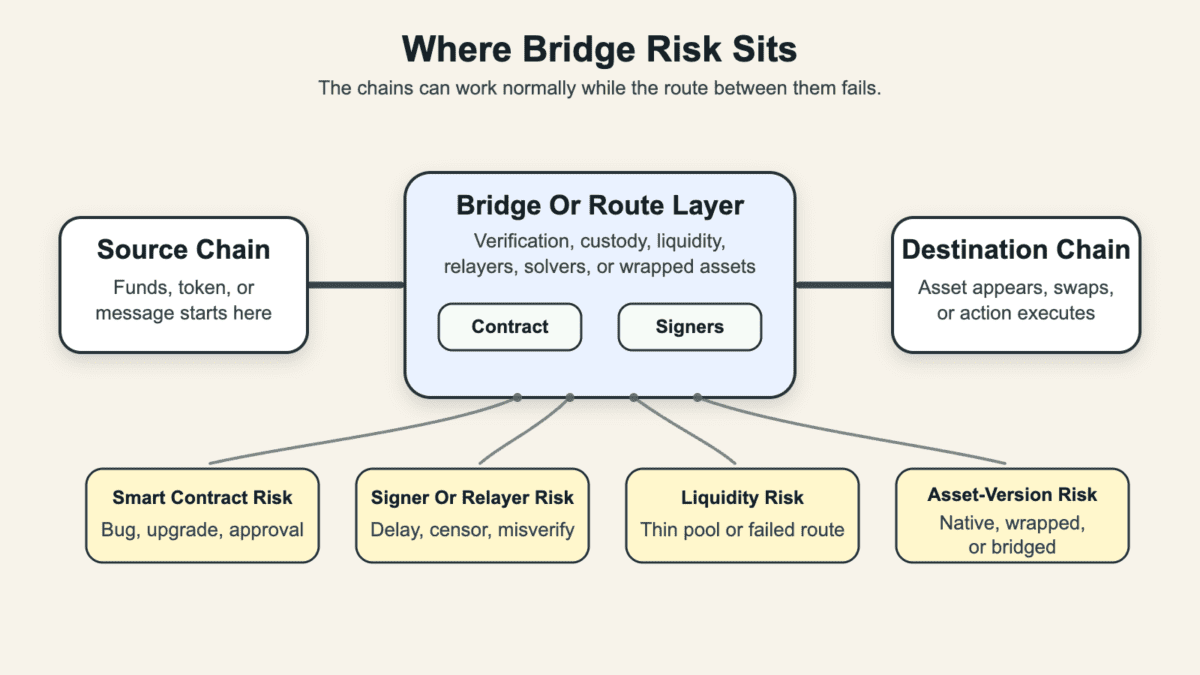
The main types of bridge risk are the failure buckets a user can inspect before signing. The labels sound technical. The checks are practical: what contract acts, who verifies the message, what backs the asset, and what happens if the route stalls.
Smart contract bridge risk comes from the contracts that lock, mint, burn, release, swap, or approve assets. If that logic is wrong, the bridge can release too much, mint the wrong claim, freeze funds, or leave a dangerous approval behind.
Users usually see this risk through wallet prompts and contract addresses. Red flags include odd approvals, mismatched contract addresses, broad spender access, and approvals that remain open after the transfer.
Signer and validator bridge risk appears when a group confirms source-chain events. A bridge may depend on validators, signers, relayers, or a multisig to tell the destination chain what happened.
If keys are compromised, offline, or misconfigured, transfers can stall or the route can accept the wrong message. For users, the visible clue is often vague language about who verifies the route.
Custody bridge risk shows up when assets are locked while a representation moves elsewhere. The token on the destination chain may depend on collateral, an issuer, a wrapper, or an operator that sits outside the destination app.
If backing is frozen, drained, or weakly controlled, the destination asset may lose credibility. That can turn a token that arrived safely into one that is suddenly hard to redeem.
Finality bridge risk appears when the source-chain event needs more settlement time before the destination route can act safely. A route that releases funds early may be betting that the source-side transaction will not reverse or conflict later.
Fast routes may front liquidity before full settlement, shifting risk to relayers, solvers, or liquidity providers. That can be fine for small moves and uncomfortable at size.
Liquidity bridge risk appears when destination inventory is thin. Asset-version risk sits beside it: native USDC, bridged USDC, USDC.e, wrapped BTC, and other wrapped assets can carry different redemption paths.
Operational bridge risk is the user-facing mess: wrong network, fake frontend, unsupported token version, expired quote, wrong recipient, or no clear refund path. It is where good infrastructure still meets a rushed signature.
Here is the short version of the warning signs:
| Risk Type | User Warning Sign |
|---|---|
| Smart contract | Unfamiliar approval, upgrade warning, or odd contract address. |
| Signer or validator | Vague verification model or unclear liveness history. |
| Custody | Wrapped asset depends on locked backing you cannot inspect. |
| Liquidity | Quote changes fast, received amount drops, or exit depth is thin. |
| Asset version | Destination token has a different contract, ticker suffix, or redemption path. |
| Operational | Fake site risk, wrong network, expired quote, or no refund details. |
No single warning sign proves a bridge is bad. Several at once should make you pause. In crypto, a pause is often cheaper than a support ticket written in panic grammar.
Bridge risk differs from blockchain risk because the bridge adds its own trust layer between chains. The source and destination networks can stay healthy while the bridge route breaks.
Think of the stack as separate layers. Chain security covers block production and settlement. Bridge security covers cross-chain verification, custody, liquidity, and messaging. App security covers the frontend and route logic. Wallet security covers what you approve and sign.
Those layers can fail independently:
This split gets expensive when users borrow the reputation of a major chain. “It bridges from Ethereum” does not mean the route has Ethereum-level security. It may mean Ethereum is only the place where the first transaction starts.
The same applies to destination chains. A token landing on Base, Solana, Arbitrum, or Polygon does not prove the token version is native, liquid, or easy to redeem. The chain is the road. The bridge is the vehicle. Inspect the vehicle.
Multi-chain crypto can still be useful. Bridge risk simply means the move creates a new failure surface. Before you sign, check the route, not just the chain logos.
Stablecoin bridge risk is the risk that a dollar-looking token on the destination chain does not carry the same practical backing, liquidity, or redemption path as the one you started with.
Native issuance usually means the issuer supports that token directly on that chain. A bridged version usually means the asset was locked, minted, or represented through a bridge.
That difference can show up under stress. Users care about exit depth, issuer support, redemption routes, and which contracts major apps accept as collateral.
Ask these questions before accepting a bridged stablecoin as “the same”:
| Question | What To Check |
|---|---|
| Is the token native or bridged? | Native and bridged versions can have different backing and support paths. |
| What contract address will land? | Same ticker text can hide a different token contract. |
| Where can I redeem or exit? | Liquidity may be deep on one chain and thin on another. |
| Do major apps accept this version? | Collateral and pool support can differ by token version. |
| What happens if the bridge pauses? | A wrapped asset may keep trading but lose a clean exit route. |
USDC examples are useful because users often see native USDC, bridged USDC, and USDC.e-style labels across L2s and other networks. You need to know what lands, who backs it, and where you can exit.
Wrapped BTC follows the same logic. BTC exposure on a smart-contract chain can depend on wrapper design, custody, liquidity, and redemption.
For stablecoins, bridge risk can combine with depeg pressure, thin liquidity, issuer controls, app collateral rules, and user panic. A stable-looking asset still deserves a route check before you move size.
Bridge risk in aggregators, cross-chain swaps, and intent routes often moves behind the interface. The app may reduce manual steps, but another party still has to settle the destination side.
A bridge aggregator compares routes. A liquidity bridge may front assets from inventory. A cross-chain swap may turn one asset on one chain into another asset on another chain. An intent route lets you state the outcome, then solvers compete to fill it.
That can be useful. Fewer manual steps can reduce wrong-network mistakes. Better routing can save fees or improve speed. But convenience can also hide who provides liquidity, how settlement works, what happens when a route fails, and where refunds land.
Compare the route before assuming a newer tool removed bridge risk:
| Route Type | Main Bridge Risk To Check |
|---|---|
| Canonical bridge | Withdrawal timing, finality, and official asset support. |
| Third-party bridge | Contract design, verifier set, custody, and incident response. |
| Bridge aggregator | Which route it selected and why that route fits your asset. |
| Liquidity bridge | Inventory depth, slippage, and delayed settlement risk. |
| Cross-chain swap | Destination asset, solver behavior, and refund path. |
| Intent route | Who fills the intent, how it settles, and what failed execution means. |
The best route is not always the one with the fewest clicks. A one-click route can be cleaner for small transfers and worse for large or time-sensitive ones when the path is unclear.
Use cross-chain tools as route selectors, not magic erasers. They can reduce visible friction while moving risk into settlement, liquidity, solver behavior, or app-layer execution.
Fast bridge routes can carry bridge risk because speed often comes from fronted liquidity, solver execution, shorter waiting assumptions, or route inventory. Speed helps only when the route is still clear enough to inspect.
A slow canonical route may wait for more finality before releasing funds. A fast route may advance destination liquidity before every upstream risk has fully settled. That does not make it bad, but it changes what you are trusting.
Fee quotes move for the same reason. A wallet may show one number, then adjust when liquidity, gas, slippage, route choice, or destination conditions change. The chain can look quiet while the route itself is crowded.
Common fee and delay drivers include:
Small transfers feel this hardest. A few dollars in bridge fees may be minor on a large move and absurd on a tiny one. So compare the received token, destination liquidity, and exit cost too.
Speed also changes behavior. Users rush when a quote expires, a farm opens, or a market moves. That is exactly when fake sites, wrong networks, and loose approvals get expensive. The faster the route feels, the slower your signature check should be.
Bridge risk turns into a real loss when a transfer, route, backing asset, or approval fails in a way the user cannot cheaply reverse. A failed transaction is annoying. A failed bridge route can be much worse.
The mild version is a stuck transfer. The source transaction confirms, the destination side waits, and the user has to track explorer links or support channels. Refunds may arrive late, arrive on the wrong chain, or require another transaction.
The severe version is asset damage. A wrapped token can depeg, a bridge can pause, backing can be drained, liquidity can vanish, or downstream apps can freeze deposits. If the bridge was used inside a larger DeFi position, the loss can travel.
As of June 20, 2026, DefiLlama’s hacks database tracked more than $3.25 billion in bridge-hack losses. A bridge failure should be treated as more than a delayed transfer.
Scam behavior can sit beside bridge risk. A fake bridge page may imitate a real app and push a malicious approval. If the goal is to drain funds rather than complete a route, it starts to look like a hard rug with bridge branding attached.
Watch for these live-loss patterns:
Do not keep signing random “fix” transactions from a comment section or direct message. Use official status pages, explorers, and support channels. When bridge risk has already turned into loss risk, extra signatures can make the hole deeper.
Bridge risk can affect your portfolio after the transfer because the destination asset may keep depending on the bridge, wrapper, or liquidity route. Arrival is not the same as clean ownership.
If you deposit a bridged asset into a lending market, LP pool, or yield strategy, the bridge dependency can become portfolio risk. A problem with the wrapper or backing can affect collateral value, liquidation safety, pool pricing, and exit timing.
Thin destination liquidity is another quiet trap. You may bridge into a small pool, earn yield for a while, then discover the exit is crowded. A route that looked cheap on entry can become expensive when everyone wants out.
After a bridge transfer, check what changed:
Recordkeeping is not the exciting part. It is still useful. Multi-chain moves can scatter cost basis, fees, swaps, and wallet history across several explorers. That can make future accounting harder, especially after partial failures.
The portfolio lesson is plain. Bridge risk does not always end when the asset lands. It can sit inside the position until you redeem, swap, repay, or exit.
Checking bridge risk before you move funds means verifying the route, asset, approval, cost, destination, and failure path before signing. The goal is not perfect safety. It is avoiding obvious traps.
Start with the route source. Use official project links, not sponsored search results or random social posts. Confirm the domain, app, connected wallet, source chain, destination chain, and supported asset.
Then inspect the token details. The ticker is not enough. Confirm the contract address, whether the asset is native or bridged, what version lands on the destination chain, and whether the receiving app supports that exact version.
Your wallet screen deserves attention too. Check approval size, spender address, and whether you can revoke or limit access after the move. Unlimited approvals are convenient until they are not.
Run this pre-sign checklist before moving anything meaningful:
Testing small proves the route, recipient, token version, and destination wallet setup before the main transfer.
For larger transfers, split the move. Compare the bridge cost with the benefit you are chasing. A farm, mint, trade, or lower-fee chain can look attractive until bridge fees, slippage, delay risk, and exit cost join the bill.
Bridge risk is not worth it when the possible benefit is smaller than the route risk, fees, delay, and exit cost. Skipping the bridge is a valid crypto decision.
Tiny transfers are the easiest example. If fees, destination gas, and slippage eat the expected gain, the bridge is mostly a payment to feel busy. Crypto offers many ways to confuse motion with progress.
Urgent exits also deserve caution. If you need funds immediately, an unfamiliar bridge with a vague refund path can add more stress than it solves. A slower but clearer route may beat a faster route you cannot explain.
Bridge risk often becomes unattractive in these cases:
Many users bridge because a yield opportunity looks better on another chain. That can make sense. But yield farming only works if the yield survives bridge costs, route risk, slippage, and the exit back home.
Sometimes the cleaner move is staying on one chain, waiting for native issuance, using a route with clearer support, or ignoring the opportunity. Missing a farm hurts less than owning a bridged asset you cannot unwind.
Related bridge risk terms help decode what a route is really asking you to trust. They are not academic labels. They are clues on the signature screen.
Use this table when a bridge app starts throwing route language around:
| Term | Plain Meaning |
|---|---|
| Canonical bridge | An official or chain-aligned route, often for L2 deposits or withdrawals. |
| Third-party bridge | An independent bridge using its own contracts or verifier set. |
| Bridge aggregator | A tool that compares routes and sends your transfer through one. |
| Liquidity bridge | A route using destination-side inventory for faster transfers. |
| Wrapped asset | A token that represents another asset through backing or custody. |
| Native asset | A token issued directly on that chain. |
| Relayer | A party or system that passes messages between chains. |
| Finality | The point where a source-chain transaction is settled enough. |
| Solver | A party that fills a requested outcome. |
| Intent | A requested outcome, such as “swap this asset and deliver that one.” |
| Refund path | The process for returning funds when a route fails. |
Map each term to a dependency. Ask what it changes about custody, settlement, liquidity, or asset version. If the answer is fuzzy, the route is fuzzy too.
Two related ideas come up during real transfers. Wallet approvals show how spender permissions can become bridge risk before transfer. Exit liquidity shows why a bridged position can become hard to unwind.
This language helps avoid bad comparisons. A canonical bridge, cross-chain swap, and intent route may all move value across chains, but they do not expose you to the same bridge risk.
No. Smart contract risk is one part of bridge risk, alongside signer, custody, liquidity, finality, asset-version, approval, and refund risk.
Cross-chain swaps can reduce manual steps, but they do not remove bridge risk. Risk may move into solvers, liquidity, settlement, destination assets, or refunds.
Yes. Bridged USDC can carry bridge risk because it may depend on a bridge, wrapper, liquidity path, or token contract. Native and bridged versions can behave differently.
Bridge risk includes changing fees because the route may depend on finality, destination gas, liquidity inventory, relayers, slippage, quote expiry, and solvers.
Yes. Bridge risk can affect assets after arrival if the token remains wrapped or bridged. It can influence collateral quality, LP positions, exits, redemption, and records.
The safest way to reduce bridge risk is to verify the route, test small, limit approvals, confirm the destination token, and avoid unclear transfers.
Start with bridge risk by treating every cross-chain move as a route inspection, not a normal transfer. The goal is to know what can fail before the wallet asks for your signature.
First, decide whether the move needs a bridge at all. If you only need cheaper fees, a small trade, or a temporary farm, the total route cost may be larger than the benefit.
Keep the boring evidence before and after the move. Save the route, source transaction, destination transaction, approval, and final token contract. If something breaks, those details separate a slow route from a wrong asset, weak liquidity, or malicious approval.
Use these actions before your next bridge:
Then ask one final question: would you still bridge if the route took longer, cost more, or landed a less useful token version? If the answer is no, the route is probably too fragile for the amount involved.
If the answer is yes, write down the route before signing: source chain, bridge or aggregator, destination chain, token contract, expected amount, and refund path. That small note makes support tickets, tax records, and later exits less chaotic.
Bridge risk does not mean never bridge. It means the bridge has to earn the transfer.