Physical Address
304 North Cardinal St.
Dorchester Center, MA 02124
Physical Address
304 North Cardinal St.
Dorchester Center, MA 02124


Learn the cabal wallet signals before chasing a loud chart.
A cabal wallet is a crypto wallet address that appears to belong to, interact with, or behave like part of a coordinated wallet cluster with possible early token access, shared funding, synchronized trades, or insider timing.
The phrase usually appears around meme coins, Solana launches, Pump.fun tokens, DEX dashboards, Telegram calls, and X threads. It points to a risk pattern, not a special wallet app by default.
Search results can be messy here. Some pages are about wallets that store a token named CABAL. Traders usually mean something different: “Are these wallets connected, and are they about to sell into me?”
A cabal wallet in crypto is a wallet suspected of being part of a coordinated group. The suspicion usually comes from observable behavior: who funded the wallet, when it bought, what other wallets moved with it, and how those wallets sold.
The word “suspected” is doing real work. A block explorer can show timing and transfers. It cannot show a private chat, a handshake, or a person’s intent. That is why a cabal wallet claim should start a risk check, not end the argument.
The phrase is most common in fast token markets. You may see it near Solana meme coins, Pump.fun launches, DEX risk panels, wallet visualizers, Telegram groups, and X posts where traders are trying to explain why a chart looks too coordinated.
Common cabal wallet clues include:
A simple example is five fresh wallets funded from one address, buying minutes after launch, then holding while callers push the token. If those wallets sell together into the next green candle, traders may call the group a cabal wallet cluster. The evidence is still behavioral, but it is no longer just one odd transfer.
None of those clues is perfect. Airdrops, market makers, exchange wallets, friend groups, and normal whale behavior can create patterns that look coordinated. The useful question is whether several clues point in the same direction.
Cabal wallets create meme-coin risk because early wallet control can decide who gets paid and who gets used. If a small cluster buys before public attention arrives, later buyers may be walking into a chart where the exits are already planned.
That is why cabal wallet talk often sits beside exit liquidity. The fear is simple: public buyers provide the demand that lets earlier wallets sell. Nobody wants to discover they were the bid after the private group chat already hit “send.”
Solana and Pump.fun are common settings because launches move fast. A token can go from unknown to crowded in minutes. In the meme-coin trenches, speed is part of the game, and speed also hides context.
A suspected cabal wallet cluster can shape a chart in a few ways:
This does not make every fast launch fake. Organic meme coins can also start with a few active wallets, loud posts, and chaotic buying. The difference is whether the wallet pattern looks staged when you check funding, timing, holder control, and sells together.
The practical risk is not only a price drop. It is a bad information setup. The wallets that bought early may know more, move faster, and care less about the public story than the people buying after the chart has already done its best impression of destiny.
Traders spot a suspected cabal wallet cluster by looking for links between wallets that should be independent. The strongest cases combine funding links, launch timing, supply control, and exit behavior.
Start with the path into the wallet. If several top holders were funded by the same wallet, bridge, or first-hop address, the cluster deserves more attention. Shared funding does not prove one owner, but it weakens the idea that the wallets arrived separately.
Shared funding is one of the cleaner cabal wallet clues because it creates a visible trail. A first-hop wallet can send funds into several fresh wallets, which then buy the same token early.
This pattern can be innocent. Friends can split wallets. A market maker can seed accounts. An exchange withdrawal can make unrelated wallets look similar. So the funding trail matters most when it appears with other signals.
Bundled buys happen when multiple wallets buy in a tight execution window, sometimes through tooling that groups or speeds transactions. Same-minute buys can also matter when they land before public attention reaches the token.
Then check supply. If a small cluster controls a large early share, the chart can move sharply when those wallets sell. Thin liquidity makes that risk worse because smaller sells can push the price harder.
The clearest cabal wallet signals usually stack like this:
| Signal | What It May Suggest |
|---|---|
| Shared funding source | Wallets may be linked before the token launch. |
| Same-minute early buys | Buyers may have coordinated timing or tooling. |
| High top-holder concentration | A small group may control price pressure. |
| Synchronized sells | Wallets may be exiting into public demand. |
| Repeated deployer links | The pattern may have appeared in older launches. |
The table is a risk map, not a verdict sheet. One strange row is a lead. Several rows pointing the same way are a stronger reason to pause.
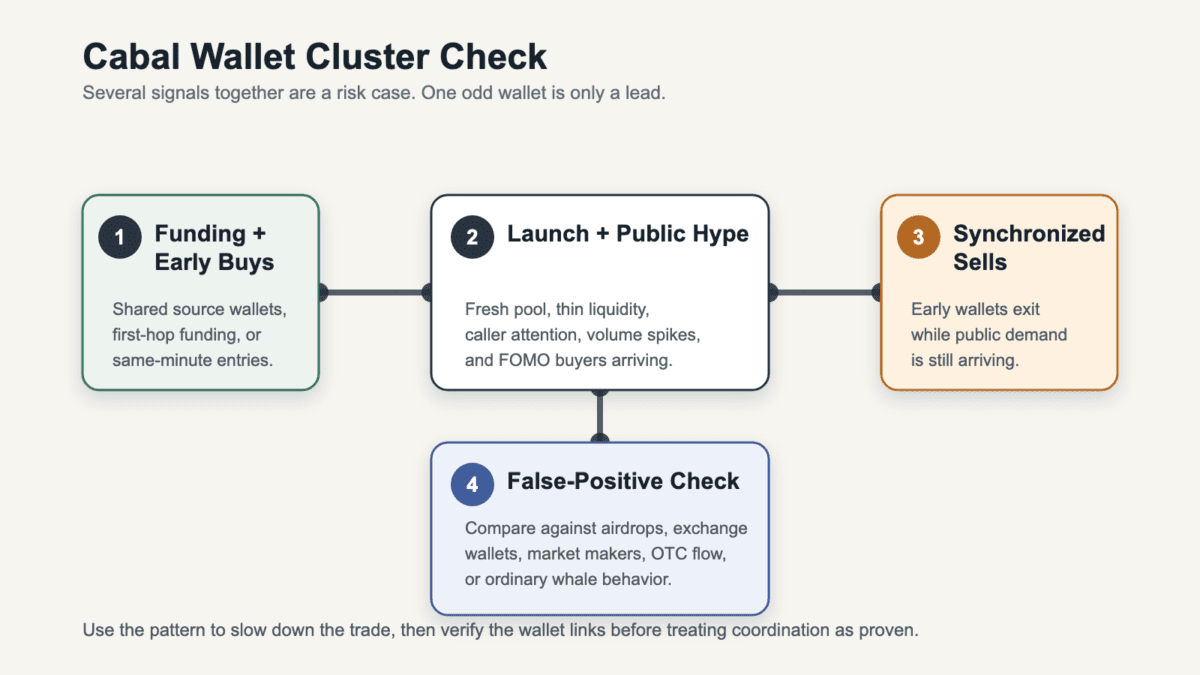
Synchronized sells are often the clue traders notice first because they hurt. The chart rises, attention arrives, and several early wallets start selling into the same demand window.
Repeat history adds context. If the deployer, funding wallet, or early cluster appears near older launches with similar exits, the new token deserves extra caution. A single launch can be messy. A repeated pattern is harder to wave away.
A cabal wallet is about suspected coordination across wallets. It is not the same thing as a whale wallet, an insider wallet, or smart money, even though those labels can overlap.
The difference changes how you read risk. A whale can move price by size alone. Smart money may have a good history, or just good marketing. An insider wallet suggests early access or proximity. A cabal wallet claim says multiple wallets may be acting together.
Here is the clean split:
| Term | What It Means |
|---|---|
| Cabal wallet | A wallet suspected of belonging to a coordinated cluster. |
| Insider wallet | A wallet suspected of having early access or privileged timing. |
| Whale wallet | A large wallet that can move price because of size. |
| Smart money wallet | A wallet tracked because it has a profitable-looking history. |
| Sniper wallet | A wallet or bot that buys very early after launch. |
Overlap is common. A suspected insider wallet can also be a whale. A smart money wallet can join a cluster. A sniper can be early without being part of a cabal. The label should match the evidence, not the mood in the group chat.
The biggest trap is copy-trading a wallet because it looks smart. Publicly watched wallets can become bait. A wallet may enter early, get copied, then sell into the crowd that made its position liquid.
So compare labels before copying behavior. Size, timing, profit history, and coordination are different claims. Mixing them together is how a trader turns a useful clue into a very expensive horoscope.
Cabal wallet tools and bubble maps can reveal patterns faster than a manual block-explorer check. They can show clusters, shared flows, token interactions, holder groups, and timing clues that would take longer to find by hand.
The Stalkchain Cabal Finder overview describes this as identifying wallet groups across token interactions. It supports up to 20 unique token addresses for multi-token analysis. That helps when you are comparing fresh tokens or looking for repeated participants.
But a tool score is not proof of intent. Wallet clustering can group addresses by behavior. It cannot prove every wallet has the same owner, predict the next sell, or confirm a private deal behind the scenes.
False positives are part of the job:
Bubble maps can also make weak relationships look dramatic. A neat cluster on a screen feels persuasive because it is visual. The map may still be showing a loose relationship, a funding shortcut, or a historical link that no longer matters.
This is also where cabal wallet risk differs from a hard rug. A hard rug usually involves direct liquidity theft or a mechanism that traps buyers. Cabal wallet warnings are often about coordinated holder behavior, which is harder to prove and easier to misread.
Use tools for triage. Then cross-check the claim with funding paths, holder concentration, liquidity depth, contract settings, social timing, and actual sells. The tool can point to smoke. It cannot promise fire.
Cabal wallet checks before buying a new token should reduce uncertainty, not create false confidence. The point is to decide whether the setup is clean enough for your risk level.
Start with the basics before chasing a cluster theory. Verify the token contract, check whether the token can be freely transferred, look for freeze or tax settings where they apply, and compare liquidity to the market cap. A huge market cap with thin liquidity can turn one wallet exit into a cliff.
Then move to wallet behavior. The useful checks are simple enough to write down:
Top-holder concentration deserves special care. A token can look active while a small group controls enough supply to dominate the next move. That does not guarantee a dump, but it changes the math.
Funding overlap is the next layer. If top wallets came from one source, bought early, then stayed quiet while public attention grew, the setup is less random than a normal scattered launch. Add synchronized selling, and the risk case gets stronger.
Beginners often underweight liquidity. Locked liquidity may stop one kind of pool pull, but it does not stop early holders from selling tokens they already own. If the pool is thin, a cluster does not need to steal liquidity to damage late buyers.
Social timing can change the read. A KOL push after early wallets are loaded is different from broad community discovery before wallets have concentrated supply. Watch whether the narrative arrived before or after the biggest early entries.
No single check gives a clean yes or no. But the pattern can tell you whether the trade is still about price discovery or whether you are mostly buying someone else’s exit path.
If you see cabal wallet warning signs, slow the trade down. The label does not mean a rug is guaranteed, but it does mean the burden of proof has moved.
The easiest move is skipping the token. That sounds boring until you remember the market creates new chaos every few minutes. Missing one suspect chart is not a tragedy. Holding the bag after a staged launch is worse.
If you still want exposure, make the risk smaller and more deliberate:
Copy-trading is the dangerous shortcut. A watched wallet may be profitable, hedged, promotional, or already selling by the time you follow it. If everyone can see the same wallet, the edge may already be gone.
New-token trading often becomes PVP trading because different players enter with different speed and information. Cabal wallet signals make that gap more visible. They do not make the gap fair.
If the warning signs fade, reassess. Maybe supply spreads out, early wallets stop selling, liquidity deepens, and public demand becomes less caller-dependent. If the warning signs intensify, you have your answer, even if the chart is still flirting with you.
Cabal wallet meaning depends on context. Lowercase trader slang usually points to suspected wallet coordination. Uppercase CABAL pages usually point to a token, ticker, price page, or storage guide.
Exact searches can return wallet pages for a token named CABAL. Those pages can be useful if you want a normal crypto wallet to store or swap a specific token. They do not answer whether a meme-coin chart has suspicious wallet clusters.
The safest read is to separate the job of the page from the word on the page. A storage guide usually talks about wallet apps, swaps, deposits, token contracts, and supported networks. A cabal wallet explainer talks about funding paths, early holders, timing, exits, and whether several wallets appear to be acting together.
Use the search result to infer the likely intent:
| Search Result | Likely Meaning |
|---|---|
| “Cabal wallet meaning” | Slang for suspected coordinated wallet behavior. |
| “CABAL token wallet” | A wallet used to store or trade a token named CABAL. |
| “Cabal Finder” | A tool or dashboard for wallet-cluster checks. |
| “CABAL price” | A token price page, not a slang explainer. |
Be careful with capitalization, ticker pages, and contract addresses. A CABAL token can exist without proving anything about cabal wallets. A cabal wallet accusation can exist without referring to a token named CABAL.
The cleanest habit is to ask what the page is trying to help you do. Storage pages help with holding or swapping a token. Cabal wallet analysis helps you decide whether wallet behavior around a token looks coordinated.
That context check also protects you from false urgency. A token-wallet page may make a CABAL asset look easier to buy, but ease of access says nothing about the wallet pattern around another launch. Before acting on either result, confirm the contract address, the chain, and whether the page is about storage or risk analysis.
Cabal wallet risk overlaps with several crypto slang terms. These concepts help you describe the danger without turning every ugly chart into the same accusation.
Exit liquidity is the cleanest related idea. It describes the late-buyer role cabal wallet warnings are trying to avoid: providing demand while earlier wallets sell. If the early cluster exits into public hype, the late buyer becomes the liquidity source, not the lucky discoverer.
Hard rug helps separate wallet behavior from contract-level theft. A hard rug usually points to direct liquidity theft, transfer traps, or contract behavior. A cabal wallet pattern can be risky even when there is no hard rug.
Bagholder names the person left holding after the story turns. Cabal wallet checks are partly about avoiding that role when early holders already control the exit.
PVP describes the market mood when traders compete with unequal information. Cabal wallet signals can show why a new-token trade feels less like investing and more like sitting at the sharp end of someone else’s timing advantage.
Use the related terms as precision tools. If the issue is the pool being drained, call it a hard-rug problem. If the issue is earlier wallets selling into newcomers, the exit-liquidity frame is cleaner. If the issue is your own position after the hype collapses, bagholder is the painful but accurate word.
That precision keeps the analysis useful. “Cabal wallet” should point to suspected coordination, not become a magic label for every red candle. The better next step is to name the specific risk, check the wallet evidence, and decide whether the trade still earns its place.
A cabal wallet is a wallet suspected of belonging to a coordinated cluster. Traders usually look for shared funding, same-minute buys, early supply control, synchronized sells, or repeated links to older token launches.
It is not a normal wallet app by default. In meme-coin trading, the phrase usually describes a risk signal around wallet behavior.
No, a cabal wallet is not always a scam. It is a suspicion based on patterns, not automatic proof of fraud.
The pattern can still be useful. If several wallets look connected and control meaningful supply, the token may carry more exit risk than the chart suggests.
No, a cabal wallet does not mean a rug pull is guaranteed. It can point to coordinated selling risk without proving a hard rug or a fixed outcome.
The strongest warning appears when cabal wallet signals combine with thin liquidity, concentrated holders, suspicious contract settings, and early wallets selling into public hype.
No, a cabal wallet and an insider wallet are related but different labels. An insider wallet suggests early access or privileged timing. A cabal wallet suggests possible coordination across several wallets.
One wallet can fit both descriptions, but the evidence should support each claim separately.
No, locked liquidity does not stop cabal wallets from dumping tokens they already control. It may reduce one kind of pool-pull risk, but it does not prevent early holders from selling into available demand.
That is why holder concentration and wallet timing still matter, even when liquidity looks locked.
CABAL token wallet pages show up because search engines mix two intents. One intent is storing or buying a token named CABAL. The other is understanding cabal wallet slang in crypto trading.
Check the page context. If it discusses storage, swaps, token price, or a contract address, it is probably about a CABAL token. If it discusses clusters, funding paths, or coordinated wallets, it is probably about the slang meaning.