Physical Address
304 North Cardinal St.
Dorchester Center, MA 02124
Physical Address
304 North Cardinal St.
Dorchester Center, MA 02124


A plain guide to cash-and-carry crypto trades, net returns, and hidden risks.
Cash-and-carry is a crypto trade that buys the asset and sells a related futures contract to capture the price gap.
In crypto, the phrase can mean two close but different trades. The classic version uses dated futures, where the futures contract expires and should converge with spot. The crypto-native version often uses perpetual futures, where funding payments create the carry.
That distinction is useful because the trade is not magic yield with a spreadsheet costume. It can reduce exposure to Bitcoin or Ethereum price direction, but it still depends on fees, margin, collateral, venue access, and whether you can close both legs when the market gets rude.
Cash-and-carry in crypto means buying a coin or token in the spot market while selling a related futures or perpetual contract. The goal is to collect the difference between spot and derivative pricing while reducing exposure to the asset’s price direction.
The clean textbook version uses dated futures. If BTC trades at $100,000 in spot and a future expiring in three months trades higher, a trader can buy BTC and short that future. At expiry, the two prices should meet, so the spread is the trade’s starting edge before costs.
The useful split is simple:
That looser language creates confusion. A dated future has an expiry date and a convergence point. A perp has no expiry, so the result depends on recurring funding payments and the trader’s ability to keep margin alive. Calling both “cash-and-carry” is common, but mixing the mechanics is how clean yield turns into surprise homework.
A cash-and-carry trade works by building two offsetting positions, then managing the gap between them. You own the spot asset, sell the related derivative, and try to keep the hedge intact until the spread is collected or the setup no longer pays.
The basic workflow is simple on paper:
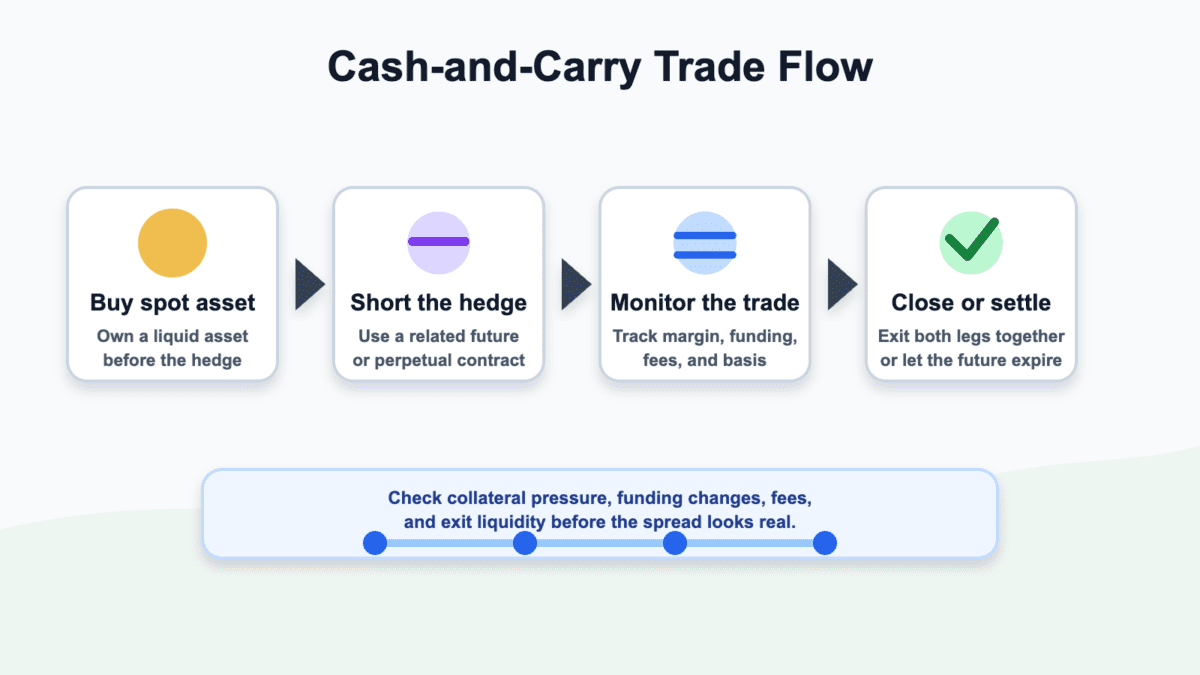
Dated futures cash-and-carry relies on expiry. The futures contract starts above spot, and the trader expects that premium to shrink as expiry approaches.
The path still matters. If spot rallies hard, the short future loses money before the spot gain is realized or transferred. If margin sits in a different account, a “market-neutral” trade can still face a very non-neutral liquidation alert.
Spot-perp funding capture replaces expiry convergence with funding payments. When perps trade above spot, long perp traders often pay shorts through the funding mechanism.
That can look steady until it flips. Funding can move from positive to flat or negative, and crowded shorts can get squeezed. Then the trade stops looking like income and starts acting like a job with alarms.
Cash-and-carry is often a basis trade, but crypto uses several related labels for similar-looking hedges. The clean way to separate them is to ask which instrument pays, when it pays, and what can break before the trade finishes.
The labels overlap, but they are not interchangeable:
| Strategy | How It Works |
|---|---|
| Cash-and-carry with dated futures | Buy spot and short a related expiring future. The payoff comes from the futures premium narrowing into expiry. |
| Spot-perp funding capture | Buy spot and short a perpetual future. The payoff comes from funding payments while they stay positive. |
| Reverse cash-and-carry | Short spot or borrow the asset, then buy the cheaper future. It is rarer for many crypto users because borrow access and costs can be awkward. |
| Plain directional futures trade | Buy or sell futures to bet on price direction. There is no offsetting spot leg, so the trade is not market-neutral. |
A basis trade is the broader term. It focuses on the spread between spot and futures. Cash-and-carry is one way to trade that spread, while funding-rate arbitrage is the perp version many crypto traders discuss in chats, fund decks, and suspiciously cheerful yield threads.
Cash-and-carry returns start with the visible spread, but the usable return is the spread after every cost that touches the trade. The headline premium is only the first line. The net result is what survives the fee schedule, the order book, collateral demands, and taxes.
A plain formula helps:
Net return = futures premium or funding received - trading costs - financing costs - slippage - tax drag - safety buffer
Here is what belongs in the calculation before the trade looks attractive:
| Return Input | How It Changes The Return |
|---|---|
| Futures premium or funding received | This is the gross carry the trade tries to collect. |
| Maker and taker fees | Small spreads can disappear after opening and closing both legs. |
| Slippage | Thin books can move the entry or exit price against you. |
| Borrowing or financing cost | Cash, stablecoins, or borrowed assets are not always free. |
| Collateral opportunity cost | Margin parked on one venue cannot earn elsewhere. |
| Withdrawal or custody cost | Moving assets between venues can add fees and timing risk. |
| Margin buffer | Extra collateral reduces liquidation risk but lowers capital efficiency. |
| Tax and accounting drag | Realized gains, losses, and funding payments may create reportable events. |
Now use round numbers. Suppose spot BTC is $100,000 and a three-month future trades at $102,000. A trader buys one BTC and shorts one future, so the gross spread is $2,000 before annualizing anything.
That number is not the profit. If entry and exit fees, slippage, funding or borrowing costs, and tax drag eat $700, the trade has $1,300 left before considering stress. If the trader needs a large margin buffer to avoid liquidation, the return on usable capital falls again.
This is why retail traders often find cash-and-carry less shiny than it looks. Institutions may get better fee tiers, credit lines, execution tools, and cross-margin arrangements. A smaller account usually gets the retail version of the buffet: same dessert photo, smaller plate.
Cash-and-carry is directionally hedged because the spot leg and short derivative leg usually offset price movement. It is not risk-free because the hedge does not remove margin pressure, platform risk, funding changes, execution mismatch, or trapped collateral.
> A hedge can reduce coin-price direction. It cannot move collateral for you, pause liquidations, or make withdrawals unblock faster.
Three failure points deserve special attention:
A simple example shows the problem. BTC can rally 12% while the futures premium also widens. The spot leg gains value, but the short futures leg demands more margin now. If the account cannot post collateral fast enough, the venue can close the short before the trade gets to its planned ending.
Crowded exits add another layer. When many traders try to unwind the same basis trade, liquidity can vanish exactly where the spreadsheet assumed it would be there. That is when a neat exit plan starts charging tuition.
Before opening a trade, check the failure points that are not visible in the headline spread:
The lesson is simple. Cash-and-carry hedges one kind of risk while concentrating several others. Experienced traders may accept that trade-off. It gets dangerous when the position is sold as free yield.
Cash-and-carry stops working when the remaining spread no longer pays enough for the risk, labor, and capital it requires. That can happen quietly through compressed basis, or suddenly through volatility, funding flips, and thinner order books.
The red flags usually show up before the trade breaks:
Crowding is the quiet killer. When more traders chase the same spread, they buy spot, short derivatives, and compress the opportunity. The trade becomes less about finding an obvious gap and more about having better funding, lower fees, and stronger infrastructure than the next desk.
Volatility can also make a small spread useless. A sudden BTC or ETH move may widen the basis, lift margin requirements, and force traders to exit at bad prices. The hedge may still be logical, but logic does not refill a margin account.
So the spread check needs stress built in. If the trade needs heroic assumptions, the edge is probably already gone.
Cash-and-carry fits traders who can manage derivatives, collateral, accounting, and venue risk without improvising under pressure. It is a poor fit for passive holders who only want yield and do not want to monitor positions.
The split is less about intelligence and more about operating discipline:
| Better Fit | Poor Fit |
|---|---|
| Active traders with futures experience | Passive holders chasing yield |
| Accounts with strong fee tiers | Small accounts where fees dominate |
| Desks that can monitor margin daily | Users who cannot react to alerts |
| Traders with clear tax records | Anyone guessing taxable events later |
| Users who understand collateral flows | Users putting all funds into one thin trade |
A good fit also knows when not to trade. If you are tempted to full-port into a thin basis spread because it looks safe, stop. That is not risk management. It is a bad idea wearing a tie.
Compare it with yield farming before sizing the trade:
For most beginners, the first useful version is a paper trade. Track entries, exits, funding, fees, and margin without money on the line. If the accounting feels annoying there, it will not become calmer during a liquidation warning.
Cash-and-carry can affect Bitcoin and Ethereum markets because large basis trades touch spot demand, futures open interest, ETF flows, and short-term pressure during unwinds. The trade may be market-neutral for one desk, but the flows still touch real markets.
The market channels are usually visible in a few places:
In a common Bitcoin basis setup, a desk may hold spot BTC or ETF exposure while shorting BTC futures. That can support spot or ETF demand while adding short interest in futures. When the trade is closed, those flows reverse.
BIS research describes crypto carry as the difference between futures and spot prices, with Bitcoin and Ethereum as the main assets studied. It also points to market segmentation and limited arbitrage capital as reasons the spread can stay large or volatile.
> Not every BTC drop is a basis-trade unwind. Markets are messier than one villain with a futures account.
Crowded carry can still add pressure when many traders reduce the same long-spot, short-futures structure at once. That mechanism is worth understanding without turning every red candle into a detective story.
ETF-linked carry adds another wrinkle. A May 2026 arXiv paper compared implied carry in IBIT options with matched CME Bitcoin futures and found a mean wedge of 2.58 annual percentage points in its selected sample. The useful takeaway is not the exact number for today’s market. It is that collateral, margin, and venue segmentation can leave carry gaps even in regulated products.
Bagholder anxiety can get misapplied here. Spot holders may read every derivatives unwind as a direct attack on price. Sometimes flows matter. Sometimes price simply moved, and the explanation arrived later wearing a lab coat.
A cash-and-carry setup should pass a practical checklist before any capital moves. The goal is to find the weak operational link before it gets the chance to turn a thin spread into a large problem.
Start with market structure, then move to plumbing:
Collateral deserves extra attention. If spot sits in one account and margin sits in another, gains on one leg may not help losses on the other leg fast enough. If spot stays off exchange, your crypto wallets setup becomes part of the trade plan, not a side chore.
Access also changes by region and product. Some users can trade regulated futures through brokerage routes. Others only see offshore perps, and some should not be using those venues at all. CME Group reported cryptocurrency average daily volume of 224,000 contracts, or $14.9 billion notional, for May 2026, but product availability still depends on the account and intermediary.
> If you cannot explain what happens during a 15% intraday move, a withdrawal pause, or a funding flip, the trade is not ready.
The spread can wait. It has no feelings.
Cash-and-carry sits beside several crypto terms, yield labels, and behavior warnings that point to different risks. Learning the nearby language helps you avoid taking the wrong lesson from trader chatter.
These linked concepts are worth separating before a basis spread looks too clean:
Reverse cash-and-carry belongs here too. It usually means the opposite structure: short the asset or borrow it, then buy the cheaper future. In crypto, that can be harder for smaller users because borrowing, custody, and short access are not evenly available.
The main point is not vocabulary collecting. It is knowing which risk you are actually taking. Basis, funding, and yield all sound clean until the trade shows where the mess lives.
Cash-and-carry in crypto is a trade that buys the spot asset and shorts a related futures or perpetual contract. The trader tries to collect the futures premium or funding payments while reducing exposure to the asset’s price direction.
The trade is common around BTC and ETH because those markets have deeper spot and derivative liquidity. But it still requires margin management, fee control, and clean execution.
No, cash-and-carry in crypto is not risk-free. It can hedge price direction, but it still carries margin, exchange, funding, execution, tax, and collateral risk.
The biggest mistake is assuming that offsetting positions remove all danger. A short future can be liquidated before the spot gain can help, especially when collateral is split across venues.
Cash-and-carry is not always the same as funding-rate arbitrage. Classic cash-and-carry uses dated futures and expiry convergence, while funding-rate arbitrage usually uses perpetual futures and recurring funding payments.
Crypto traders often use the terms loosely. When someone mentions the trade, ask whether the short leg is an expiring future or a perp.
There is no universal minimum for cash-and-carry because venue rules, contract sizes, fees, and collateral requirements vary. Small accounts often struggle because costs eat a larger share of the spread.
Focus on net return after all costs and a realistic margin buffer. If the expected profit disappears after fees and slippage, the account size is not the main problem.
U.S. traders may be able to do cash-and-carry through eligible regulated futures access, but availability depends on the broker, product, account approval, and state or federal rules. Offshore perp access is a separate issue and should not be assumed.
Anyone considering the trade should verify product access before planning returns. A strategy that requires an unavailable venue is just fan fiction with decimals.
If an exchange freezes withdrawals during cash-and-carry, the hedge may stay open while the trader cannot move collateral where it is needed. That can create liquidation risk even if the overall position looks balanced.
This is why venue risk belongs in the return calculation. A thin spread is not enough payment for a setup that fails when one account becomes unreachable.
Start with mechanics, not yield. Cash-and-carry rewards traders who understand the plumbing before they chase the spread.
Before the checklist, decide what would make you close early. A funding flip, withdrawal delay, or margin rule change should have a written response before money moves. If the response is “wait and hope,” you do not have a setup yet.
Use this sequence before risking capital:
Run the paper trade like it is real. Record the entry spread, funding or expiry date, every fee, collateral movements, and the exit price you would need. Then compare the result with doing nothing.
After that, decide whether the return is still worth the work. Many cash-and-carry setups are real, but real does not mean suitable. If one weak venue, fee tier, or transfer delay can wipe out the edge, the cleanest trade is usually the one you skip.