Physical Address
304 North Cardinal St.
Dorchester Center, MA 02124
Physical Address
304 North Cardinal St.
Dorchester Center, MA 02124


A plain-English guide to claim window deadlines and wallet risk.
A claim window in crypto is the period when an eligible wallet or account can claim a token, reward, airdrop, or distribution before a deadline or next phase.
The phrase usually appears when a project announces an airdrop, reward program, fork token, redemption event, or delayed distribution. It sounds simple until the page asks you to connect a wallet, sign a message, pay gas, or beat a deadline that was apparently announced on three social feeds and one half-buried blog post.
A claim window in crypto is a time-limited period for claiming tokens or rewards. It is common in airdrops, incentive programs, token migrations, staking rewards, and project redemptions.
An airdrop is the broader distribution idea. The claim window is the open period when an eligible wallet, account, or user can take the required action. A simple version looks like this:
That is why airdrop farmers track snapshots, eligibility pages, and claim periods separately. The work starts before a token is announced, then turns into deadline management once a claim page appears.
A claim window only proves that action has a deadline. The token can still have weak liquidity, poor distribution, scam risk, tax friction, or no useful market at all. For low-value claims, the deadline may be the least interesting part of the risk.
A claim window is only one timing label in a crypto distribution. A common mistake is assuming the snapshot, claim period, unlock, and vesting schedule all mean the same thing.
These labels do different jobs. A snapshot can make a wallet eligible before a claim page exists. A vesting schedule can delay usable tokens after a claim succeeds. A redemption period can offer a later route with reduced terms.
Crypto Timing Terms Compared:
| Term | What It Means |
|---|---|
| Snapshot | A point in time when a project records wallets, balances, or activity for eligibility |
| Eligibility Window | The period when user activity, holdings, staking, or points may count toward qualification |
| Claim Window | The period when an eligible wallet or account can claim the allocation |
| Claim Deadline | The cutoff after which normal claiming may close or change |
| Distribution Date | The date tokens are sent, become claimable, or start reaching eligible users |
| Unlock Period | The period when locked tokens become transferable or usable |
| Vesting | A gradual release schedule that gives access over time |
| Redemption Period | A later or alternate phase for claiming, swapping, or recovering a reduced allocation |
This timing map separates the parts that airdrop pages often blur. Holding at the snapshot may prove that an address qualified, but it may not finish the job.
Some drops are automatic. Others require an active claim. Kraken Learn explains that some airdrops include an optional claim window and may require users to claim within a set timeframe.
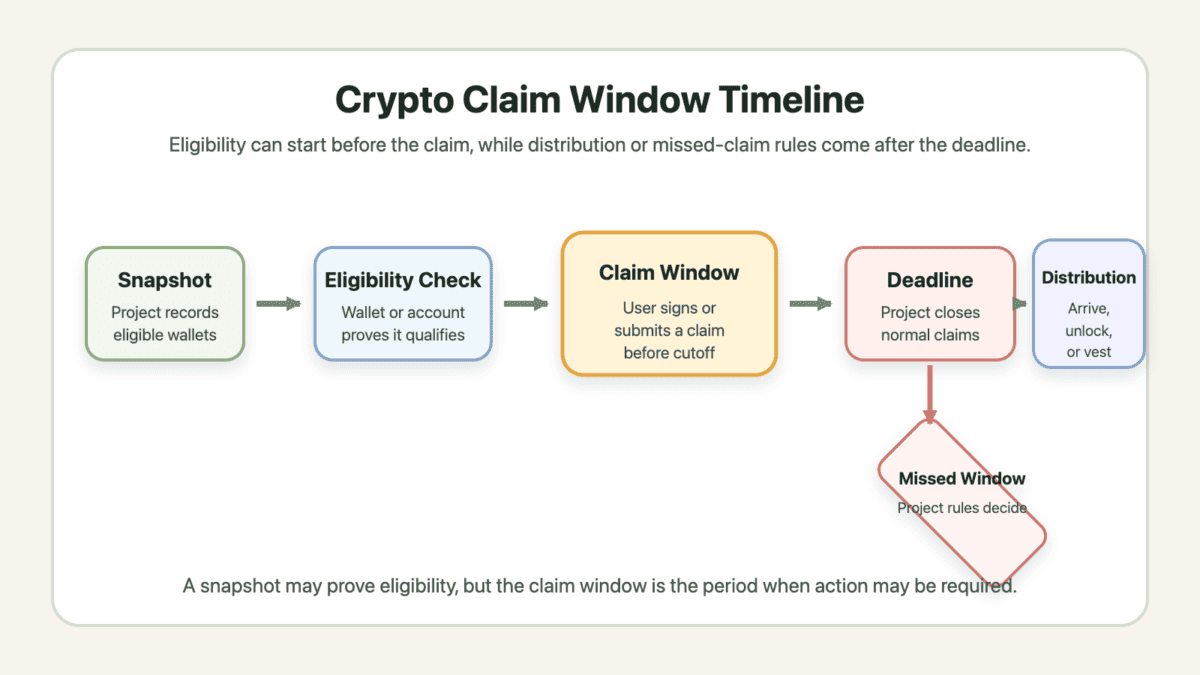
The order is not always neat. A project may open a claim window before tokens are transferable. It may distribute tokens first and unlock them later. Or it may run several phases for different wallet types, networks, partners, or custody routes.
So read the time labels carefully. The question is not only “Did I qualify?” It is “What action is required, when, and what happens after?”
A crypto claim window works by giving eligible users a defined route to receive, unlock, redeem, or register for tokens. The route can be direct through a project portal, inside a wallet app, through a partner, or through an exchange.
Most claim flows follow the same basic pattern, even when the interface looks different:
The wallet step deserves a pause. These actions can look similar in a pop-up, but they carry different risk:
A legitimate claim may need a transaction because the contract records the claim on-chain. It may also need gas because the network charges for execution. Other distributions skip the claim window entirely because tokens are sent automatically.
Start with the wallet prompt. If it grants broad spending access, asks for a token approval you do not understand, switches to an odd chain, or sends assets instead of claiming them, stop. Free tokens have a talent for becoming expensive when the signature is wrong.
Staged claim windows split the claim process across several phases. One phase may prove eligibility, another may assign tokens, and a later phase may unlock, vest, redeem, or recover part of an allocation.
This is common when a project has several user groups. Direct wallet claimants, exchange users, partner app users, and late recovery users may see different labels and deadlines.
The labels usually point to different jobs:
A staged setup can be normal. It can also be annoying. Users may need to return monthly, claim installments, wait through an unlock, or use a later recovery phase if they missed the first window.
One successful claim may not finish the distribution. Save dates, receipts, and official links. Then check whether the project calls the next step an unlock, redemption, recovery, vesting, or another claim period.
Verify a claim window before connecting a wallet by proving the link, chain, wallet action, and deadline from official sources. Do that before the page gets anywhere near your signature.
Start outside the claim portal. Use the project’s main domain, verified social profiles, official support pages, wallet-native notices, or contract addresses published through official channels. Claim links spreading on CT can be useful alerts, but they are not proof.
Use this checklist before you connect:
Wallet compatibility is not a small detail. A claim may support MetaMask but not every EVM wallet, Phantom but only one Solana account type, or a hardware wallet only through a specific connector. If compatibility is the issue, solve the wallet problem before you touch the claim portal.
Random wallet assets deserve extra caution. Fake airdrops often arrive as spam tokens, unwanted NFTs, or dust tokens that point you toward a claim site. The asset sitting in the wallet is usually less dangerous than the approval, signature, bridge, or fake support flow it tries to trigger.
> Hardware wallets help only when you read the device screen. If it shows an address, contract, approval, or action you did not expect, reject it.
If you miss a claim window, the outcome depends on the project’s published rules. Tokens may be gone, delayed, reduced, burned, returned to a treasury, redistributed, or moved into a later recovery phase.
There is no universal blockchain rule that reopens missed airdrops. The contract, project policy, custody route, and partner terms decide the result.
Missed Claim Window Outcomes:
| Outcome | What It Means |
|---|---|
| No Recovery | The claim closes and the user loses the allocation |
| Grace Period | The project keeps claims open briefly after the main deadline |
| Support Appeal | The user can ask support to review a narrow issue, such as a failed claim |
| Later Recovery Phase | A later route opens, sometimes with a smaller allocation |
| Reduced Claim | Late claimants receive less than the original allocation |
| Treasury Return | Unclaimed tokens return to a project treasury or incentive pool |
| Burn | Unclaimed tokens are permanently removed from supply |
| Redistribution | Unclaimed tokens are reassigned to other users, rewards, or future programs |
| Partner Handling | An exchange, wallet app, or campaign partner applies its own process |
Current official examples show why the details matter. In April 2026, Sonic Labs reported that approximately 32.69 million S remained unclaimed across airdrop allocations and could be burned if still unclaimed after the final cutoff. In August 2025, Midnight Network described a 60-day Glacier Drop claim period followed by later phases, including a long Lost-and-Found route for eligible users who missed the first phase.
Those are examples, not templates. One project’s burn does not mean every missed claim burns tokens, and one project’s recovery period does not mean your missed airdrop claim has a second chance. Start with official project pages, then check the exact wallet, account, partner, or exchange route you used.
Claim window risks fall into two buckets: wallet safety and market behavior. The first can drain funds. The second can turn a token receipt into a bad trade.
The wallet risks are direct. A fake claim portal can ask for a malicious approval, push the wrong network, imitate a trusted app, or route users into a wallet drainer. A malicious claim can behave like a hard rug at wallet level because the loss can be immediate.
The market risks are quieter:
Post-claim selling is where traders often get trapped. A fresh token can look liquid for five minutes, then meet a wall of claimants who want cash more than governance rights. Late buyers can become exit liquidity for early claimants.
No claim window predicts a dump by itself. It changes supply, attention, and liquidity at the same time. If you buy after the claim rush, understand who received tokens, whether they are unlocked, and whether the market can absorb sellers.
> The worst setup is emotional urgency. A countdown timer, a social-feed stampede, and a thin pool can turn a careful user into a bagholder with impressive speed.
Self-custody and exchange custody change who controls the claim. With self-custody, you usually control the wallet address and can prove ownership. With an exchange, the platform controls the address and decides whether to support the drop.
That difference becomes painful around snapshots. If eligibility was tied to an address held by an exchange, you may not be able to sign for that address yourself. The exchange may claim and credit users, ignore the airdrop, support only some regions, or apply its own schedule.
Self-custody and exchange routes compare like this:
| Custody Route | Claim Window Impact |
|---|---|
| Self-Custody Wallet | You can usually connect, sign, and claim if the wallet is eligible and supported |
| Hardware Wallet | You can add a device-level review step, but compatibility still matters |
| Exchange Account | The exchange controls the address and may decide whether users receive anything |
| Partner Wallet App | The app may support only certain chains, accounts, or claim phases |
| Custody Provider | Institutional rules, approvals, and support timing may control the claim |
No exchange is universally safe or unsafe for every claim window. The answer changes by project, jurisdiction, listing policy, snapshot method, and platform support.
So check custody before the deadline. If you held assets on an exchange during the snapshot, look for official support statements from that platform and the project. If no support is disclosed, do not assume the tokens will appear because the blockchain “owes” them to you.
A short claim window can be a red flag without proving a scam. Projects use short deadlines for logistics, contract cleanup, treasury planning, anti-bot controls, staged launches, and support workload.
But short windows can also punish passive holders. They reward people who monitor announcements constantly and frustrate users who qualified honestly but missed a narrow airdrop claim period.
Watch for these warning signs:
Poor deadline handling can become a soft rug pattern when users are not drained at once but lose confidence through vague rules, shifting promises, and avoidable confusion.
Short deadlines also feed the attention economy. A countdown can turn a normal claim into a social scramble. That is useful for visibility, but bad for judgment. Look for clear notice, official links, consistent rules, enough wallet support, and a reasonable way to handle real claim failures.
Related claim terms are useful because projects rarely use one clean timeline. They stack snapshots, claim portals, unlocks, vesting schedules, recovery phases, and exchange rules until the calendar looks like it was assembled during a power outage.
Use these related CryptoProcent pages when the claim window creates a more specific problem:
Safety concepts matter just as much. Wallet drainers, suspicious approvals, spam tokens, and rushed social posts often appear around real deadlines because urgency makes users sloppy.
For timing questions, use the comparison table above. Snapshot, eligibility rules, claim contracts, unlocks, vesting, recovery, and redemption are useful only when they answer the problem in front of you: whether you qualified, whether the portal is real, whether the wallet action is safe, and whether missing the deadline changes your allocation.
No. An airdrop is the token distribution, while the claim window is the period when eligible users may need to claim it.
Some airdrops are sent automatically. Others require a wallet action during a claim window.
No. A snapshot records eligibility at a point in time, while a claim window is when eligible users can act.
You may qualify at the snapshot and still miss the claim deadline later.
Sometimes, but only if the project allows it. A closed crypto claim window may lead to no recovery, a support appeal, a later recovery phase, or a reduced allocation.
Use official project pages for this answer. Fake “late claim” portals are common because they target users who already feel rushed.
Many claim windows require a wallet connection, but not all do. Some claims need a read-only eligibility check, some need a message signature, and some need an on-chain transaction.
Review the prompt before signing. A real claim should never ask for your seed phrase or secret recovery phrase.
Yes, a fake claim window can drain a wallet if you sign a malicious approval, submit a dangerous transaction, or follow a fake support flow.
The safer habit is boring: verify the URL, check the chain, read the wallet prompt, and reject anything that asks for a secret phrase.
A claim window can affect token price, but it does not predict it. Claim timing can change circulating supply, selling pressure, liquidity, gas demand, and short-term attention.
The market effect depends on allocation size, unlock rules, liquidity depth, holder behavior, and whether buyers already priced in the claim event.
Start before the countdown becomes your only source of wisdom. A claim window is mostly admin work, but admin work with a wallet attached deserves respect.
Use these steps:
Then decide whether to act. Claiming is not mandatory just because a token is free, and skipping is not always a mistake. The right answer depends on token value, wallet risk, gas cost, custody route, and how much trust the project has earned. If the claim is tiny, skip it rather than turn a small reward into a wallet-risk exercise.
Separate the deadline from the trade. You can claim a token without buying more, chasing the first candle, or rushing into a pool you have not checked. If any part feels unclear, slow down. A missed claim can sting, but a bad signature can sting harder and faster.