Physical Address
304 North Cardinal St.
Dorchester Center, MA 02124
Physical Address
304 North Cardinal St.
Dorchester Center, MA 02124


What clip farming means in crypto, and when viral clips become a risk.
Clip farming is the deliberate creation or mass distribution of short, shareable clips to harvest attention in crypto markets.
In crypto, clip farming can mean paid clipping campaigns, viral token promotion, streamer-style attention bait, or onchain platforms that attach tokens to clips. The hard part is not deciding whether a clip is funny. It is deciding whether the attention points to real demand, or only to a loud funnel with a wallet button at the end.
Clip farming in crypto means using short, repeatable clips to multiply attention around a creator, project, token, or trade. The clip farming meaning changes by context, but the thing being farmed is usually reach.
The phrase came from broader internet and streamer slang. Wiktionary records “clip farm” as internet slang for acting or creating situations to gain online attention, often in a repeated or inauthentic way. In streamer culture, it can be a roast. The issue is not just the performance. It is the performance built for the clip.
Crypto adds sharper edges. A founder clip from an X Space can become twenty TikToks. A project can pay clippers to turn one podcast into a week of Shorts, Reels, and CT posts.
That does not make every clip dishonest. Normal clipping can explain a product, summarize a talk, or spread a useful idea.
In crypto, the phrase usually points to one of three situations:
The crypto-specific trap is the word “farming.” It can sound like crypto farm language, where users earn rewards through activity. But clip farming is not automatically yield, staking, or airdrop work. Most of the time, it is attention labor with marketing incentives attached.
Clip farming gets confusing because several nearby terms use the same words. A clip farm, a crypto clipping campaign, and farming in crypto can describe very different incentives.
Use the table to separate the meanings before campaign mechanics enter the picture.
| Term | What It Means In Practice |
|---|---|
| Streamer Slang | A creator acts in a way that seems designed to generate viral clips. |
| Normal Clipping | Someone edits useful moments from a longer video, stream, podcast, or Space. |
| Clip Farms | A service or group produces many short clips for creators, brands, or campaigns. |
| Paid Clip Campaigns | Clippers are paid by output, views, performance, or bounty rules. |
| Crypto Clipping | A Web3 campaign turns founder content, AMAs, or token narratives into short-form posts. |
| Tokenized Clip Platforms | A platform attaches tokens, fees, or trading to clips or creator attention. |
| Yield Farming | Users move assets through DeFi protocols to earn rewards, fees, or token incentives. |
| Airdrop Farming | Users perform actions to improve odds of qualifying for future token rewards. |
That split blocks one bad shortcut. Yield farming starts with capital and protocol risk. Clip farming starts with attention and distribution risk.
Crypto clipping is the cleaner marketing term. It usually describes projects paying clippers to cut long-form material into short posts. A clip farm is the production machine. Clip farming is the broader slang and tactic, especially when the campaign feels forced.
Tokenized clip platforms are a separate layer again. They try to make clips tradable, fee-bearing, or speculative. That can turn attention into a market, which is exactly when traders need to slow down and ask who profits from the next click.
Clip farming works in a crypto campaign by turning one source moment into many short posts, then pushing those posts through social feeds where crypto traders already hunt for narratives. The campaign may look organic from the outside, but the workflow is often coordinated.
Lunar Strategy described crypto clipping as a current Web3 marketing tactic built around short-form distribution, CT reach, and campaign monetization. For traders, the takeaway is narrower: projects use clips for distribution, but distribution does not equal demand.
The source is usually long-form material with one sharp moment. It might be a founder explaining a launch, a trader making a bold call, a podcast guest naming a sector, or an X Space where someone says the quiet part loudly.
Good source material is clear out of context. If a clip needs twenty minutes of background, the edit often leans on captions, reaction shots, or a spicy hook to force the point.
Clippers cut the source into short posts and may get paid per clip, per view, per milestone, or through campaign bounties. Some work for agencies. Some are fans.
The incentive shapes the output. A pay-per-view model rewards volume and hooks. A bounty model rewards speed. A quality model rewards clips that send users to a product, community, or claim page. Guess which model gets abused first.
Campaign terms should be clear before anyone treats clip farming as income. The payment currency, payout timing, accepted platforms, disclosure rules, and proof requirements can all change the real economics.
Clips usually move through TikTok, YouTube Shorts, Instagram Reels, X, and sometimes Telegram or Discord. One long Space becomes five quotes. One founder interview becomes a week of snippets.
That format suits crypto because narratives move fast. A token can be unknown at breakfast and everywhere by dinner.
CT is where crypto clipping becomes market-relevant. A clip posted on TikTok may get attention, but a repost by a trading account, founder, or KOL can aim that attention straight at a chart.
If you need the broader social layer, CryptoProcent’s guide to CT explains how crypto Twitter functions as a shared market feed. Clip farming plugs into that feed because it turns slow content into fast signals.
KOLs can overlap with clip farming, but they are not the same thing. A KOL is usually a named account with influence. A clip campaign can involve dozens of smaller accounts repeating the same line.
Crypto teams may measure clip farming by views, watch time, reposts, comments, follower growth, Discord joins, Telegram activity, wallet signups, token buys, or referral clicks. Some of those numbers are useful. Some are vanity metrics in nicer shoes.
The gap shows up fast:
That chain can break at any point. A clip can travel widely and still bring in no serious users. A loud campaign can also create weak buyers.
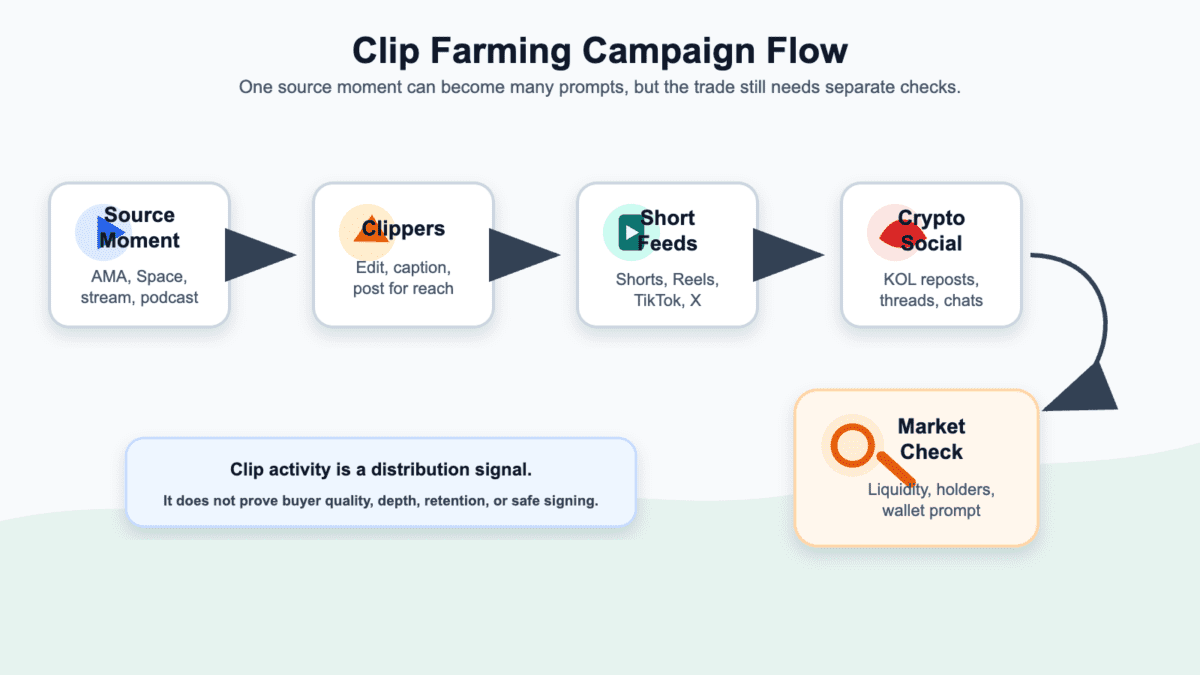
Clip farming can move a token because attention can become flow before it becomes conviction. A sudden wave of clips can make a coin feel active, scarce, funny, or inevitable, even when the market underneath is thin.
That effect is strongest in meme coins, creator tokens, and new launches. These markets often trade on narrative first. A short clip can become the symbol of the trade while the token contract sits in the background.
For trades, split clip signals from market signals.
| Signal | What It Can And Cannot Prove |
|---|---|
| Views | Shows reach, but not buyer quality or wallet activity. |
| Reposts | Shows spread, but not whether accounts are paid or coordinated. |
| Comments | Shows reaction, but comments can be shallow, botted, or copied. |
| New Followers | Shows audience growth, but not product use or token demand. |
| Wallet Activity | Shows onchain action, but not whether users stay. |
| Liquidity Depth | Shows how much size can enter or exit without heavy slippage. |
| Holder Spread | Shows ownership distribution, but not whether holders are committed. |
| Repeat Users | Shows stronger interest than one-off clip traffic. |
| Revenue Or Fees | Shows economic activity, if the numbers are real and relevant. |
| Exchange Or DEX Access | Shows where trades happen, not whether the trade is wise. |
Here, clip farming meets the broader attention economy. Crypto attention can turn into a bid, but attention alone does not prove that a product works or that buyers can exit.
It can also make a weak token look bigger than it is. A clip campaign can amplify narrative coins before the story has support.
That gap creates exit liquidity risk. Late buyers can arrive because every feed shows the same clip, while earlier holders use the new demand to leave. Nobody rings a bell. They just post another edit.
Thin markets can also become a PvP market where one trader’s attention edge becomes another trader’s loss. The clip is the spark, not the trade.
Clip farming risks come from incentives. Traders may chase a token because it looks everywhere. Investors may confuse paid attention with adoption. Clippers may accept vague work terms because the campaign sounds like easy money.
The tactic is not automatically dirty. The danger is cheap reach blurring into paid shilling, fake engagement, poor disclosure, weak liquidity, and payout disputes.
Paid clip farming becomes risky when users cannot tell whether a post is organic or sponsored. A clip can look like a random find while actually being part of a coordinated campaign.
That changes how you should read it. If a clip points toward a token, mint, app, claim, or pair, look for sponsorship labels, referral codes, campaign hashtags, or repeated captions.
Bot-like engagement can make weak clips look alive. Repeated comments, odd account histories, identical emojis, and low-quality replies can all inflate the feeling that “everyone is talking about it.”
One clip with strange engagement proves little. A pattern across many accounts says more. Slow down when comments sound copied.
The market risk appears when clip volume pulls buyers into a pool with shallow liquidity. A token can be easy to buy and hard to sell at a fair price.
This is where a promotion can overlap with hard rug risk if liquidity is removed or funds disappear. Even without that, poor exits can punish late buyers who thought reach meant safety.
Clippers face their own risk. A campaign may promise payouts in fiat, stablecoins, tokens, points, or future rewards. The work can be real while the payout terms are still mush.
Before taking a clip farming job, check who pays, when payment happens, what proof counts, and whether token rewards can actually be sold. “You get exposure” is not a payment plan.
Short clips can reuse creator content, podcast footage, Twitch streams, X Spaces, or brand assets. If the campaign lacks permission, clippers and projects can face takedowns, account strikes, or angry creators.
Consent also affects trust. A crypto project that clips people without permission may get reach, but it also weakens credibility.
Clip farming is not automatically a scam. It can be a normal content strategy, a paid marketing campaign, a creator growth tactic, or a crypto slang insult.
The scam risk appears when the campaign hides incentives, misrepresents demand, pushes users toward unsafe wallet actions, or uses fake job offers to extract work or funds.
Watch for these red flags before you click:
A bad clip campaign can also decay into a soft rug pattern. The launch gets attention, the team slows down, communication fades, and the token keeps trading on old hype.
That is different from an instant wallet drainer, but it can still hurt users. Separate the clip, campaign, and token. Each one needs its own check.
You spot paid clip farming by looking for patterns across clips, accounts, links, timing, and follow-through. One viral video can be real. A synchronized wall of similar edits deserves more skepticism.
Organic clips usually vary. Different accounts choose different hooks, captions, and angles. Paid or coordinated clips often converge on the same phrase, same founder soundbite, same referral link, or same token ticker.
Use this checklist when a token suddenly appears everywhere:
Do not try to prove intent from one post. Instead, look for enough weak signals to change your behavior.
The answer is not panic. Add friction. Open the official site separately. Check the contract from a trusted source. Compare social activity with liquidity, holder spread, and repeat usage. If the only evidence is a clip swarm, you have noise with better editing.
Before buying or connecting to anything promoted through clip farming, check the source, sponsor, contract, liquidity, wallet action, and incentive model. The clip should start your research, not replace it.
Use extra care when a clip pushes a tokenized attention platform, a creator token, a meme coin, or a claim-style app. ClipFi says its clip-token model routes 1% of every trade to the clipper who launched the clip. That fee claim is exactly the kind of platform detail users should verify before assuming anything is safe or liquid. It is an operator-reported example, not independent proof of safety, liquidity, or returns.
Run through these checks before your wallet touches the page:
Some clip-driven tokens look like lottery-ticket trades: tiny size, large upside story, and ugly odds if the exit disappears. That does not make every such trade forbidden. It does mean the trade size should match the risk, not the noise.
Team accountability is another check. An anon dev can still build useful software, but anonymity raises the amount of verification you need. A doxxed team does not guarantee safety either, but it gives users more context than a faceless clip storm.
Wallet setup deserves extra caution. If a platform asks for signing, claiming, trading, or social login, use CryptoProcent’s wallets resources to understand custody basics before experimenting.
Related clip farming terms help users avoid one common mistake: treating every “farm” phrase as the same crypto activity. The words overlap, but the incentives do not.
In clip farming, attention is the crop. In yield farming or airdrop farming, user actions, capital, or protocol activity usually create the potential reward. The difference changes the risk. Attention can vanish faster than liquidity, and liquidity can vanish faster than the clips do.
These related concepts help when a token starts moving because every feed keeps serving the same edit:
Repeated clips can also change how conviction forms. A trader may see them and feel like the market has confirmed the idea. That is not a conviction play by itself. Conviction needs a thesis, sizing discipline, exit plan, and evidence beyond feed volume.
Translate the phrase before reacting. Is this a creator being accused of attention bait? A project paying clippers? A token market built around clips? Or a normal short-form edit? The answer changes what you should check next.
No, clip farming is not the same as yield farming. Clip farming usually creates attention through short videos, while yield farming involves using crypto assets in DeFi protocols to seek rewards.
Yes, clip farming can make a crypto project more visible, especially if many clips spread across X, TikTok, Reels, and Shorts. But viral reach does not prove liquidity, product demand, holder quality, or long-term use.
Some clippers may be paid in crypto, tokens, points, fiat, or campaign bounties. Payment terms vary, so clippers should verify who pays, what proof is required, and whether any token reward can actually be sold.
No, clip farming should not be a buy signal by itself. Use clips as a prompt to investigate the contract, liquidity, holders, team, campaign disclosure, and wallet risks.
Check the official source, contract address, requested wallet action, permissions, fees, platform terms, and whether the connection is necessary. Use a low-balance interaction wallet if you still decide to test it.
Clip farming is usually not passive income. Clippers often need to find content, edit clips, post quickly, follow campaign rules, and prove performance before any payout is possible.
If a token is being clip farmed, start by slowing the trade down. The campaign wants speed. Your edge is refusing to let a short video make the whole decision.
Use this order:
Then decide whether the idea still survives without the edits. If it only works while every account posts the same clip, you are probably looking at a campaign, not a thesis.
Clip farming is useful to understand because it is not going away. Short clips are cheap, fast, and perfect for crypto’s attention cycle. Just do not confuse a good edit with a good market. One can make you laugh. The other has to let you exit.