Physical Address
304 North Cardinal St.
Dorchester Center, MA 02124
Physical Address
304 North Cardinal St.
Dorchester Center, MA 02124


Conviction trade meaning, risks, and crypto examples.
A conviction trade is a crypto position held with strong belief in a thesis, but belief alone does not make the trade safe.
The phrase usually appears when traders talk about Bitcoin, major alts, narrative coins, or meme coins they expect to outperform. The useful version has research, sizing, invalidation, liquidity checks, and an exit plan. The dangerous version has a loud chat, a bigger bag, and vibes in a lab coat.
A conviction trade in crypto means a high-confidence position based on a specific reason for owning or trading an asset. That reason might be long-term Bitcoin demand, Ethereum usage, Solana activity, a DeFi token’s revenue model, or a short-term catalyst around a narrative.
The key word is reason. A conviction trade should be explainable before the entry, not invented after the chart turns red. If the holder cannot name what would prove the idea wrong, the position is closer to faith than analysis.
At minimum, the position should name these parts:
Crypto makes the phrase slippery because users apply it to very different setups. A spot BTC allocation, an ETH swing trade, a Chainlink thesis, and a low-liquidity meme coin can all be called high conviction. They do not carry the same risk.
In crypto slang, a conviction play usually means a trade or investment held through volatility because the holder believes strongly in it. That fits the social use of the phrase, but it also hints at the problem. Strong belief may be earned research, or it may be cope with better lighting.
So the conviction trade meaning is not “this will work.” It is “I have a thesis strong enough to justify this position, and I know what would make me change my mind.”
A conviction trade overlaps with several crypto terms, but they are not the same thing. The difference is usually whether the term describes a reason, an entry method, a holding habit, or a risky position size.
That comparison helps because crypto language can make an emotional decision sound structured. A user can say “high conviction” while actually describing a late entry, an oversized bet, or a refusal to sell.
| Term | Practical Meaning |
|---|---|
| Conviction trade | A position based on a specific thesis, risk limit, and review plan. |
| Conviction play | A crypto slang cousin for a high-belief position held through volatility. |
| HODL | Holding through volatility, with or without fresh evidence. |
| DCA | Buying over time instead of choosing one entry. |
| Full port | Putting all or nearly all available capital into one idea. |
| Bagholding | Holding mainly because selling would hurt or feel embarrassing. |
A conviction play is the closest sibling. In casual crypto use, it often means “this is the asset I believe in.” A conviction trade should go one step further by spelling out the time horizon, invalidation point, and size limit.
HODL is different. A HODLer may keep holding because the long-term thesis still works, or because selling feels impossible after years of identity and price swings. The action looks the same from the outside. The reasoning is not.
DCA is also separate. Dollar-cost averaging can help build a conviction position, but it does not create conviction by itself. Buying every week into a weakening thesis is still averaging into a weakening thesis.
Full port is about concentration. A conviction trade can be small. A full port can be reckless. And a bagholder may still call the position a conviction trade long after the original reason has disappeared.
A crypto conviction trade becomes credible when the thesis can be checked against reality. The user should know why the asset should outperform, what event or trend supports that view, and what evidence would weaken it.
The research does not need to sound institutional. It needs to be specific. “Strong community” is not enough unless it connects to liquidity, retention, usage, development, fees, distribution, or demand.
Start with checks that force the thesis into plain language:
A Bitcoin thesis may involve scarcity, liquidity, custody, and long-term adoption. An ETH or SOL thesis may involve network activity, apps, fees, developer demand, staking, or settlement use. An alt thesis may depend on a catalyst, but the token still needs a reason to capture value.
Venue access also belongs in the check. A token that trades only in thin DEX pools can be harder to exit than a major asset on deep venues. Custody belongs in the same review. A long-term spot position needs safer key storage than a two-hour trade.
Write the thesis plainly. If it only works as a thread, chart screenshot, or influencer phrase, it is probably borrowed confidence.
Risk in a conviction trade should come from the account, the asset, and the exit plan. It should not come from how confident the user feels that morning.
High conviction can justify attention. It does not automatically justify more size, borrowed exposure, or a worse entry. Crypto punishes that mistake quickly because volatility and liquidity can change faster than confidence.
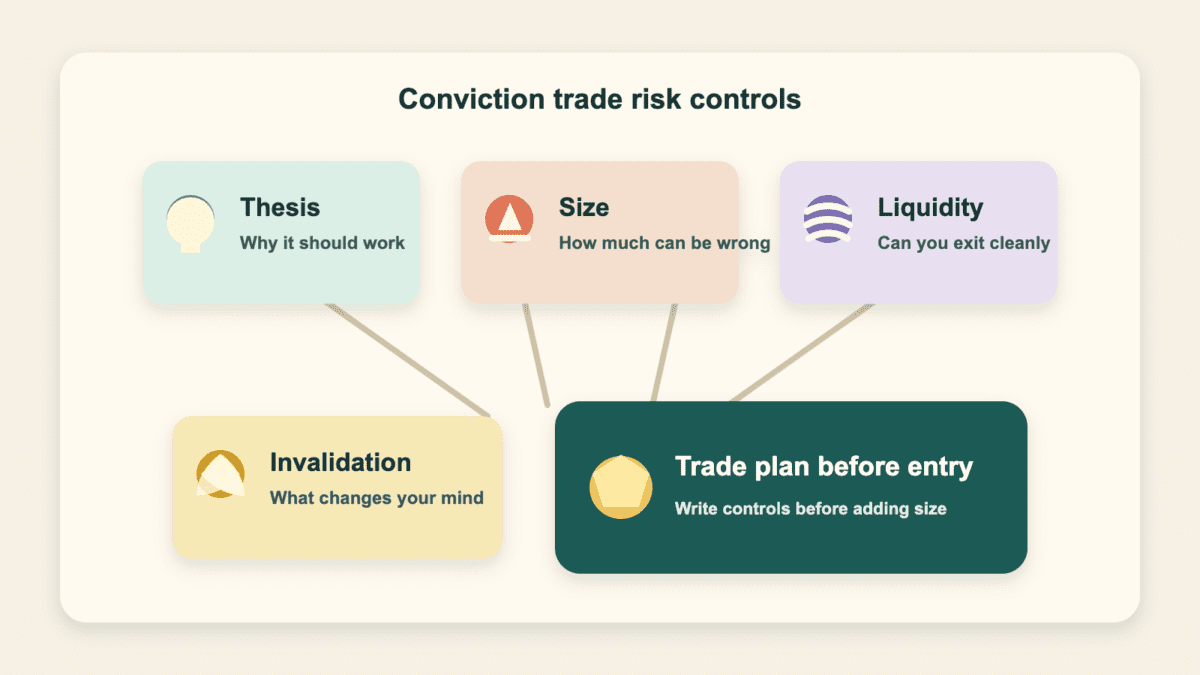
Set the risk before entry with checks like these:
Once the position is live, every candle starts negotiating with the plan. That is how a small thesis becomes a portfolio problem.
A full port is not just a bigger conviction trade. It is a concentration choice. A user can have strong conviction and still size the position modestly because the asset is volatile, illiquid, or early.
Margin and perps deserve their own warning. A trader can be right about the broader direction and still get liquidated first. Perps do not care that the thesis might look brilliant next month. They care where the liquidation price sits today.
Spot positions need discipline too. If a position grows from 5% to 40% of a portfolio after a pump, the risk has changed even if the thesis has not. Conviction should update when exposure changes.
A conviction trade becomes a bagholder trap when the holder keeps the label after the thesis breaks. The warning sign is not a red candle. It is the moment hope starts doing the work that evidence used to do.
This often happens after a strong story gets weaker in stages. Liquidity thins. Usage stalls. Scheduled token releases add sell pressure. The roadmap slips. The community grows louder but less specific. Then the holder averages down because selling feels like admitting defeat.
Watch for these broken-thesis signals before adding more:
Low liquidity makes the trap harsher. If a position needs later buyers so earlier holders can leave, the trader is dealing with exit liquidity, not just patience. The quoted wallet value may look fine until a real sale moves the market.
Social certainty can also become a top signal. When everyone suddenly has unshakable conviction after a large move, the risk is not only price. It is crowded positioning, victory laps, and late buyers confusing confidence with proof.
A valid thesis can fail. That is normal. The costly mistake is refusing to update because the old story once made sense.
Conviction trades look different across Bitcoin, large altcoins, and meme coins. The word may stay the same, but the evidence and risk checks change by asset type.
Bitcoin conviction is usually a long-horizon thesis. Users may focus on supply, liquidity, institutional access, censorship resistance, and self-custody. But even BTC conviction still needs rebalancing, tax awareness, secure storage, and a plan for deep drawdowns.
Large-cap altcoin conviction usually depends on activity and value capture. For ETH, SOL, or similar assets, the user should ask whether the network has real demand, useful apps, sustainable fees, developer activity, and a token role that benefits from that demand.
Narrative alts need extra care. A narrative coin can run because a market story gets hot, but a hot category is not a complete thesis. AI, gaming, DePIN, RWA, or restaking labels still need token-specific proof.
Meme-coin conviction is the most fragile version. A meme coin can have a thesis around culture, distribution, attention, and liquidity windows. But attention can leave quickly, insiders may already be positioned, and exits can depend on new buyers arriving late.
That fragility shows up in recent narrative data too: CoinGecko reported average meme-coin narrative returns of -31.6% in its 2025 profitability study, a useful reminder that attention can be loud while returns are ugly.
Ten alts can still be one risk-on bet. If they all need BTC strength, the same exchange access, the same retail flow, and the same narrative cycle, the portfolio may be less diversified than it looks.
Ask this instead: “What evidence does this asset type require before the risk deserves capital?”
A conviction trade checklist turns belief into a written process. It will not make the trade right, but it can expose weak spots before money and identity get involved.
Use it before entry and again after major news, large price moves, vesting releases, exchange changes, security events, or narrative shifts. A conviction trade that never gets reviewed is just a bag with a slogan.
The value is not prediction. It is forcing the next decision to be visible before the market starts shouting. If the plan has no invalidation point, no size cap, or no exit rule, the user is not holding a high conviction trade. They are holding a feeling.
| Check | What To Write Down |
|---|---|
| Thesis | Why this asset should outperform or remain worth holding. |
| Time horizon | Whether the trade is days, months, or years. |
| Invalidation | The fact, price area, or event that changes the plan. |
| Position size | The maximum exposure before the trade becomes too emotional. |
| Liquidity | Whether the position can exit without heavy slippage. |
| Supply pressure | Vesting releases, emissions, insider wallets, or future selling risk. |
| Exit plan | Where to trim, stop adding, or leave completely. |
| Review trigger | News, data, or market changes that force a reassessment. |
The checklist should be boring. That is the point. Boring rules are easier to follow when the market is loud.
Blank rows are warnings, not paperwork. A missing liquidity answer may mean the position is too large for the venue. A vague exit plan may mean the user wants upside without naming the moment the trade stops making sense.
If the trade passes, size it so being wrong is survivable. If it fails, the next action may be waiting, reducing size, doing more research, or skipping the setup. Not taking a trade is still a position.
No. A conviction trade can be a small or medium position if the risk is high. Going all in is a concentration choice, and it can be dangerous even when the thesis sounds strong.
No. A high conviction trade means the user has strong belief in the setup. It does not mean the asset is safer, more liquid, less volatile, or more likely to recover after a bad entry.
Yes, but it is usually the riskiest version of a conviction trade. Meme coins can depend on attention, community momentum, insider positioning, and thin liquidity, so the thesis needs strict sizing and exit rules.
Not automatically. Review why it dropped, whether the thesis changed, whether liquidity weakened, whether the position is too large, and whether your original invalidation point has been hit.
Build conviction before entering a crypto trade by writing the thesis, checking liquidity, understanding supply pressure, comparing competitors, using the product when possible, and naming what would prove the idea wrong.
Yes. HODL means holding through volatility. A conviction trade should include a researched thesis, a position size, an invalidation point, and a review plan.
Start with a small written plan before money enters the trade. If the idea cannot survive one plain paragraph, it probably should not survive a real position.
Do not begin with size. Begin with the reason. A conviction trade should answer why this asset, why now, what could go wrong, and what would make the user step back instead of adding more.
Then check the boring parts that usually decide the outcome. Liquidity, supply pressure, custody, tax timing, and correlated exposure do not sound exciting in a group chat. They decide how much room the trade has when the plan gets tested.
Use these actions before entry:
After entry, review the plan when the facts change, not only when the price hurts. A pump can also change the trade if the position grows too large for the portfolio.
If the answer is “I will know later,” the setup is not ready. Put it on a watchlist, wait for a cleaner entry, or reduce the intended size until the risk can be described without drama.
Conviction improves when the user can stay calm enough to update the plan. If the position is too large to think clearly, the trade has already started managing the trader.
Keep the plan close enough to use. A conviction trade should help you act with discipline, not give stubbornness a nicer outfit.