Physical Address
304 North Cardinal St.
Dorchester Center, MA 02124
Physical Address
304 North Cardinal St.
Dorchester Center, MA 02124


A plain guide to danksharding, Ethereum blobs, L2 fees, and rollup risk.
Danksharding is Ethereum’s full data-scaling plan for rollups. It uses cheap blob data so Layer 2 networks can post transaction data more efficiently without making every Ethereum node keep every byte forever.
Proto-danksharding is already live through EIP-4844. Full danksharding is the larger target. So the useful split is simple: what has shipped, what still sits on the roadmap, and which fees or risks users should expect to change.
Danksharding in Ethereum is a data-scaling design for rollups. It gives rollups more room to publish transaction data to Ethereum without forcing that data into permanent calldata.
Instead of splitting Ethereum into old-style execution shards, danksharding makes Ethereum a better settlement and data availability layer for rollups that execute transactions elsewhere.
The name also needs a quick cleanup:
On Crypto Twitter, danksharding often gets flattened into “blobs make Ethereum cheap.” That version is close enough to be dangerous.
The accurate version is narrower. Danksharding is about cheap, verifiable data space for rollups. Users may feel that through lower Layer 2 fees, but Ethereum mainnet transactions still pay normal execution gas. Proto-danksharding is the live first step, and full danksharding is the broader target with more data capacity and protocol work still involved.
Danksharding and proto-danksharding are related, but they are not the same stage. Proto-danksharding is the shipped EIP-4844 blob upgrade. Full danksharding is the larger Ethereum roadmap goal for scaling rollup data availability further.
Proto-danksharding, also known as EIP-4844, lets rollups add cheaper data to blocks through blobs. It went live on Ethereum mainnet with the Dencun upgrade in March 2024, as outlined in the Ethereum.org roadmap.
Keep the stages separate:
| Term | What It Means |
|---|---|
| Proto-danksharding | The live EIP-4844 step that introduced blob-carrying transactions for rollups. |
| Full danksharding | The later roadmap design for much larger rollup data capacity and data availability sampling. |
| Dencun | The Ethereum upgrade that activated EIP-4844 on mainnet in March 2024. |
| Blob | Temporary data attached to Ethereum blocks so rollups can publish transaction data more cheaply. |
| Calldata | The older execution-layer data path that is more permanent and usually less suited for rollup bulk data. |
This split keeps upgrade language from aging badly. A page written before Dencun may call blobs “upcoming.” A trader thread may call full danksharding “live.” Both can confuse the fee story.
Use this quick test when you hear the term:
Keep the split simple. Ethereum already has the first blob lane. The full danksharding version needs more scaling work before users can call it finished infrastructure.
Danksharding uses blobs because rollups need transaction data to be available long enough for verification. They do not need every byte stored forever by every Ethereum node.
A rollup executes transactions on Layer 2, then posts data and commitments back to Ethereum. That lets other parties reconstruct, verify, or challenge the rollup’s state changes.
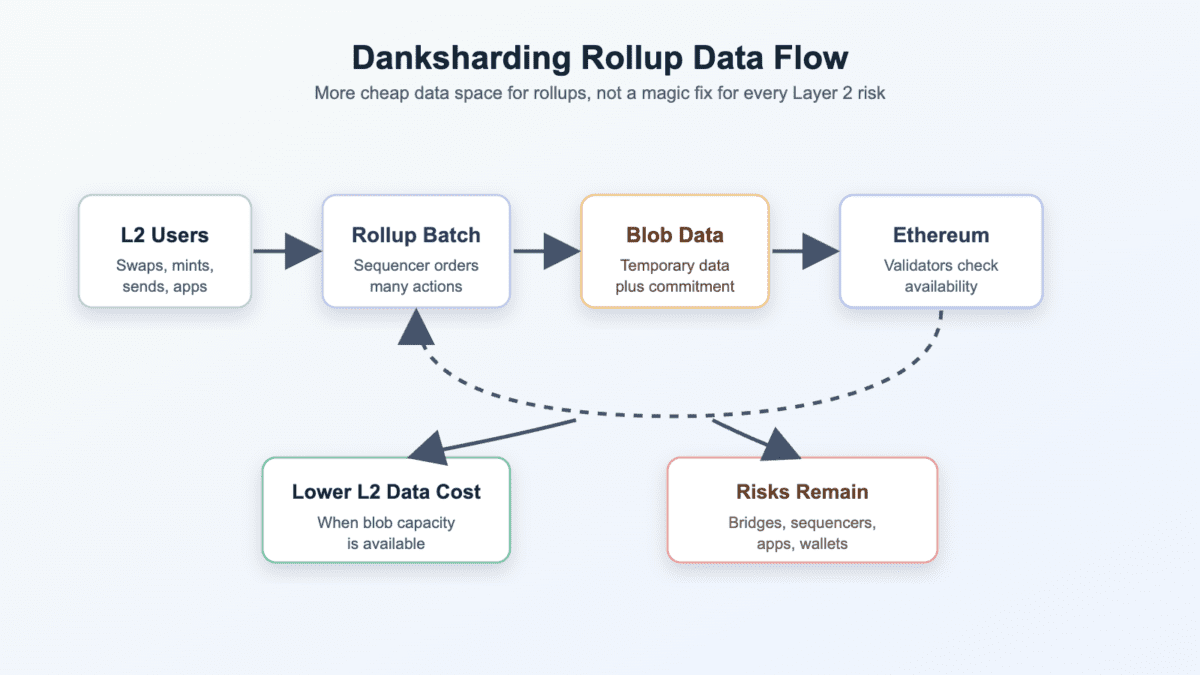
The EIP-4844 specification defines blob-carrying transactions as data that cannot be accessed by EVM execution, while commitments to that data can be accessed. In plain English, Ethereum can verify the data path without treating blob contents like normal smart-contract input.
That separation gives rollups a cheaper lane. It also keeps Ethereum nodes from carrying rollup data forever when a shorter verification window is enough.
Blob data can be temporary because rollups mainly need availability during the window when fraud proofs, validity checks, reconstruction, or other verification work can happen.
The blob pruning window is 4096 epochs, or about 18 days at the time of writing. After that, Ethereum nodes can prune the blob data, while rollups, indexers, or archive services may keep copies elsewhere.
The useful sequence looks like this:
That does not make the data private. Temporary public data can still be copied, indexed, archived, and analyzed.
The EVM cannot read blob contents directly because blobs are built for data availability, not contract execution. Smart contracts can access commitments or versioned hashes, but not open the blob like normal calldata.
This is easy to miss. A blob is not a cheaper storage drawer for any app. It is a rollup data object tied to Ethereum consensus and verification.
That design keeps blob use focused:
Danksharding gives Ethereum more specialized data space aimed at the exact bottleneck rollups face.
Danksharding changes Layer 2 fees by reducing the data-posting cost that rollups pay to Ethereum. When blob capacity is available, rollups can pass some of that savings to users.
That is the good news. The catch is that a wallet quote includes more than blob cost. It can include L2 execution, bridge routing, sequencer policy, app fees, congestion, and sponsored-gas choices.
Use this split before blaming the wrong layer:
| Fee Or Cost | What Danksharding Changes |
|---|---|
| L1 execution gas | Not directly changed. Mainnet swaps still pay normal execution gas. |
| L2 execution fee | May fall if the rollup’s total cost base falls, but each rollup sets policy. |
| L1 data posting fee | The main target. Blobs give rollups a cheaper data lane than calldata. |
| Blob fee | Priced separately and can rise when rollups compete for blob capacity. |
| Bridge fee | Not solved by danksharding. Bridge design and route costs still matter. |
| Withdrawal cost | Still depends on the rollup design, proof system, and exit path. |
| App-sponsored gas | Can hide costs from users, but someone still pays the bill. |
After EIP-4844, many users started noticing cheaper activity on rollups before they learned the word danksharding. That is normal. Protocol plumbing rarely gets a front-row wallet label.
But blob capacity can fill. If rollups compete for the same data lane, blob fees can rise, and L2 quotes can stop looking so gentle.
A useful fee check has a few parts:
Danksharding makes one important part cheaper. It does not make the whole fee stack disappear.
Danksharding does not make every Ethereum action cheap. It mainly improves rollup data economics, while Ethereum mainnet execution, bridges, wallets, and apps keep their own risks.
That distinction keeps sloppy claims from getting expensive. A mainnet swap can still cost real money. A rollup bridge can still be slow. An app can still have a bad contract.
Run these checks before lower L2 fees start looking like a full safety signal:
Wallet safety is the boring part, which is why it costs people money. Cheaper data does not protect wallets from bad approvals, fake sites, or rushed signatures. Taxes and records also stay outside danksharding, so a low-fee L2 trade can still create taxable activity, accounting friction, or a messy cost basis trail.
So the user-facing promise should stay modest. Danksharding can improve the data layer for rollups. It cannot clean up every layer above it.
Danksharding risk starts with the blob system, but it does not end there. Rollups still depend on bridges, sequencers, upgrade controls, apps, and liquidity.
Start with sequencers. Many rollups still rely on a small set of operators to order transactions. That can affect uptime, censorship resistance, fee policy, and user experience.
Use this checklist before you move serious funds:
Three risks deserve separate attention:
Cheaper data is useful. It does not audit a bridge, decentralize a sequencer, or make a rushed wallet signature wise.
Danksharding affects ETH holders and traders by changing Ethereum’s rollup economics. Cheaper rollup data can support more Layer 2 activity, more apps, and stronger demand for Ethereum as a settlement and data availability layer.
Then comes the caveat. ETH price impact depends on usage, fee capture, issuance, staking, liquidity, competition, and market cycle. One upgrade does not boss the whole chart around.
Use this investor split:
| Signal | What It Does Not Prove |
|---|---|
| Lower L2 fees | That ETH must rise immediately. |
| Higher blob demand | That every rollup token is fairly priced. |
| More rollup activity | That users are safe from bridges or app risk. |
| Ethereum roadmap progress | That rival chains stop competing. |
| Upgrade excitement | That the trade is early. |
After that split, watch the narrative traps:
Watch for the top signal version of danksharding hype. If every post treats a technical roadmap step as guaranteed price action, the trade may be more crowded than the explanation.
For ETH holders, the balanced read is simple. Danksharding can make Ethereum more useful for rollups, but usefulness still has to turn into sustained demand, fees, and user activity.
Full danksharding does not have a simple date you can trade around. Proto-danksharding is live, while full danksharding remains a later roadmap stage with more data availability and validator-workload changes ahead.
The current roadmap language should stay conservative. Ethereum upgrades can ship in steps, change scope, or move across forks as client teams test what is safe.
A useful ladder looks like this:
The Ethereum Foundation summarized Pectra as having doubled blob throughput, while Fusaka, PeerDAS, and later blob scaling work keep the roadmap moving. That is a stronger anchor than a random upgrade countdown graphic. The trade risk is timing: a roadmap step can be real and still arrive later than a market narrative wants.
So avoid claims that full danksharding is already complete. The cleaner statement is that Ethereum has shipped proto-danksharding, has continued expanding blob capacity, and is still working toward fuller data availability sampling. That may sound less exciting, but it is also how roadmaps avoid becoming confetti cannons with GitHub links.
Danksharding gets easier once the surrounding terms stop blending together. You do not need a protocol dictionary. You need to know which word explains which part of the fee and risk stack.
If you need a broader map of market language, CryptoProcent’s guides can help. For this topic, keep these Ethereum terms straight first.
Use these quick definitions:
The pattern to keep is that danksharding improves the data availability path. It does not replace rollups, sequencers, bridges, or wallets.
If a sentence uses all these terms at once, slow it down. Most user mistakes happen when one technical improvement is mistaken for a whole-stack guarantee.
Start with the fee quote in front of you. Danksharding is useful only if you know whether your action is on Ethereum L1, on a rollup, through a bridge, or inside an app with its own pricing.
Then separate protocol progress from market pressure. A roadmap thesis can be valid without becoming a conviction play at any price.
Use this practical checklist:
If you hold ETH, watch whether cheaper rollup data leads to steady usage, not only loud upgrade threads. If you use L2s, watch the final wallet quote and the exit path, because those are the parts that hit your account.
For users, the first win is understanding the bill. For traders, the first win is avoiding a trade that relies on a misunderstood bill. Danksharding is real Ethereum scaling work, but keep the promise in its lane: cheaper rollup data, more room for L2s, and no free pass on risk.
Proto-danksharding is live on Ethereum through EIP-4844, which shipped with Dencun in March 2024. Full danksharding is not the same thing. It is the larger roadmap target for much greater rollup data capacity and data availability sampling.
So if someone says “danksharding is live,” ask which part they mean. Blobs are live. The full roadmap version is still broader than that.
Danksharding does not directly lower ordinary Ethereum mainnet gas fees. It mainly lowers the data-posting costs that rollups pay when they publish transaction data to Ethereum.
That can make Layer 2 transactions cheaper when blob capacity is available. But a mainnet swap, mint, or contract call still pays normal L1 execution gas.
Proto-danksharding is the live first step that introduced blobs through EIP-4844. Danksharding is the broader Ethereum scaling design that aims to expand rollup data availability much further.
Think of proto-danksharding as the first usable data lane. Full danksharding is the expanded road system Ethereum still works toward.
Danksharding uses blobs because rollups need temporary data availability, not permanent calldata storage for every byte. Blobs give rollups a cheaper place to publish transaction data while keeping commitments on Ethereum.
Normal calldata is processed through the execution layer and kept more permanently. That makes it less efficient for bulk rollup data.
Danksharding can support the bullish ETH case if cheaper rollup data brings more useful activity to Ethereum. It can also change fee-burn expectations, rollup economics, and competitive narratives.
That does not make it a guaranteed price catalyst. ETH price still depends on demand, liquidity, issuance, staking, market cycle, and competition.
Danksharding can improve the data availability side of rollups, but it does not make every rollup safe. Sequencer design, bridge contracts, upgrade keys, liquidity, app security, and withdrawal rules still matter.
Cheaper data is one improvement. It is not a security audit, bridge guarantee, or wallet safety net.