Physical Address
304 North Cardinal St.
Dorchester Center, MA 02124
Physical Address
304 North Cardinal St.
Dorchester Center, MA 02124


A plain-English guide to DeFAI, from AI agents to wallet risk.
DeFAI means using AI inside DeFi to help analyze, plan, and sometimes execute on-chain financial actions.
In practice, that can mean route comparison, wallet monitoring, yield research, transaction preparation, risk alerts, or limited automation. It can also mean a project using the DEFAI label for a token, which is where the acronym starts wearing too many hats.
DeFAI in crypto means DeFi plus AI. The expanded phrase is decentralized finance artificial intelligence, but most users mean AI used inside DeFi workflows.
In crypto trading and DeFi conversations, DeFAI is a category label. It is not one protocol, one standard, or proof that a product is safe. A DeFAI app might only summarize positions, or it might prepare a swap, monitor liquidation risk, compare yield, or request wallet permissions.
Many users meet the term first in social feeds, where a clean acronym can outrun the actual product. CT and market-theme language can shape how people hear DeFAI before they understand the controls.
Keep three distinctions clear:
DEFAI ticker or brand is one project, not the whole category.That split helps token buyers avoid category shortcuts. A project can borrow a hot label without proving useful automation, audited controls, or real users. The acronym is the start of the question, not the answer.
DeFAI works by turning a user goal into data checks, a plan, a transaction preview, an approval step, and sometimes limited execution. The safe version adds friction before money moves.
Imagine asking a DeFAI tool to find a stablecoin yield option under a risk limit. The system needs wallet balances, supported chains, pool liquidity, withdrawal rules, contract risk, gas fees, and the user’s own limits before it prepares anything responsible.
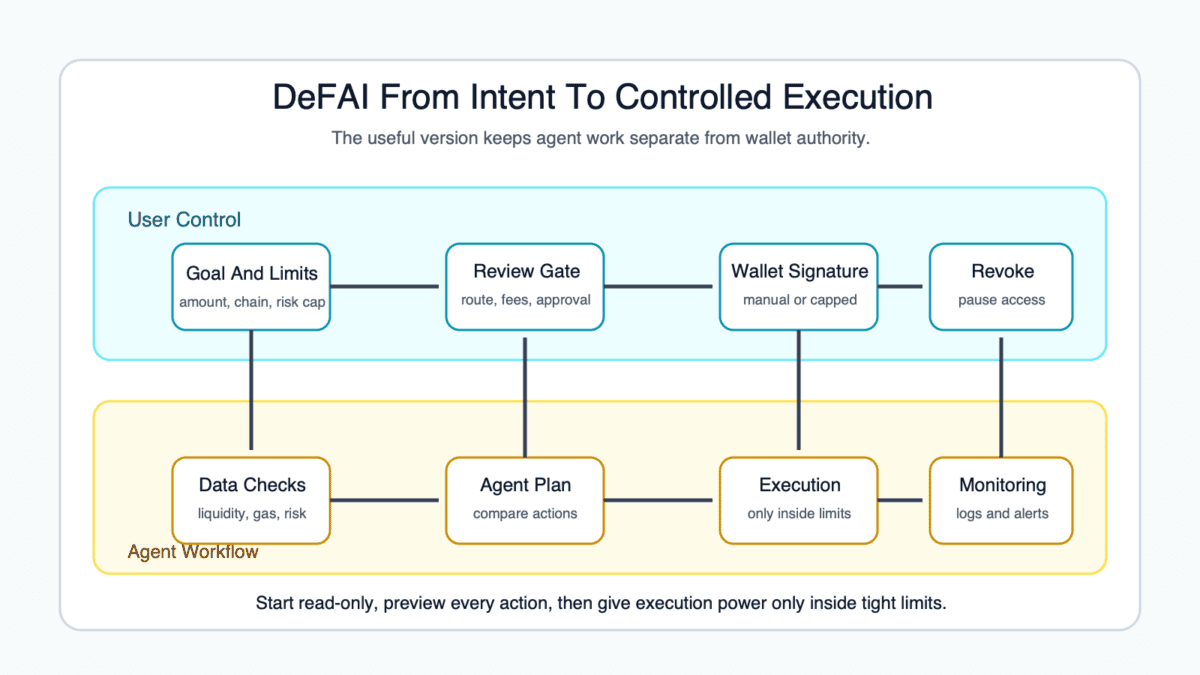
DeFAI starts with data because an agent cannot plan safely from vibes. It may read token prices, liquidity depth, gas fees, wallet balances, open positions, protocol status, oracle feeds, and prior approvals.
Bad data creates clean-looking mistakes. A route can look cheap while liquidity is thin. A yield pool can look attractive while withdrawals are slow. A wallet can look healthy while one broad approval is still sitting there like a loaded trap.
DeFAI turns a user intent into constraints before it should prepare action. “Find yield” is vague. “Compare stablecoin options under a spending cap, no bridge exposure, and manual approval” is much better.
A useful plan shows what the agent checked, what it rejected, and what tradeoff remains. If the tool only gives a confident recommendation, you are missing the useful part.
DeFAI still needs controls before execution because signing is where advice becomes exposure. The review screen should show asset, amount, chain, recipient contract, expected output, fees, slippage, approval scope, and failure path.
Some products may support limited execution through spending caps, session keys, policy wallets, or whitelisted contracts. That can work for tiny, repeated actions. It should still include logs, pause controls, and a clear revoke path.
DeFAI overlaps with AI agents, AgentFi, trading bots, and AI wallets, but those terms serve different jobs. The overlap is useful only after you separate interface, automation, wallet access, and DeFi context.
A trading bot can be rule-based without being an AI agent. An AI wallet may only explain transactions. AgentFi often emphasizes agents that can act in crypto finance. DeFAI stays centered on DeFi workflows such as swaps, lending, liquidity, yield, routing, and risk monitoring.
| Term | What To Check |
|---|---|
| DeFi | Which smart contracts hold funds, how liquidity works, and what the user must sign. |
| DeFAI | Whether AI only analyzes DeFi, prepares transactions, or can execute with wallet permissions. |
| AI agent | What tools it can use, what logs it keeps, and where it must ask for approval. |
| AgentFi | Whether the agent can touch wallets, assets, or on-chain actions. |
| Trading bot | Whether the strategy is fixed, capped, tested, and easy to pause. |
| AI wallet | Who controls keys, what the wallet previews, and how permissions are revoked. |
| Decentralized AI | Whether the topic is AI infrastructure, not DeFi plus AI. |
The clean split is money movement. A chatbot that explains lending rates is not DeFAI by itself. A wallet-connected agent that checks rates, builds a transaction, asks for approval, and monitors the position is much closer.
More autonomy is not automatically better. Ask what the tool can touch, what it can change, what it can spend, and how quickly you can stop it.
DeFAI can help with DeFi tasks that involve too much data, too many routes, or too many repeated checks. It is strongest when the task is narrow, visible, and easy to verify.
Most use cases are less magical than the marketing. That is good. Useful DeFAI should make DeFi less error-prone, not turn a wallet into a slot machine with a language model attached.
Common DeFAI uses include:
The safer starting point is monitoring. Let the system watch positions, summarize risk, and prepare drafts. Then review every action before funds move.
Yield is a useful example. A DeFAI tool can compare pools, fees, withdrawal rules, token incentives, and smart-contract exposure. It may make yield farming workflows easier to compare, but it should not rank options by headline APY alone.
Routing is another clear example. A DeFAI tool can compare DEX paths, estimate slippage, and avoid routes that break a user rule. But “can prepare a route” is not the same as “should execute with unlimited funds.”
DeFAI affects traders and investors because DeFi is fragmented, fast, and tiring to monitor manually. Liquidity moves across chains, pools, bridges, and venues while normal people sleep.
A useful DeFAI tool can reduce interface work. It can watch gas, alert on liquidity shifts, compare routes, summarize risks, and surface a position before it becomes a mess. That saves attention, not judgment.
For traders, execution quality is the big draw. DeFAI may help compare routes, spot slippage, flag MEV exposure, and avoid obvious bridge or gas traps. The useful version reduces avoidable mistakes instead of promising better returns.
For investors, DeFAI can support research discipline. It can track whether a thesis still has evidence, whether usage exists, and whether a token is only riding the AI story. That kind of work can support a conviction play, but it cannot create conviction from a chart going vertical.
The downside is speed. A manual mistake hurts. An automated mistake can repeat before the user notices.
So the useful DeFAI question is not “will AI beat DeFi?” It is whether the tool makes a defined workflow clearer, smaller, safer, and easier to stop.
DeFAI wallet permissions decide whether an app is an assistant or a liability. The biggest risk is giving a system more authority than the user can inspect, limit, or revoke.
If a DeFAI app only reads a public wallet, the downside is bad analysis or privacy leakage. If it can approve tokens, sign transactions, rebalance positions, or bridge funds, the risk becomes financial. That is no longer just a product-quality issue.
This is where crypto wallets belong in the conversation. A separate wallet, small balance, spending cap, manual signing, and clean revoke path can reduce the blast radius when something fails.
The personal-wallet risk is not theoretical. Chainalysis reported that personal wallet compromises made up 23.35% of all stolen-fund activity year-to-date in 2025. That is why DeFAI experiments should start with tight limits instead of main-wallet trust.
| Access Level | What It Allows |
|---|---|
| Read-only dashboard | The app watches balances, positions, prices, and alerts without signing power. |
| Recommendation tool | The app suggests actions, but the user still builds and signs elsewhere. |
| Transaction builder | The app prepares calldata or a route, then waits for user review and signature. |
| Limited execution | The app acts inside caps, allowlists, session keys, or policy-wallet rules. |
| Full wallet control | The app can move funds broadly, which creates the highest loss risk. |
The table is not a ladder you need to climb. For many users, read-only alerts and transaction building are enough. The more power a tool requests, the clearer its controls should be.
Good controls show asset limits, contract allowlists, chain limits, expiry times, transaction previews, logs, and revocation. Bad controls hide behind confidence scores, vague “AI managed” language, or a single green button.
Use a separate wallet for tests. Keep core holdings away from agent access. Revoke unused approvals after testing. If the app cannot show what it can spend, it should not get to spend anything.
The biggest DeFAI risk is letting a system act with more wallet authority than you understand. AI mistakes are annoying in a spreadsheet. In DeFi, they can become signed transactions.
Bad input is next. A DeFAI agent may read stale liquidity, spoofed volume, wrong contract addresses, broken oracle data, misleading social posts, or hostile tool output. A polished answer can still point at the wrong action.
AI-specific failure adds another layer. Prompt injection can nudge an agent toward bad instructions. Opaque tool calls can hide what the model actually used. A malicious app can package the whole thing as “automation” and still behave like a wallet-drain scam with nicer copy.
Watch these DeFAI risks before connecting funds:
Narratives are another risk layer. A DeFAI project can become the market’s meta before the product has durable users. The attention economy can make weak demos look inevitable for a few loud weeks.
Extreme certainty can become a top signal when every thread says the same thing. The control check is boring, but boring beats explaining to yourself why an agent signed something at 3 a.m.
Check a DeFAI project by inspecting its permissions, logs, limits, and real usage before you care about its token. A useful product should explain what the agent can do without making users decode marketing fog.
Start with the access model. Who holds keys? Can the agent sign, or only prepare? Are actions simulated before signing? Are approvals scoped by asset, chain, contract, amount, and time?
Use this checklist before funds are involved:
Team identity helps, but it is not a force field. An anon dev can ship serious code, and a doxxed team can still build weak controls. Identity is context, not custody.
Also check whether the project keeps shipping after the first narrative wave. A slow project fade can look polite because the website stays up, the token still trades, and the AI language keeps posting while the actual product disappears.
The best sign is a small, clear workflow that works under limits. The worst sign is a project that asks for broad wallet access before it can explain what the agent will do.
DeFAI is not the same as a DEFAI token. Here, DeFAI means the DeFi plus AI category, not any one ticker, project, or branded platform.
That distinction protects users from confusing a category with a tradeable story. A token can rally because DeFAI becomes a narrative coin theme, even if the product is thin, untested, or barely used.
A project using DEFAI in its name only proves the project chose the label. It does not prove the category is mature, the agent can execute safely, or token holders receive value from the tool.
Late buyers face the usual market risk. If the story outruns evidence, they can become exit liquidity for earlier holders. If the product stops improving while the token lingers, the path can drift toward a dead coin outcome.
That does not make every DeFAI token worthless. It means token evaluation is separate from category education. First understand the workflow. Then inspect the project. Only then consider whether the token has a real role.
Related DeFAI terms are useful when they clarify control, hype, or token risk. They should not become a shopping list of acronyms.
AI agents are the software layer. DeFAI applies that agent idea to DeFi tasks. AgentFi is adjacent, often focused on agents that can act in crypto finance. AI wallets are the user-facing control layer where permissions become real.
Market-language terms help because DeFAI is also a narrative. The useful ones explain how attention, buyer behavior, and project failure affect real decisions.
Use these linked concepts to sort the noise:
The common thread is control. If DeFAI helps you see permissions, risk, and execution more clearly, it is doing useful work. If it only adds a faster buy button, it is old crypto with a shinier mask.
DeFAI means AI used inside DeFi workflows. That can include AI agents or AI systems that analyze data, plan actions, prepare transactions, monitor risk, or execute within limits.
DeFAI is safer when it stays read-only or requires manual approval before transactions. It becomes riskier when it can approve tokens, sign transactions, bridge funds, or trade without tight limits.
Some DeFAI agents may prepare or execute trades, but the safe version should use spending caps, slippage limits, whitelisted contracts, readable previews, logs, and manual approval for meaningful amounts.
DeFAI is not automatically the same as an AI trading bot. A trading bot may follow fixed rules, while a DeFAI agent may analyze DeFi data, build a plan, and interact with wallet workflows.
DeFAI and AgentFi overlap, but they are not always identical. DeFAI usually means AI applied to DeFi, while AgentFi often emphasizes agents that can act across crypto finance.
A DEFAI token is not the same as the DeFAI category. The category describes DeFi plus AI, while a token is a specific project asset with its own utility, risk, and market behavior.
Start with DeFAI by mapping the access model before connecting a wallet. Ask what the tool can see, suggest, prepare, sign, spend, pause, and revoke.
The first test should be boring. Use read-only mode if available. Then try transaction preparation without signing. Then test a tiny amount in a separate wallet only after you understand the controls.
Use this order:
After the test, check the logs. Did the agent explain the route? Did the signed transaction match the preview? Did revocation work without drama?
Do not buy a DeFAI token just because the category sounds early. First check whether the product solves a real DeFi problem, whether the permissions are narrow, and whether users can stop the agent fast.
The useful version of DeFAI should make DeFi actions clearer and easier to control. If it makes the wallet harder to understand, it is not helping yet.