Physical Address
304 North Cardinal St.
Dorchester Center, MA 02124
Physical Address
304 North Cardinal St.
Dorchester Center, MA 02124


A plain-English guide to crypto emissions, token schedules, unlocks, and supply risk.
Emissions in crypto are new coins or tokens created, released, or made available under a protocol or tokenomics schedule.
Here, emissions means token supply, not environmental emissions from mining. The market question is simple: when new supply enters circulation, who receives it, and can demand absorb it without making holders the cleanup crew?
Emissions can fund security, staking rewards, liquidity, grants, or user incentives. They can also dilute holders when supply growth outruns demand, so the schedule deserves attention before the chart gets loud.
Emissions in crypto mean new supply entering the token economy through creation, release, or distribution. In common glossary usage, CoinMarketCap Academy describes emission as new coins being generated and released.
People use the phrase in a few loose ways. It can mean Bitcoin-style mining rewards, proof-of-stake rewards, DeFi incentives, treasury distributions, or vested tokens becoming available.
That loose usage is why crypto emissions need context. A miner reward, a validator reward, and a team unlock can all add or release supply, but each one reaches the market through a different route.
Several related terms show up around token emissions:
The important word is “available.” Some tokens already exist but cannot move because they are locked, vested, or restricted. When they become transferable, traders may still talk about emissions because new sellable supply is reaching the market.
So emissions in crypto are a supply flow. The next question is where that flow starts, who receives it, and whether the market can handle it.
Crypto emissions work through a supply rule, a release path, and a recipient. A protocol or project defines how tokens are created or released, then those tokens move to miners, validators, stakers, liquidity providers, treasuries, contributors, investors, or users.
Some emissions are automatic. A proof-of-work network may pay miners for adding blocks. A proof-of-stake network may pay validators for securing the chain. A DeFi protocol may reward liquidity providers.
Other emissions come from project-controlled supply. Team, investor, treasury, grant, and airdrop allocations may release over time. The market feels them when they can move, trade, or be sold.
This table keeps the common paths separate before the details blur together.
| Emission Source | What Usually Happens |
|---|---|
| Protocol issuance | New coins or tokens are paid through mining, validation, staking, or epoch rewards. |
| Treasury release | Project-held tokens fund grants, operations, liquidity, or growth programs. |
| Team or investor vesting | Restricted allocations become transferable after cliffs or linear schedules. |
| DeFi incentives | Users receive reward tokens for supplying liquidity or using a protocol. |
| Airdrops and claims | Eligible wallets receive tokens that may become sellable after claim rules. |
The table hides one key variable: recipient behavior. Validators, farmers, funds, and treasuries do not sell for the same reasons, or at the same speed.
Protocol issuance creates emissions through network rules. Bitcoin mining rewards are the clean beginner example. Proof-of-stake networks may instead pay validators or delegators through staking rewards.
These rewards can support security because participants need compensation. But the new supply still needs buyers if recipients sell.
Treasury, team, and investor releases are emissions in the practical holder sense when locked tokens become available. These releases may follow a published vesting plan, but the price impact depends on timing, liquidity, and recipient incentives.
A public schedule beats a surprise. It still deserves attention because a known supply event can be priced early, ignored late, or overtraded by everyone watching the same calendar.
DeFi incentives emit tokens to pull liquidity into pools, vaults, markets, or campaigns. The reward can be useful if it builds depth that remains after incentives taper.
The weaker version pays users with a reward token nobody wants to hold. Then the farm creates sellers faster than buyers, and emissions become a spreadsheet wearing perfume.
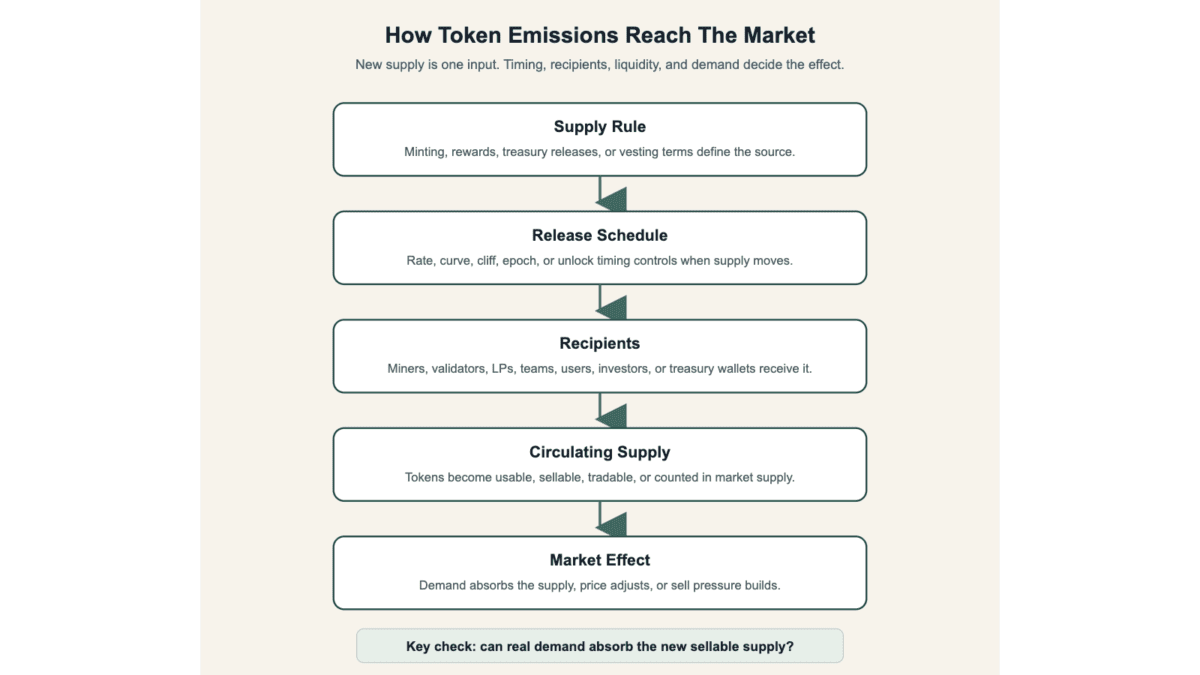
Emissions, inflation, token unlocks, and circulating supply growth are related, but they answer different questions. Emissions describe the flow of new or newly released supply. Inflation measures supply growth over a period. Token unlocks make restricted tokens transferable.
Holders usually care most about circulating supply growth. That is the supply competing for current buyer demand. A token can show low official inflation while circulating supply still rises because large locked allocations become liquid.
Use this table when a tokenomics page starts mixing the terms.
| Term | What It Means For Holders |
|---|---|
| Emissions | New or newly released supply enters the token economy. |
| Emission schedule | The timing and pace of future supply releases. |
| Inflation | Supply grows over a measured period. |
| Token unlock | Restricted tokens become transferable or tradable. |
| Vesting | Tokens release over time instead of all at once. |
| Burn | Tokens are removed from usable supply. |
| Net emission | New supply minus burns or permanent removals. |
| Circulating supply | Tokens counted as available in the market now. |
| FDV | The implied valuation if all future supply were counted at today’s price. |
The labels do not decide price. Sellability, recipient behavior, liquidity, market timing, and demand decide whether supply becomes pressure.
For example, a small protocol reward can feel harmless if demand is strong and recipients keep staking. A larger investor unlock can hit harder if recipients have a low cost basis and buyers are thin.
So do not ask only whether supply is called emissions or inflation. Ask whether new sellable supply is reaching the market, who holds it, and how much demand is waiting.
Emissions can pressure token price when new sellable supply needs more buyer demand than the market has. If emissions arrive faster than demand, liquidity, or usage grows, the market has to absorb more tokens with the same capital base.
That does not make emissions an automatic sell signal. Markets can price schedules early, demand can absorb new supply, and thin liquidity can make a small release feel large.
Sell pressure appears when recipients sell emitted or newly released tokens. Miners may sell to pay costs, validators may sell rewards, farmers may sell claims, and investors may sell after cliffs.
The market absorbs that selling only if enough buyers show up. If late buyers become the demand that lets early recipients exit, the setup starts to look like exit liquidity with a tokenomics PDF attached.
Demand can still beat supply. A strong narrative coin may absorb emissions for a while. The risk is assuming attention lasts longer than the release schedule.
Capital also moves. During market rotation, emissions may hurt more when traders leave a sector and less when capital is flowing into it.
Low-float tokens can make emissions feel worse. If only a small share of supply trades at launch, market cap can look cheap while FDV shows a much larger future valuation.
Imagine a token trading with a small circulating float while most supply remains locked. If price rises before major releases, future buyers must absorb supply at a richer valuation.
Daily volume is the first reality check. A release that looks small beside total supply can look huge beside normal trading activity. Order-book depth deserves the same attention, because thin bids make selling feel heavier.
The useful check is boring: compare the next emissions or unlocks with daily volume, liquidity, recipient class, and demand.
Emissions schedules in crypto describe how supply enters the market over time. Some schedules are predictable by design. Others can change through governance, treasury decisions, or incentive campaigns.
A schedule does not need live numbers to be useful. The shape tells you whether supply arrives steadily, suddenly, or in waves.
CryptoEconLab covers common emission schedule models and tradeoffs. Holders can translate those models into timing, size, recipient, and flexibility checks.
| Schedule Type | What To Watch |
|---|---|
| Fixed block rewards | Ongoing rewards that may create steady supply pressure. |
| Halving or decay schedule | Rewards decline over time, but demand still has to support price. |
| Linear vesting | Supply drips out over months or years. |
| Cliff unlocks | A large chunk becomes available on one date. |
| Epoch rewards | Supply releases in repeated network periods. |
| Dynamic emissions | Governance or formulas can change the rate. |
| Incentive taper | DeFi rewards start high, then fade as campaigns mature. |
Predictable does not mean harmless. A known cliff can still pressure price if buyers ignore it. A linear release can still grind on a chart if demand stays weak.
Flexible schedules need extra attention. Governance-controlled emissions can adjust incentives, but they also add policy risk. Know who controls the vote and who benefits.
Emissions go to recipients the network or project wants to reward or fund. The recipient list changes the risk because each group has a different reason to hold, spend, stake, or sell.
Projects emit tokens to pay for network security, bootstrap liquidity, reward early users, fund grants, compensate contributors, or support treasury operations. Useful work can be funded this way, but ownership still shifts. That tradeoff is the whole emissions bargain.
Common recipient groups include:
Recipient identity changes market risk. A validator reward behaves differently from a discounted investor unlock or a farm reward paid to APY chasers.
The sharper question is not only “how many tokens?” It is “who gets them, when can they sell, and what reason do they have to keep holding?”
Staking can offset some emissions for a participant, but it cannot protect against every source of supply growth. A staker may earn more tokens while still facing price declines, validator commission, taxes, unlocks, and broader circulating supply growth.
Separate token count, ownership share, and dollar value. You can earn more tokens and still lose dollar value if price falls. You can also offset protocol issuance while team or investor unlocks add sellable supply.
This table shows what staking rewards can hide.
| What You See | What It Can Hide |
|---|---|
| More tokens in your wallet | Price can fall faster than rewards accrue. |
| A headline staking APY | Validator commission, lockups, slashing, or claim friction. |
| Protocol inflation rewards | Team, investor, treasury, or DeFi emissions outside staking. |
| A higher token balance | A smaller share if others earn or unlock more supply. |
| Compounding rewards | Costs, timing, and tax treatment can reduce the result. |
Staking works best inside a wider supply check. It may help active participants avoid dilution from protocol issuance.
But staking is not a helmet for every supply hit. If a low-float token has large unlocks and weak liquidity, staking may only soften the damage.
Burns and buybacks can offset emissions only when they are large, real, recurring, and meaningful beside new supply. The useful measure is net emission.
Gross emissions are the tokens entering supply. Burns remove tokens from usable supply. Net emission looks at what remains after both forces are counted.
A burn can sound powerful while doing little. If burned tokens were never circulating, holders may not feel much change. If buybacks are small or irregular, they may not absorb steady emissions.
Timing counts too. A project can announce a burn after months of reward emissions, then market the headline as if the whole supply problem disappeared. That is backwards. First compare the new supply, then measure what the burn or buyback actually removed.
Check the offset claim before trusting it:
Buybacks need the same filter. A one-time buyback can support liquidity briefly, but it does not erase a long emission schedule.
Burns and buybacks can improve supply math when they are real and repeatable. They do not turn emissions into free money. Crypto already has enough magic tricks with worse accounting.
DeFi emissions are reward tokens paid to users for supplying liquidity, staking in an app, joining a campaign, or using a protocol. They can bootstrap activity, but they can also create farm-and-dump pressure.
Some DeFi yield comes from fees or borrower interest. Some comes from newly emitted tokens. Fee-funded yield depends on activity. Emission-funded yield depends on a reward budget and buyers.
In farming rewards, users may earn tokens for depositing into a pool, vault, or campaign. A shorter farming setup may look simple, but the reward source still decides the risk.
Watch the reward path before chasing APY:
High APY can be a valid incentive. It can also warn that the token needs constant new buyers. If everyone farms, claims, and sells, rewards become market pressure.
In DeFi, check source first and rate second. A smaller fee-backed return can be cleaner than a giant emission number that depends on the reward token holding up.
Check emissions before buying by tracing future supply from schedule to market. You want to know what can enter circulation, who receives it, and what demand absorbs it.
Start with the tokenomics page, whitepaper, governance forum, contract permissions, supply chart, and unlock calendar. Then compare those claims against circulating supply, total supply, FDV, volume, and liquidity.
A January 2026 Tokenomist report put 2025 token releases at $97.43 billion across major sectors. That is why upcoming supply belongs next to volume and liquidity instead of buried in a tokenomics tab.
Use this checklist before buying, staking, farming, or averaging down:
Holding through emissions requires a thesis. A conviction play should rest on demand, usage, liquidity, and timing, not on hoping the schedule politely stays quiet.
The check also protects yield decisions. If a token pays high rewards while large unlocks approach, the reward may not cover the price risk.
No single metric is enough. FDV shows future supply risk, volume shows absorption capacity, and recipient categories hint at behavior.
Emissions red flags appear when supply growth is unclear, concentrated, flexible in the wrong hands, or far larger than demand.
Low-float launches deserve extra caution. A small circulating float can make scarcity look stronger than it is. If large emissions follow, late buyers may become the bagholder side of the supply trade.
Watch for these supply-risk patterns:
Scheduled emissions are not a rug by themselves. The problem starts when supply rules are hidden, changed after buyers arrive, or used to bleed value.
A slow, insider-friendly release can resemble a soft rug when holders face a long decline with vague explanations. A hidden mint, malicious treasury move, or abusive control path sits closer to a hard rug because trust can break quickly.
Use one sharp test: would the project still look attractive if the next six months of supply were printed beside the price chart? If not, the chart may be doing public relations for the schedule.
Related emissions concepts help when supply risk hides under several labels. Tokenomics pages often split it across allocation, vesting, rewards, burns, and valuation.
Use these next when an emissions check turns into a broader supply review:
Keep the parent map simple. Circulating supply shows what can trade now. Total supply and max supply show broader limits, but not what becomes sellable next. FDV helps when the float is small because it exposes future supply without pretending to predict price.
Token unlocks are still the closest confusion point. Burns and buybacks sit on the other side of the ledger. Farming rewards connect emissions to DeFi yield, where a farm can pay real tokens while still pressuring the reward token.
Start with emissions by finding the schedule, then matching it to market depth and demand. The goal is to avoid obvious supply pressure, not predict every candle.
First, separate what is already circulating from what can become sellable later. Then ask who receives that supply. A validator reward, a treasury release, and an investor cliff all land differently, even when the chart only shows one price.
Use these steps before the trade:
Going full port into a token with heavy future supply leaves no room for being early, wrong, or both.
Then decide what would prove the setup wrong. Maybe demand is rising, liquidity is deep, and recipients have reasons to keep holding. Or maybe the next release is larger than normal volume and the only plan is vibes in a nicer font.
Emissions do not make a token doomed. They make the supply side visible. If demand cannot absorb the flow, the market will ask who is paying for all those new tokens.
Emissions in crypto are new coins or tokens created, released, or made available through a protocol or tokenomics schedule. They can come from mining rewards, staking rewards, DeFi incentives, treasury releases, or vesting schedules.
Emissions are not automatically bad for crypto. They can fund security, liquidity, grants, and user incentives, but they become risky when new sellable supply grows faster than demand.
Emissions do not always lower token price. Price depends on demand, liquidity, recipient behavior, market timing, and whether the emissions were already expected.
An emission schedule is the plan for when and how token supply enters circulation. It can include block rewards, staking rewards, cliffs, vesting, epoch rewards, or DeFi incentive campaigns.
Emissions describe the broader flow of new or newly released supply. Token unlocks are a specific event where restricted tokens become transferable or tradable.
Staking can protect you from some protocol emissions, but it cannot protect against every supply event. Unlocks, price declines, validator fees, taxes, and weak demand can still reduce the real result.