Physical Address
304 North Cardinal St.
Dorchester Center, MA 02124
Physical Address
304 North Cardinal St.
Dorchester Center, MA 02124


Intent in crypto makes routes simpler, not risk-free.
Intent in crypto is a signed request that states the outcome and limits you want while another actor finds the execution path.
That sounds small. It changes the whole user flow. Instead of choosing every pool, bridge, gas token, and route step, you sign the result you are willing to accept. Before you sign, know what the request permits, who can fill it, how they get paid, and what happens when the route fails.
Intent means a crypto instruction that says, “I want this result under these limits.” The signed request gives a wallet, app, solver, or settlement contract something concrete to interpret.
For example, a normal swap might send a transaction through a specific route right now. An intent might say: swap this token for at least this much of another token, send it to this wallet, and expire the request if nobody can fill it before the deadline.
That difference is the whole point. Use this quick split:
The word can confuse people because “intent” already means ordinary intention in English. It also has meanings in Android apps, network systems, and other technical fields. In crypto, the useful meaning is narrower: outcome-first execution.
Think of it as a conditional order with guardrails. Common guardrails include:
The route can be flexible. The signed limits should not be.
That is why intent in blockchain is tied to wallet UX, DeFi routing, and cross-chain swaps. It tries to hide route chores without asking users to accept a blank check. Done well, that is useful. Done badly, it becomes a smooth button with sharp corners.
A crypto intent works by separating what you want from how the route gets built. You review the token pair, amount, destination, minimum received, deadline, and any visible fees. Then you sign an intent or order message.
From there, the execution work moves away from you. The app may publish the intent to a solver network, auction, relayer, private order flow system, or protocol backend. Solvers look for liquidity, gas paths, bridge routes, market-maker inventory, or any route that can settle profitably.
The basic lifecycle looks like this:
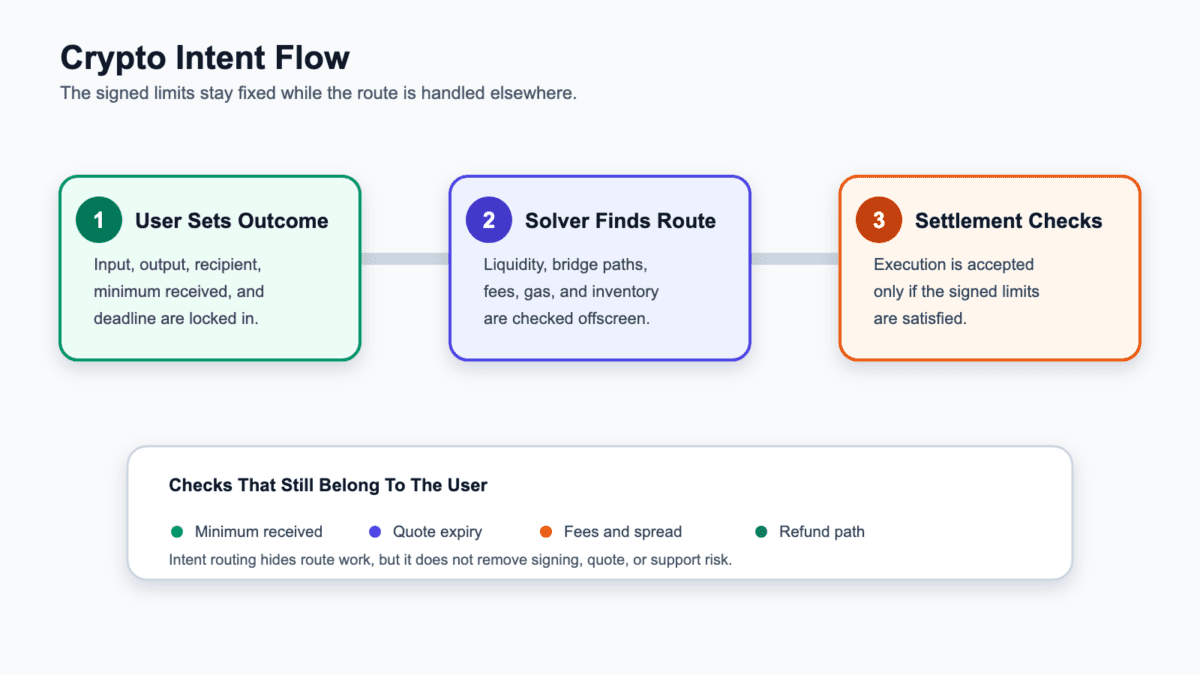
Gas abstraction often appears in this flow, but “gasless” does not mean free. Someone still pays network costs. The cost may show up as spread, a fee, a sponsored route, a solver incentive, or a worse final quote.
Failure is also part of the model. If no solver can meet your minimum output, the market moves, liquidity disappears, or the destination chain is unsupported, the intent may expire without a fill. That can be frustrating, but it beats forcing a bad route through because the interface wanted a success screen.
Intent differs from a transaction because it specifies the acceptable result, while a transaction specifies the execution path. That distinction decides who chooses the route and what can fail.
A normal crypto transaction is direct. You approve or send a specific call to a contract. An intent-based transaction can be more flexible because another actor can search for a route that satisfies your conditions.
Here is the clean comparison:
| Model | What The User Is Really Doing |
|---|---|
| Normal Transaction | Sends a specific contract call, route, or transfer for the chain to execute. |
| Limit Order | Sets a price or condition, then waits for someone or something to fill it. |
| DEX Aggregator Swap | Lets an app compare routes, then usually signs a route-specific transaction. |
| Crypto Intent | Signs an acceptable result and lets solvers find a valid execution path. |
| Cross-Chain Intent | Signs a result that may require liquidity, settlement, and finality across chains. |
The important shift is route control. In a normal swap, you may see the route before you confirm. In an intent flow, you may see only the outcome and limits while solvers handle the route behind the scenes.
That can improve UX when routing is messy. It can also make costs harder to inspect. A quote screen may hide solver spread, private liquidity, bridge assumptions, or surplus handling.
That leaves two checks:
So intent-based transactions are a different execution model. You still need a wallet signature, settlement logic, and onchain results. But the user no longer has to assemble every route step by hand.
The tradeoff is simple enough. Less manual routing means more reliance on the app, solver market, and settlement checks.
Crypto intents are used where users want a result but do not want to manage every route step. The clearest cases are swaps, cross-chain transfers, gas abstraction, and wallet flows that combine several actions.
Start with a simple swap. You might want to trade USDC on one layer 2 for ETH on another layer 2, with at least a certain amount received. A manual path could involve a bridge, destination gas, a DEX swap, and a few chances to click the wrong thing.
An intent flow can bundle that into one signed outcome. The solver decides whether it can deliver the ETH on the destination chain while respecting your minimum output and deadline.
Intent-style systems can appear in:
Wallet UX is the common thread. Users often sign the summary they can understand, not the route they cannot see. That makes the wallet prompt and app design a real safety layer, not decoration.
This is why cross-chain intents get so much attention. They can hide some bridge and gas-token friction. They can also route through liquidity sources that a normal wallet screen may not show.
The overlap is easiest to read this way:
| Nearby Idea | How It Relates To Intent |
|---|---|
| Account Abstraction | Improves signing, batching, gas payment, or account permissions. |
| Chain Abstraction | Hides network details so the user focuses on the action. |
| Crypto Intent | Describes the desired result those tools may help execute. |
They are related tools. They are not the same tool wearing three hats.
Crypto traders care about intent-based routing because execution can be adversarial, fragmented, and expensive. A better route can change the final amount received, especially when liquidity is split across chains and venues.
The biggest value appears when a solver can search more routes than a basic interface can present. That may include AMM pools, RFQ quotes, private inventory, bridge-like fills, and destination-chain liquidity.
Intent-based routing may help most when the trade has real routing complexity:
Small, highly liquid same-chain swaps may see little benefit. If you are swapping a tiny amount of ETH for USDC on deep liquidity, a direct AMM or DEX aggregator may already be good enough.
Intent routing is less likely to matter when:
That is the sober version. Intents can improve execution when there is something for solvers to improve. They are less exciting when the best route is already obvious.
The MEV angle also needs care. Intent-based routing can reduce some public mempool exposure when the order is handled privately or through an auction. But it does not remove competition from the trade. It changes where the competition happens.
That is why intent routing belongs in the same mental bucket as PVP trading pressure. The user wants a clean fill, while searchers, solvers, market makers, and other traders may want the surplus.
Compare the final output, minimum received, fees, expiry, and failure path against a normal aggregator. If the intent route cannot give you a better result or remove real friction, the buzzword has not earned its keep.
Intent risks come from the actors and assumptions between your signature and the final fill. The user sees a cleaner screen. The market still has solvers, spreads, liquidity limits, routing choices, and support paths.
Solver concentration is the first risk. If many independent solvers compete, weak routes should lose. If one or two solvers dominate, the system may still work, but price pressure, censorship resistance, and route transparency can weaken.
Spread is the second risk. A solver may fill your order at a better internal price than your minimum and keep the difference, depending on the design. That is not always abusive. It may be how the solver gets paid. But users should know whether surplus goes to them, to the solver, or to the protocol.
Start with these risk checks:
| Risk | What To Check |
|---|---|
| Solver Concentration | Whether several independent solvers can fill the order. |
| Hidden Spread | Whether the app shows fees, surplus, and final output clearly. |
| Loose Limits | Whether slippage and expiry give too much room. |
| Route Failure | Whether refund and support paths are visible before signing. |
Loose limits make the problem worse. A wide slippage setting or long expiry gives solvers more room to fill under worse conditions. If liquidity thins out, a smooth intent flow can still leave the user with a poor result.
That is where thin liquidity can turn a user into exit liquidity with a better-looking interface. The route is abstracted, but the market depth is not magically deeper.
Failed or delayed fills are another real concern. A cross-chain intent may depend on solver inventory, bridge-like liquidity, destination finality, and settlement timing. If any piece breaks, the user needs to understand expiry, cancellation, refund, and support.
Split the problem like this:
MEV protection is not magic either. Some intent systems reduce exposed routing. Others move order flow into private channels where a different set of actors can compete for surplus.
Narratives can outrun safety checks, especially when Crypto Twitter turns “intents” into a market slogan. That does not make the concept fake. It means product claims need to meet routing evidence.
The warning signs are not subtle:
The boring checks are still the useful ones. Look for minimum received, solver competition, fee logic, route visibility, supported chains, refund terms, and support channels before you sign.
Intent standards and examples help separate the broad crypto concept from specific products. “Intent” is the general model. ERC-7683, Open Intents Framework, NEAR Intents, UniswapX, CoW Swap, and Anoma are different implementations or related designs.
ERC-7683 is one current reference point. As of its May 2026 resolver redesign, Ethereum Improvement Proposals listed ERC-7683 as a Draft with seven named authors and framed it as a cross-chain intents standard where orders express desired outcomes and solvers or fillers execute the required actions.
That does not make ERC-7683 the standard for every intent. It is focused on cross-chain order structure and settlement interfaces. Other intent systems can use different auctions, settlement contracts, escrow models, solver rules, or signing flows.
Open Intents Framework is another example of shared infrastructure for cross-chain intents. Across and LI.FI are often discussed around that context. Their role is not to make every app identical. It is to make parts of cross-chain intent execution easier to integrate.
Then there are swap and order-flow examples:
| Example | Role In The Intent Conversation |
|---|---|
| UniswapX | Uses fillers for swap execution. |
| CoW Swap | Uses batch auctions and solver competition. |
| 0x And 1inch Fusion | Show intent-style routing in DeFi order flow. |
| NEAR Intents And Anoma | Sit closer to intent-centric product and protocol narratives. |
These examples show the model already appears in real DeFi, not just whiteboard architecture. They are useful names to know, but they should not hijack the definition.
There is also an investor caveat. Useful infrastructure does not automatically create token demand, fee capture, or better price action. A strong intent product can still be a weak token thesis if value does not accrue to the token.
That is where market meta thinking helps. Intents can become a real technical theme and a noisy trading narrative at the same time. The job is knowing which one you are looking at.
Check an intent-based swap by reading the signed outcome, not just the headline quote. The visible summary should tell you what you receive, when the order expires, and what happens if no solver fills it.
The wallet screen is the inspection point because most users do not inspect every hidden route. They sign the digest, quote, and permissions the app presents. If that summary is vague, the route abstraction is doing too much work.
Use this checklist before signing:
Approvals deserve separate attention. If a route asks for token approval before the intent, confirm the spender and allowance. If the wallet asks for a broad signature, slow down. Convenience is not a reason to sign fog.
Wallet choice also affects how much you can inspect. Good wallet setup helps users review signatures, manage approvals, separate funds, and avoid turning one bad route into a full wallet problem.
For cross-chain swaps, save the order ID, source transaction, destination transaction, provider name, and support route. A failed same-chain swap is annoying. A failed cross-chain route without receipts can become a support scavenger hunt.
Save these before the route gets messy:
The final check is simple. If you cannot explain the minimum received, expiry, and refund path in one sentence, do not sign yet.
Related intent concepts help you decode what a wallet or protocol is actually doing. The terms can sound interchangeable, but each one points to a different job in the route.
The nearby roles break down like this:
| Term | What It Usually Means |
|---|---|
| Solver | Searches for a valid route that can satisfy the intent. |
| Filler | Executes or fronts a fill, often in cross-chain or order-flow contexts. |
| Relayer | Transmits messages or transactions, usually without taking price risk. |
| Paymaster | Handles or sponsors gas in some wallet flows. |
Account abstraction changes how accounts handle signatures, gas, batching, and permissions. If an intent flow uses smart-wallet features, the account abstraction layer explains why one wallet prompt can cover more than one action.
Chain abstraction hides network complexity so users can focus on the action. Intents can use both ideas, but an intent is still the outcome request.
DEX aggregators compare available routes before a swap. Intent-based systems may go further by letting external solvers compete after the user signs constraints. Bridges move value or messages across chains. Cross-chain intents can wrap bridge-like behavior into an outcome-first request.
Gas abstraction can make an action feel gasless, but the cost has to land somewhere. It may be paid by the app, a campaign, a solver, or indirectly through the final quote.
A UI gets much clearer once every role has an owner. Who shows the quote? Who signs the order? Who fills it? Who checks settlement? Who helps if it fails?
Once you can name those roles, the route stops sounding mystical.
No. A crypto intent states the outcome and limits the user accepts, while a transaction usually tells the chain which exact action to execute. The intent may lead to one or more transactions later, but the user is signing the result conditions first.
Solvers in crypto intents are actors that search for a valid execution route. They may use liquidity pools, inventory, bridge routes, market-maker quotes, or auctions to fill the order under the user’s signed limits.
Crypto intents can reduce some MEV exposure when routing is private, auction-based, or settlement-checked well. They do not remove MEV risk entirely. Bad slippage settings, weak solver competition, and opaque order flow can still hurt execution.
Yes. An intent-based swap can fail or expire if no solver can satisfy the minimum output, the market moves, the route loses liquidity, or the destination chain has problems. A good app should show the expiry, refund path, and support route.
Crypto intents are not automatically custodial. Some designs keep user custody until settlement, while others may rely on escrow, allowances, fillers, or app-specific contracts. Check what you approve, what you sign, and who can move funds.
No. ERC-7683 is a cross-chain intents standard, not a definition of every crypto intent. It helps standardize parts of cross-chain order handling, while other intent systems can use different solver, auction, settlement, and wallet designs.
Start with crypto intents by testing the user flow, not the narrative. The model is useful when it solves a real routing problem. It is less useful when it only makes a simple swap sound smarter.
Use this starting sequence:
Then ask who carries the execution risk. If solvers compete openly, routes are visible enough, and settlement terms are clear, the UX improvement may be worth it. If the app hides the route, support path, and fee logic, the cleaner button is not doing you a favor.
Run one test where the outcome is easy to verify. Same token, clear destination, short expiry, and a small amount. If the app cannot explain that simple path, it has not earned a harder cross-chain route.
For larger trades, compare more than the expected output. Look at the minimum received, the spread between expected and minimum, the route visibility, and the support path. A quote can look generous while giving the solver too much room to deliver a weak fill.
Keep the investor angle separate. A protocol can make intents easier to use without making its token valuable. Product utility, fee capture, and token demand are different claims.
The best starting rule is plain: use intents when they reduce a specific execution problem, and skip them when they only reduce the number of screens you have to read.