Physical Address
304 North Cardinal St.
Dorchester Center, MA 02124
Physical Address
304 North Cardinal St.
Dorchester Center, MA 02124

A plain-English guide to compute markets, AI GPUs, and token risk.
A compute market is a crypto marketplace where buyers rent computing power from providers, often for AI, rendering, apps, or batch jobs.
The idea sounds simple until the token enters the room. A compute market can be useful infrastructure, a cheaper GPU option, a provider income stream, or a narrative trade with a very expensive hat.
That is why the useful question is not “Which AI token is hot?” It is whether the market can match real workloads with reliable providers, prove the work happened, and make the token role more than decoration.
A compute market in crypto is a marketplace for buying, selling, or coordinating computing capacity. Buyers want work done. Providers supply hardware. The marketplace handles discovery, pricing, rules, and payment.
The compute can be CPU time, GPU time, a server, a container, an inference endpoint, rendering capacity, or another packaged resource. In crypto, tokens or smart contracts may handle incentives, staking, rewards, governance, settlement, or checks on provider behavior.
The vocabulary overlaps. Before comparing projects, separate the market, the hardware, the token, and the broader category.
| Term | What It Means Here |
|---|---|
| Compute market | A marketplace where buyers rent computing capacity from providers. |
| Decentralized compute | Compute supplied by many independent providers instead of one cloud company. |
| GPU marketplace | A compute market focused on graphics processors, often for AI or rendering. |
| DePIN | The broader crypto category for networks that coordinate real-world or digital infrastructure. |
| ComputeFi | A Web3 framing for programmable, financialized, or verifiable compute resources. |
| AI mining | A loose marketing phrase for earning tokens by supplying AI compute. |
| Verifiable compute | Methods for checking that a computation ran correctly or honestly. |
These terms are related, but they are not identical. A compute market can sit inside DePIN, use decentralized compute, rent GPUs, and talk about ComputeFi without being all those things at once.
In plain English, the market is the buyer-provider layer. The token is one possible coordination tool. The useful work still has to happen somewhere, on real hardware, with real costs.
A compute market works by turning available hardware into a service that buyers can request, price, run, check, and pay for. The exact flow changes by network, but the moving parts are usually buyer, provider, market, verification, and settlement.
Some markets feel like a cloud dashboard. Others feel like a developer deployment tool. Others expose only an API for inference or rendering. So the first job is to know what you are actually renting.
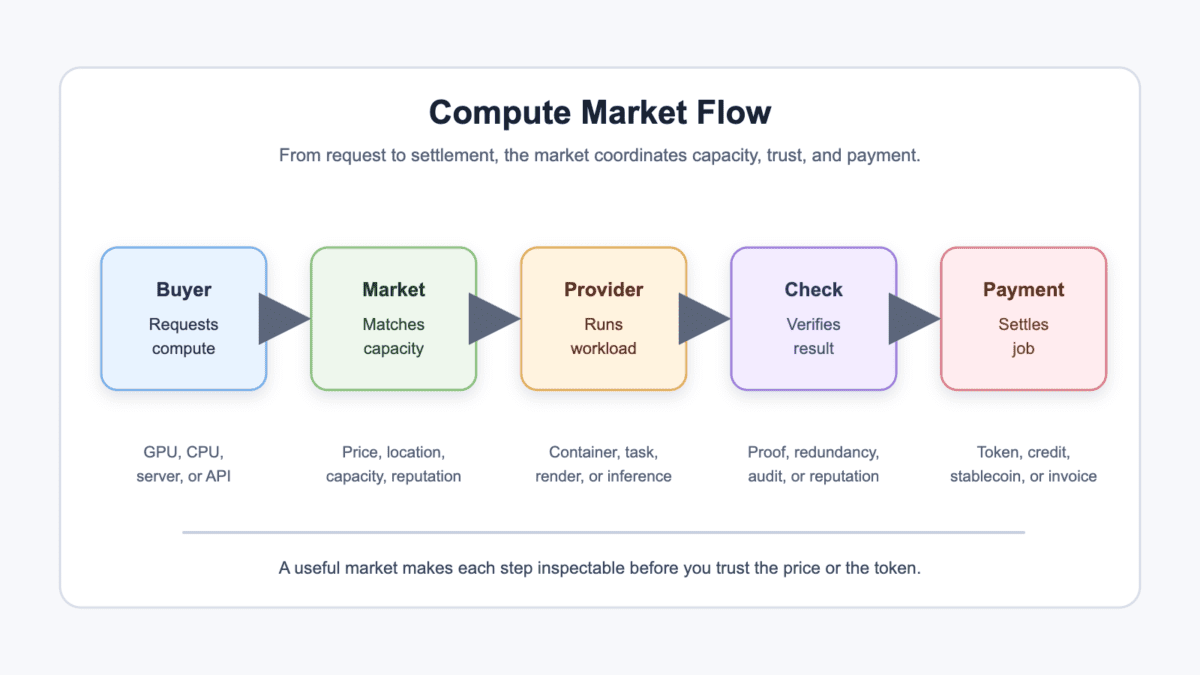
Buyers request compute by describing the workload they need to run. That may mean a GPU job, a container, a machine-learning notebook, a rendering task, an app deployment, or access to an inference API.
The buyer should know the basics before paying: hardware class, memory, region, price, uptime target, data handling, job duration, and support path. “Cheap GPU” is not a full product spec.
Providers supply the machines that make the market real. They may be data centers, smaller operators, GPU owners, cloud resellers, or specialized infrastructure teams.
Provider quality matters more than provider count. A thousand weak nodes do not beat a smaller pool with usable hardware, decent uptime, clear pricing, and repeat demand.
The market matches buyer demand with provider supply through bids, listings, scheduled jobs, API routing, or protocol rules. This is where a decentralized compute marketplace can differ from a normal cloud account.
The match can consider price, region, hardware, reputation, availability, collateral, and workload type. If the project hides those details, the buyer is mostly trusting the brand and hoping the invoice behaves.
The workload runs off-chain on provider hardware, then the market needs a way to confirm enough trust. That can involve logs, reputation, redundancy, audits, deterministic output checks, trusted hardware, cryptographic proofs, or human support.
After that, payment settles. It may use a native token, credits, stablecoins, invoices, or a mix. The crypto part can make settlement open and programmable, but the work itself still depends on hardware and operations.
Compute markets became an AI crypto narrative because AI created visible demand for GPUs while crypto already had a way to coordinate strangers with tokens. That combination attracts builders, traders, providers, and a few pitch decks with smoke machines.
The story has a real base. AI inference, image generation, video generation, fine-tuning, and experimentation can need flexible GPU access. Centralized cloud GPU capacity can be expensive, hard to reserve, or awkward for smaller teams.
NVIDIA reported record Data Center revenue of $75.2 billion for its fiscal first quarter, which is why AI compute capacity keeps pulling attention into adjacent crypto markets.
Crypto adds another ingredient: narrative rotation. When a category starts to feel like the current crypto meta, attention can arrive before the service has stable users.
Use these signals to separate real demand from pure timeline heat:
The attention economy can push AI compute tokens far ahead of usage. That does not make the whole category fake. It means the service case and the token case need separate checks.
A compute market can be useful even when the token is overpriced. It can also have a rising token while the service is barely used. Crypto is talented like that, for better and worse.
A compute market token is supposed to coordinate economic behavior inside the network. It may pay providers, secure commitments, give governance rights, fund rewards, meter access, or create a sink for usage fees.
That utility can matter. But token utility is not the same as token value capture. A marketplace can process real compute demand while token holders still face emissions, weak sinks, poor liquidity, or governance that does not touch revenue.
Token utility describes what the token does inside the market. Common roles include payment, staking, provider collateral, rewards, slashing, governance, usage credits, discounts, or access to certain network functions.
The stronger token cases are specific. A token that providers must stake against poor service is easier to inspect than a token that “powers AI.” One is a mechanism. The other is confetti.
Token value capture asks whether network usage can create durable demand for the token. The answer depends on fee flow, payment currency, emissions, burns, staking demand, buybacks, credits, and whether users can avoid the token entirely.
This is where a compute token can start looking like a narrative coin if the market story grows faster than measurable usage. A strong story can move price. It does not guarantee a strong design.
The token thesis breaks when useful compute demand does not flow back to holders. That can happen when users pay in stablecoins, providers sell rewards, emissions dilute buyers, governance is cosmetic, or the token has no real sink.
> Token utility can explain why a token exists. It cannot prove the token is worth buying.
That distinction helps avoid bagholder risk when an AI compute story is already crowded. You can like the infrastructure and still pass on the asset.
A compute market works best when the workload is flexible, parallel, bursty, or easy to retry. Those jobs can benefit from spare capacity, distributed supply, or cheaper access without needing perfect enterprise-grade support.
It works worse when the workload needs strict compliance, locked-down data controls, guaranteed uptime, deep cloud integrations, or long-running frontier-scale training. The more sensitive the job, the less you should accept vague marketplace claims.
Here is a practical fit map.
| Workload | Fit and Main Caveat |
|---|---|
| AI inference | Often a good fit when latency, privacy, and model support are clear. |
| Image or video generation | Good fit for bursty GPU demand, but output checks still matter. |
| Rendering | Strong fit when jobs can be split, retried, and priced clearly. |
| Fine-tuning | Possible fit for smaller runs, but data handling needs care. |
| Notebooks | Useful for experiments, but setup and persistence can be uneven. |
| Batch jobs | Good fit when jobs are parallel and not time-critical. |
| Crypto-native apps | Useful when apps already handle wallets, tokens, and off-chain workers. |
| Frontier training | Usually a weak fit because scale, networking, and reliability needs are extreme. |
| Regulated data | Risky unless privacy, compliance, and audit boundaries are explicit. |
| Mission-critical systems | Usually a poor fit without strong support and service guarantees. |
“Best fit” does not mean always cheaper or safe by default. It means the job can tolerate the market’s tradeoffs.
A buyer should compare total cost, uptime, setup time, data exposure, and support. A cheap failed job is just an expensive way to learn procurement.
Compute market risks change by role. Buyers worry about reliability and privacy. Providers worry about hardware economics. Investors worry about whether demand, incentives, and token design line up.
The same project can look attractive from one angle and weak from another. A buyer may love cheaper capacity while a provider loses money after power costs. A trader may love the chart while users avoid the product.
Buyer risks start with uptime, support, and data handling. You need to know where the workload runs, what happens when it fails, who sees the data, and how quickly you can get help.
Run a small test before moving serious work. Check logs, output quality, billing, job reproducibility, support response, and whether the result can be verified without heroic optimism.
Provider risks start with utilization and cost. A GPU earns nothing while idle, and it costs money while running. Power, cooling, bandwidth, hardware wear, maintenance, colocation, support, and payout currency all matter.
Provider earnings pages can make idle hardware look like magic income. The boring version is better: calculate power cost, expected utilization, token liquidity, taxes, and whether large professional providers can underbid you.
Investor risks start with demand quality and token structure. A network can show provider growth, social attention, and token volume without proving recurring compute usage.
Watch emissions, token releases, thin liquidity, provider selling, governance control, hardware concentration, and weak token sinks. Late buyers can become exit liquidity risk when a token narrative runs faster than revenue.
Weak demand can also turn a compute token into a slow-fade project. Dead coin warning signs look different across sectors, but vanished usage and vanishing liquidity usually rhyme.
Wallet and install-flow risks deserve their own check because compute markets often involve provider software, dashboards, wallets, scripts, or node daemons. Do not connect wallets or run install commands because a landing page promises earnings.
Use a separate wallet where possible, review permissions, verify domains, and avoid unknown scripts on machines that hold private keys or work data. If custody becomes part of the setup, start with wallet setup basics before chasing provider rewards.
Compute market verification is hard because arbitrary computation is difficult to prove cheaply. A network may know a provider accepted a job, but proving the job ran correctly, privately, and fully can be much harder.
Simple tasks can be checked by comparing outputs. Deterministic jobs can be rerun. A rendering job may be easier to inspect than a private dataset job. An inference request may be easy to time and price, but harder to verify for data handling.
Some systems use redundancy, reputation, audits, slashing, trusted execution environments, zero-knowledge proofs, or proof-of-useful-work designs. Each method answers a different question. Did the provider stay online? Did the output match? Did the hardware isolate the workload? Did the network punish bad behavior?
These tools help, but none should be treated as magic dust. Each method has tradeoffs:
Privacy has the same problem. A buyer may need to send model inputs, datasets, prompts, code, or outputs to a provider. Containers and encryption can reduce exposure, but many systems still rely partly on trust, policy, isolation, or limited data sharing.
That makes the setup flow part of the product. A buyer should know what data leaves their machine, where logs live, who can inspect failed jobs, and whether support can access the workload. If the project cannot explain that clearly, cheap compute is not cheap enough.
That is why “verifiable compute” should trigger questions, not applause. Ask what gets verified, who verifies it, what remains trust-based, and what happens when the result is wrong.
ComputeFi is useful vocabulary here. It frames compute as a programmable or verifiable resource, sometimes with financial rails around it. But a label cannot replace a working proof model.
A compute market is different from cloud, mining, DePIN, and ComputeFi because it describes the marketplace layer for compute capacity. The other terms describe providers, security models, broader categories, or financial framing.
The confusion is understandable. All of these terms can involve hardware, tokens, networks, and rewards. The difference is the job being done for the user.
Use this comparison when the vocabulary starts blending together.
| Model | What Changes for Users |
|---|---|
| Centralized cloud | Users usually get better support and integrations, but rely on one company and its pricing. |
| Compute market | Users rent capacity from marketplace providers, often with token or protocol coordination. |
| Crypto mining | Hardware secures a blockchain and earns rewards, rather than serving buyer workloads. |
| DePIN | The broader category for token-coordinated infrastructure, including compute, storage, wireless, maps, and more. |
| Decentralized GPU network | A compute market or network focused on GPU capacity for AI, rendering, or parallel workloads. |
| ComputeFi | A Web3 framing around programmable, financialized, or verifiable compute. |
AWS, Google Cloud, and Microsoft Azure are more mature for many enterprise needs. They bundle support, identity, storage, networking, compliance tools, and predictable procurement.
A compute market tries to compete on open supply, flexible pricing, global provider access, token incentives, or specialized capacity. That can be valuable, but it is not “AWS with a wallet” unless the only difference is payment friction.
Mining is a different animal. Proof-of-work mining performs chain security work. A compute market should run useful work for buyers. Confusing those two leads to bad assumptions about rewards and demand.
Check a compute market by separating the service, the provider side, and the token. If all three are mashed into one pitch, slow down until the parts become visible.
Start with the service. Can you see pricing, hardware, workload examples, provider quality, support, and privacy boundaries? Then check whether the token has a real job beyond attracting attention.
Use this checklist before using the market or calling the token a conviction play:
Service checks should come first. If the market cannot show pricing, hardware specs, workload examples, provider quality, support, and privacy boundaries, the token story is arriving too early.
Then check provider economics. A market that depends on weak provider incentives can look busy for a while, then lose usable supply when rewards fall, power costs rise, or large operators undercut smaller ones.
Token checks come last. Look for the path from real usage to token demand, and look just as hard for emissions, reward selling, token releases, credits, or stablecoin payment routes that weaken that path.
Team transparency does not remove technical risk, but it changes accountability. A doxxed team is easier to evaluate than a blank crew asking for wallet permissions and root access.
The strongest compute markets make boring details easy to find. Specs, prices, docs, terms, support, privacy, and token mechanics should not require detective work.
Related terms help because compute markets sit between infrastructure, AI hype, wallets, and token risk. Use them to name the exact problem in front of you: technical capacity, trading attention, wallet exposure, or token failure.
CT is where AI compute narratives often spread first, especially when a project is still short on hard usage evidence. Trenches are the high-risk trading venues where new compute-token stories can appear before users can verify demand.
In trading language, a top signal is the moment GPU and AI hype starts sounding too obvious, too late, or too clean. A hard rug is the sharper failure mode, when a project disappears, drains value, or leaves buyers without recourse. A soft rug is slower: weak updates, fading liquidity, and a product that keeps promising more than it ships.
Wallet safety belongs beside compute markets because buyers and providers may connect wallets, approve spending, or install software. That is not a side quest. It is where a research mistake can become an operational mistake.
A compute market is not the same as DePIN, but it can be part of DePIN. DePIN is the broader category for token-coordinated infrastructure. A compute market is the marketplace for CPU, GPU, server, or API capacity.
A compute market can replace cloud providers for some workloads, but not all. It may fit bursty GPU jobs, rendering, inference, experiments, or crypto-native apps. It is usually weaker for sensitive data, deep enterprise integrations, and mission-critical uptime.
Compute markets use tokens to coordinate payments, rewards, staking, governance, provider collateral, or settlement. The token should have a clear job inside the market. If the role is vague, the token may be more narrative than utility.
You may earn money by providing GPUs to a compute market, but earnings depend on utilization, power cost, hardware class, token price, downtime, taxes, and payout liquidity. Idle hardware income is never free income.
Verifiable compute in a compute market means checking that a provider ran the promised work correctly. It may use redundancy, reputation, audits, trusted hardware, deterministic reruns, proofs, or network-specific verification rules.
The biggest compute market risks are weak demand, unclear verification, poor provider quality, privacy exposure, token emissions, thin liquidity, and unsafe wallet or install flows. Cheap compute is useful only when the trust model holds.
Start with compute markets by identifying your role. A buyer, provider, and token investor should ask different questions before taking action.
A buyer should test one small workload and compare the result with a normal cloud route. A provider should calculate real cost before counting rewards. An investor should prove the token captures value before calling the AI story early.
If you are both a user and a token buyer, keep the tests separate. A cheap job does not prove token demand, and a rising token does not prove reliable compute.
For a buyer, the first test should be boring and disposable. Run a small job, check the output, inspect the bill, and see how support responds when something is unclear. Do not start with sensitive data or a workload that must finish on time.
For a provider, the first test is math. Estimate power, cooling, bandwidth, hardware wear, payout timing, taxes, and downtime before assuming idle hardware will pay for itself. If the return only works while the token rises, it is a trade, not stable infrastructure income.
For an investor, the first test is value capture. Follow the money from user payment to provider payout to token demand. If the path breaks at stablecoin payments, emissions, reward dumping, or cosmetic governance, the compute market may still be useful while the token remains weak.
After the first test, write down what failed, what support answered, what the job actually cost, and which wallet or install permissions were required. Those details tell you more than a polished landing page.
Use these next actions:
The useful path is slower than the hype path. That is the point. A compute market deserves attention when it makes real compute easier, cheaper, or more open without asking you to ignore the hard parts.


