Physical Address
304 North Cardinal St.
Dorchester Center, MA 02124
Physical Address
304 North Cardinal St.
Dorchester Center, MA 02124


Graduation is a launchpad milestone, not a free pass to ape.
Graduation in crypto is when a launchpad token completes a platform milestone and moves into broader DEX or AMM trading.
The term usually shows up around Solana memecoins, bonding curves, Pump.fun, and post-launchpad trading. It does not mean school, project maturity, or a shiny badge from the market’s dean. Graduation can make a token easier to find, route, and sell, but it can also give early buyers a cleaner exit while late buyers see only the celebration candle.
Graduation in crypto means a token has moved past a launchpad’s early trading stage and into a broader market venue. In current memecoin use, that early stage is often a bonding curve or a launchpad-only market.
The token’s trading setup changes after that milestone. Before graduation, buys and sells may run through the launchpad’s pricing model. After graduation, trading often moves to an AMM pool, a DEX route, or a venue that more screeners and aggregators can read.
Use graduation to answer three concrete questions:
The word is slang. It is not a certificate, audit, listing approval, or quality score. Someone asking about a graduated token in crypto usually wants three answers: whether trading became easier, whether liquidity changed, and whether the move made a dump more likely.
So use the term as a lifecycle label. Graduation says the token crossed a platform-defined threshold. It does not say the creator is honest, the holders are healthy, or the next buyer will be waiting.
Graduation works by moving a token from one trading phase into another. The exact trigger depends on the launchpad, but the user-facing pattern is usually simple: launch, curve trading, milestone, migration, then pool trading.
Before graduation, a launchpad can use a bonding curve to price buys and sells. As more buyers enter, the curve changes the price and builds the conditions for graduation. Once the threshold is reached, the token can migrate into a new pool or trading venue.
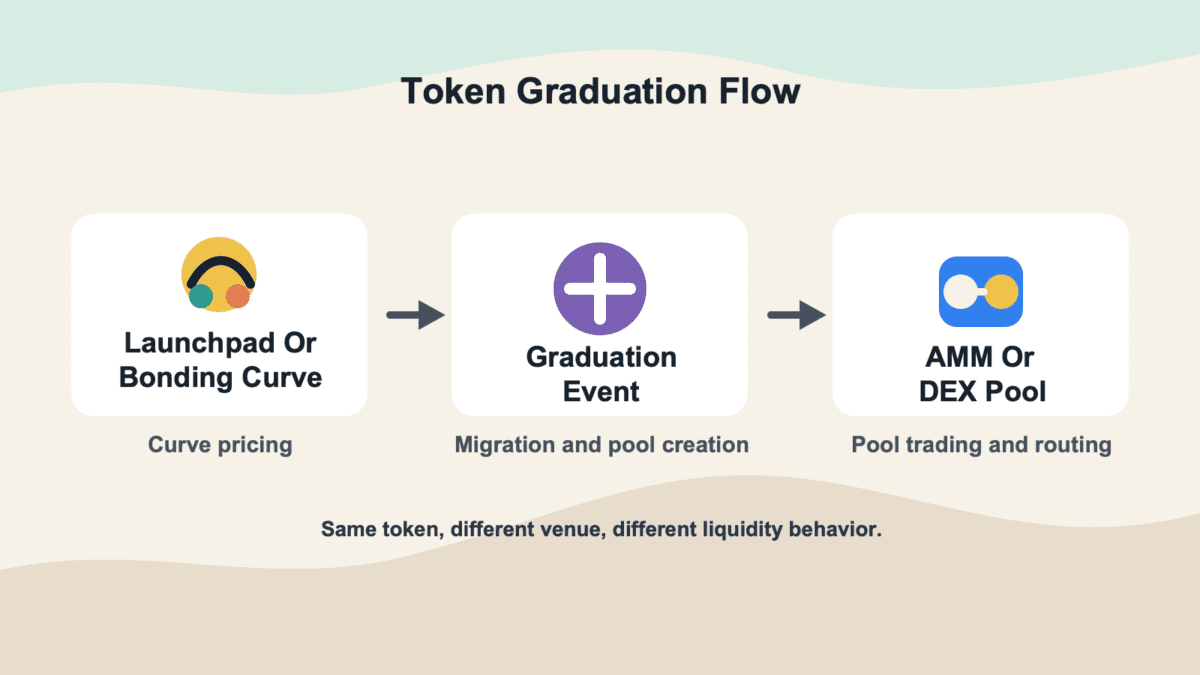
The lifecycle is easier to read when you separate each stage from its trader effect.
| Stage | What Changes For Traders |
|---|---|
| Token creation | The token appears on a launchpad, often with fresh-wallet and creator-wallet risk still unclear. |
| Launchpad trading | Buyers trade through the launchpad interface or bonding curve instead of a mature market pool. |
| Bonding curve progress | Price movement and available supply are shaped by the curve’s rules, not a normal order book. |
| Graduation event | The token crosses a platform milestone and can migrate into a pool or wider DEX route. |
| Post-graduation trading | Screeners, aggregators, and AMM routes may show the token in a more familiar market view. |
Continuity is the messy part. A chart can look different after graduation because the price source, pool address, and venue may change. The token did not become a new asset. The same token is now being priced through a different market structure.
For beginners, exact threshold numbers should come later. They can change by platform, date, token pair, or stale screenshot. First confirm that the token actually graduated, where it migrated, and whether the post-graduation pool has enough real liquidity to absorb buys and sells.
Graduation changes the market plumbing. Once a token moves to an AMM, trades usually happen against a liquidity pool instead of the launchpad’s early pricing model.
That can make the token easier to discover. DEX aggregators may route through the pool, screeners may show a new pool address, and traders in the trenches can see cleaner candles. Cleaner candles are still allowed to be rude.
Three things change first:
AMMs price trades based on pool balances. If the pool is thin, one larger buyer can push price up fast, and one seller can push it down just as quickly. Slippage can turn a neat-looking entry into a worse fill than expected.
Graduation risk gets sharper here. More routing can attract bots and short-term traders, not just casual buyers. That can create PVP trading conditions where your buy is someone else’s exit path. So the AMM phase can improve access while making impulse entries more expensive: clearer venue, faster data, wider discovery, and less patience for weak demand.
Graduation can look bullish because it is visible. The token hit a milestone, traders notice the migration, and the chart may get a new audience.
But visibility cuts both ways. The same milestone that pulls in late buyers can give earlier buyers a cleaner place to sell. That is classic exit liquidity risk, just with confetti on the chart.
> Graduation proves the token reached a platform threshold. It does not prove demand will survive the next sell wave.
The danger is not one single rug pattern. A hard rug usually involves a sharper break in liquidity or control. A soft rug can look slower, with creators, insiders, or early clusters selling while the story stays alive.
Watch for these danger signs before you chase a graduated token:
The warning is simple: graduation is not a safety badge. Burned or locked liquidity can reduce one removal risk, but it does not stop holders from selling tokens they already control.
That is how a late buyer becomes a bagholder. The token looked stronger at the exact moment the best sellers had the cleanest exit. It can also become a top signal if the milestone attracts attention after the easy move is already gone.
Pump.fun graduation dominates the way traders use the term, but graduation is bigger than one platform. Any launchpad can define its own threshold, migration process, fee rules, and post-graduation venue.
The current Pump.fun fees page ties graduated Pump.fun coins to associated pools on PumpSwap and lists a 0.015 SOL fee when a coin graduates from Pump.fun to PumpSwap. That is why current Pump.fun graduation should not be explained as automatically going to Raydium.
Check the platform before assuming the path:
Older pages mention Raydium because the venue history changed. CoinGecko’s Pump.fun guide covers the move from Raydium-era migration to PumpSwap, while Bitquery lifecycle documentation tracks the flow from Pump.fun creation through graduation and PumpSwap trading.
Other launchpads can work differently. Meteora, LetsBonk, Believe, Moonshot, and similar Solana launch tools may use different venues, curves, routing paths, or incentives. Jupiter may route trades after a pool exists, but that does not mean Jupiter is the graduation venue. So avoid universal wording, and check the launchpad, token page, mint address, and pool address before assuming where liquidity lives.
Graduation gets confused with bonding, migration, and listings because the words appear in the same small window. They are related, but they are not the same.
Read each word by the job it does. Some describe pricing. Some describe movement. Some describe the venue after movement.
| Term | Meaning In This Context |
|---|---|
| Bonding curve | A pricing model where buys and sells follow a programmed curve during early launchpad trading. |
| Bonding | The process of trading along that curve before the token reaches the launchpad’s milestone. |
| Graduation | The milestone where the token leaves the early launchpad phase for broader market trading. |
| Migration | The technical or platform process that moves trading into a new venue or pool. |
| Liquidity pool | The token pair that AMM traders buy from and sell into after migration. |
| AMM | The automated market maker that prices trades from pool balances. |
| DEX listing | A broader phrase for being tradable on a decentralized exchange or through DEX routes. |
| CEX listing | A centralized exchange listing, which is separate from launchpad graduation. |
This distinction prevents a common mistake. A token can be bonding without having graduated. It can graduate without being listed on a centralized exchange. It can move into a liquidity pool and still trade poorly because the pool is shallow.
Graduation is the transition word. Bonding describes the pre-transition pricing phase. Migration describes the move. The AMM or DEX pool is the next place traders meet.
Checking graduation before buying means verifying the transition, then testing whether the new market can survive real selling. Do not stop at the word “graduated” on a chart or alert.
Start with identity. Confirm the mint address, launchpad page, pool address, and venue. A wrong pool can make a real token look fake, or a fake token look real long enough for someone to get paid.
If the identity check is fuzzy, stop there. A clean thesis cannot sit on a messy token address.
Then look at liquidity and behavior. Pool depth, slippage, sell pressure, creator-wallet movement, and holder concentration matter more than the milestone label. If the creator is an anon dev, wallet behavior carries even more weight.
Use this checklist before you buy the graduation candle:
| Check | What It Tells You |
|---|---|
| Actual graduation status | Whether the token crossed the milestone or is only near it. |
| Venue and pool address | Where trades now happen and whether you are looking at the right market. |
| Pool depth | Whether normal buys and sells can happen without brutal slippage. |
| Buy and sell balance | Whether post-graduation demand is real or only one-sided hype. |
| Early wallet behavior | Whether the best-positioned holders are distributing into attention. |
| Holder concentration | Whether supply is spread out or still controlled by a tight cluster. |
| Creator-wallet moves | Whether the deployer or related wallets are adding trust or creating pressure. |
| First candles after graduation | Whether the chart absorbs selling or instantly turns into a trap. |
This is not a safety formula. It is a filter for obvious mistakes. If a token passes the milestone but fails the checks, the milestone is just a brighter warning label.
Also be careful with the first dump. A red candle after graduation is not automatically a bottom signal. Sometimes it is just early holders proving the exit door works.
Related terms help because graduation sits inside a larger launchpad risk map. The word tells you a token moved phases, but adjacent slang explains who benefits, who gets trapped, and why the candles can turn mean.
Living in the trenches describes the habit of hunting fresh tokens before most traders notice them. That is where graduation alerts, bonding progress, and sniper behavior usually appear.
Social chatter can move faster than careful checks.
Use those terms as context, not decoration. Graduation sits at the crossing point between mechanics, culture, and timing. That is why the same milestone can feel like a launch event for one trader and a sell window for another.
You do not need to memorize every nickname. You need to recognize the setup faster. When a token graduates, you are reading a market handoff, a crowd reaction, and a liquidity test at the same time.
Graduation in crypto means a token has completed a launchpad milestone and moved into a broader trading phase, often a DEX or AMM pool.
It is most common around launchpad tokens and bonding curves. It describes market structure, not project quality.
Pump.fun graduation is the point where a Pump.fun token leaves its early launchpad phase and moves into post-graduation trading, currently tied to PumpSwap context.
That does not mean every old article about Raydium is still current. Check the platform’s current flow and the token’s actual pool before trading.
No, graduation does not mean a token is safe. It only means the token crossed a platform milestone.
The token can still dump after graduation. Creator wallets, early holders, thin liquidity, bot activity, and weak demand can all hurt late buyers.
No, graduation does not always move a token to PumpSwap. PumpSwap is the current Pump.fun context, not a universal rule for every launchpad.
Other launchpads can use different venues, pools, thresholds, and routing setups. Always check the launchpad and pool address.
Graduation is not exactly the same as a DEX listing. Graduation is the milestone or transition, while a DEX listing describes where the token can trade.
In practice, graduation often leads to DEX or AMM trading. But it does not imply a centralized exchange listing or broad market trust.
Yes, a token can dump after graduation. The milestone can attract late buyers while early holders sell into better liquidity.
That is why pool depth, sell pressure, holder concentration, and creator-wallet behavior matter more than the graduation label alone.
Start graduation research by proving the token moved phases, then decide whether the new market is worth touching. The word “graduated” should make you check more, not click faster.
Give the token a few minutes if the first pool data is messy. Fast alerts can be useful, but rushed entries often happen before the pool, chart, and wallet behavior tell the same story.
Use a short routine before acting:
If one check fails, do not let the milestone talk you into ignoring it. A shallow pool, clustered holders, or a nervous creator wallet can erase the advantage of early access.
If you want to hold through the noise, make it a researched conviction play, not a reflex buy because a progress bar filled up. And if capital starts rotating from one hot launchpad token to the next, learn how rotation changes attention before you become the final bid.