Physical Address
304 North Cardinal St.
Dorchester Center, MA 02124
Physical Address
304 North Cardinal St.
Dorchester Center, MA 02124


Bag rotation is the crypto slang to understand before chasing the next hot coin.
Bag rotation in crypto is trader slang for moving capital from one crypto holding to another because the first bag has run, stalled, or become too risky while a new asset or safer destination looks better.
The phrase sounds tactical, but it is not a signal by itself. It can mean trimming a winner, cutting a stale altcoin, parking profit in stablecoins, or moving into a new narrative after the old one cools.
That range gives bag rotation its edge. A planned move can protect gains. A rushed move can turn one tired bag into a louder problem with better memes and worse liquidity.
Bag rotation means moving money out of one crypto bag and into another destination because the first holding no longer looks like the best use of capital. The destination can be another coin, Bitcoin, Ethereum, stablecoins, cash, or a smaller remaining position in the same bag.
A “bag” is simply a holding. The term can be neutral, but it often carries baggage of its own. A trader might call a profitable position a bag, while a losing holder may end up stuck with bagholder risk after the market moves on.
That gives the phrase its emotional edge. Nobody wants to be the last person lovingly guarding a dead chart. Bag rotation is one way traders try to avoid that fate, although the move can create the same problem somewhere else.
The exact phrase “bag rotation” is niche. The pieces are not. Crypto traders talk about bags, bagholders, rotation, alts, narratives, and profit-taking all the time. Together, they point to a clear idea: capital leaves one holding because another destination looks better now.
Bag rotation is not automatically smart, and it is not automatically reckless. The move needs a reason beyond “this new thing is running and my old thing is boring.”
Watch the intent behind the move:
So the bag rotation meaning comes down to why capital moves, where it goes, and what plan exists if the new destination fails.
Bag rotation works by moving capital from an old holding to a chosen destination. First, the trader decides that the old bag has already done its job, stopped doing its job, or become too risky for the current market.
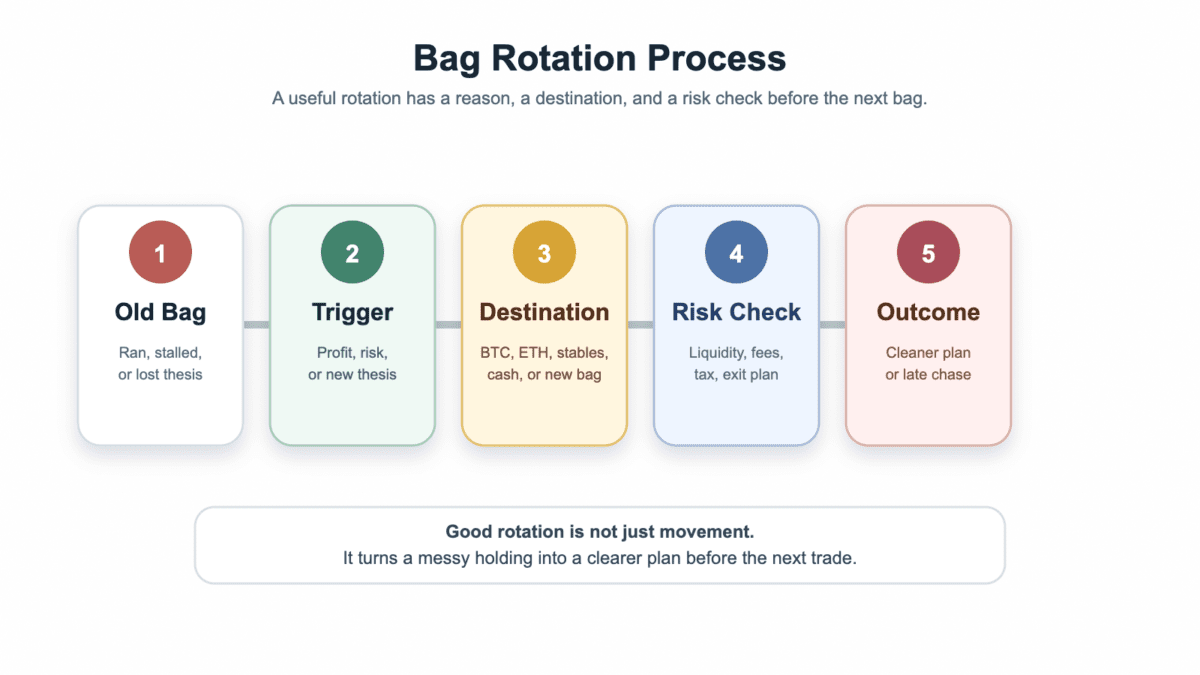
_Bag rotation should move through a reason and a risk check before capital reaches the next destination._
The old bag might be an altcoin that doubled, a meme coin that lost momentum, or a token that no longer matches the trader’s thesis. Sometimes the old bag is still up. Sometimes it is down so badly that the trader is deciding whether to salvage what remains.
Then comes the trigger. A trader may rotate because a catalyst passed, volume faded, a new narrative got stronger, a vesting event is approaching, or the position became too large. The trigger should be specific enough that someone else could understand it without needing your group chat.
The destination is the part many traders rush. Crypto bag rotation does not always mean buying another risky alt. Capital can move into several buckets:
That last option is underrated. No trade is not a personality defect. It is sometimes the only move that keeps a profit from turning into tuition.
Here is a simple example. A trader holds an altcoin that ran hard on a listing rumor. The rumor plays out, volume starts fading, and the token is now a large share of the trader’s portfolio.
Instead of selling everything or riding the whole position back down, the trader trims part of it.
Some capital moves to stablecoins. A smaller piece stays in the original bag in case momentum continues. The trader considers a new meme coin, but skips it because liquidity is thin and the chart already moved before the entry.
That is bag rotation with restraint. It can still be wrong. But it has a reason, a destination, and a refusal to let one noisy chart make the whole decision.
Bag rotation is about a specific holding. Altcoin rotation is about broader market money moving between Bitcoin, Ethereum, altcoins, sectors, or narratives. Rebalancing is a planned portfolio process, not trader slang.
That distinction protects the decision. The same word, rotation, gets used for very different moves. A person rotating out of one stale meme coin is not doing the same thing as a market-wide move from Bitcoin into alts. A portfolio that returns to target weights is doing something else again.
Traders may watch Bitcoin dominance, TOTAL2, TOTAL3, and the Altcoin Season Index for context. Those tools can show whether money is broadening into alts or concentrating in majors. They do not prove that your specific bag deserves more capital.
The clean distinction looks like this:
| Term | What It Really Means |
|---|---|
| Bag rotation | Moving capital from one specific crypto holding to another destination |
| Altcoin rotation | Broader market movement from BTC or majors into altcoins or sectors |
| Coin rotation | A general phrase for money moving between coins as momentum shifts |
| Crypto portfolio rebalancing | Returning holdings to planned target allocations |
| Profit taking | Selling part or all of a winning position to lock in value |
They can overlap. A trader may rotate one bag during a broader altcoin rotation. Another may rebalance by trimming a winner and adding to a weaker target allocation.
But the risk logic is different. Bag rotation asks, “Is this specific holding still worth this capital?” Broader crypto rotation asks where market attention and liquidity are moving. Rebalancing asks whether your portfolio drifted away from its plan.
Mixing them up creates bad decisions. A broad altseason story can become an excuse to hold a weak bag. A rebalancing plan can become a cover story for panic selling. And bag rotation can become a nicer phrase for chasing a chart that already left the station.
Keep the labels clean before acting. The name of the move should match the reason for the move.
Traders use bag rotation because capital has opportunity cost. A bag that once looked strong can become too large, too stale, too illiquid, or too disconnected from the current market.
Profit taking is the most direct reason. If a holding has moved fast, rotating part of it can lock in value while leaving some exposure. The trader avoids the all-or-nothing trap and keeps a smaller moon bag alive.
Another reason is thesis decay. Maybe the original catalyst passed. Maybe development slowed. Maybe the token’s narrative stopped matching what the market is rewarding. Holding only because the entry price hurts is not conviction. It is nostalgia with a chart.
Narrative attention also drives rotation. Crypto traders often follow the current crypto meta, such as AI, DePIN, memes, RWA, L2s, or whatever the market is currently rewarding. These categories are examples, not recommendations.
Common motives usually fall into a few buckets:
Some traders rotate because the market itself changes tone. When Bitcoin leads, smaller alts may lag. When risk appetite broadens, capital may move into higher-beta assets. When liquidity dries up, the cleaner move may be reducing exposure rather than reaching for more risk.
The mistake is confusing activity with skill. A trader can make a good decision for a bad reason and still get lucky. That does not make the process repeatable.
Bag rotation is easier to judge when the trader can name the old thesis, the new thesis, and the cost of being wrong. If the only reason is “everyone is talking about it,” the trade is already borrowing someone else’s excitement.
Bag rotation turns into chasing when the new bag is chosen because it is already loud, already vertical, or already impossible to ignore. The move may feel decisive, but it can be late buying with better branding.
The danger is not only price. Thin liquidity can make a chart look strong until you try to enter or exit with size. A small market can move quickly, then punish the late crowd when early holders sell into new demand.
That is how someone can escape one weak bag and still become exit liquidity in the next one. The old position was stale. The new one may be crowded. Both can be bad uses of capital.
Social pressure makes this worse. A feed full of green screenshots can make patience feel like incompetence. A token chat can make every dip sound like FUD and every warning sound like weakness.
> A rotation is dangerous when the plan is mostly urgency, the liquidity is thin, and the exit depends on finding a later buyer.
Late rotations often share the same clues:
A top signal does not always mean price must fall. It means the easy upside may already be crowded with late attention. Bag rotation gets risky when that attention becomes the main reason to buy.
Emotional attachment can also distort the old side of the trade. Some users refuse to sell a weak bag because selling would make the loss real. Then they finally rotate only after frustration peaks, which is often when the new target is already extended.
The goal is not perfect timing. Nobody gets that. The goal is refusing to let one bad position push you into a second rushed one.
Before bag rotation, check the reason for leaving, the reason for entering, and the cost of being wrong. If those three pieces are vague, the trade is not ready.
Start with the old bag. Write the original thesis briefly. Then write what changed. If nothing changed except your patience, you may be reacting to boredom. If the catalyst passed, liquidity faded, or the risk changed, rotation may have a stronger case.
Then check the new destination. A conviction play needs a thesis you can explain without leaning on noise. “It is pumping” is not a thesis. It is a description of the thing you already missed.
Use a short checklist before moving capital:
Tax is not the main story, but it should not be ignored. For U.S. filers, IRS digital asset guidance requires people using seven federal return forms, including 1040, 1040-SR, 1040-NR, 1041, 1065, 1120, and 1120-S, to answer the digital asset question. Other jurisdictions have their own rules, so keep records before platform history becomes a scavenger hunt.
Custody also changes the trade. A rotation on a centralized exchange has different risks than a self-custody move through bridges, DEXs, and new token contracts. More steps create more places to make a bad click.
The final check is ugly but useful. Ask what happens if the new bag drops hard right after entry. If the answer is “I will just rotate again,” pause. That is not a plan. That is a subscription to overtrading.
Bag rotation profits can go into lower-risk crypto assets, stablecoins, cash, another altcoin, a smaller remaining bag, or nowhere at all. The destination should match the reason for rotating.
A trader taking profit after a fast move may want dry powder. A trader cutting a broken thesis may want a cleaner setup. A trader reducing concentration may want BTC, ETH, or cash. There is no universal best choice because the problem changes.
The choices break down like this:
| Destination | What It Changes |
|---|---|
| Bitcoin or Ethereum | Keeps capital in crypto while reducing relative altcoin risk |
| Stablecoins | Parks value and creates dry powder for later entries |
| Cash or bank account | Removes crypto market risk and may help lock real-world gains |
| Stronger altcoin | Keeps upside exposure but raises timing and thesis risk |
| Smaller same-bag position | Lets the trader trim while leaving a moon bag |
| No trade | Avoids forcing capital into crowded or unclear setups |
Stablecoins and cash can feel boring after a strong run. That is partly why they work. They reduce the need to make the next decision under pressure.
Another altcoin can make sense when the new thesis is stronger, liquidity is real, and position size is controlled. It becomes fragile when the move is just a transfer of hope from one chart to another.
Leaving a smaller same-bag position is often the least dramatic version of rotation. The trader reduces risk but still has exposure if the original asset keeps running. It is not perfect. It is just less binary than selling everything or holding everything.
No trade deserves respect too. If every destination looks crowded, keeping capital still can be the cleanest rotation available.
A bag rotation example works best when it avoids fake precision. The point is not to pretend a trader can forecast every candle. The point is to show how the decision can be structured.
Imagine a trader holds an altcoin that caught a strong narrative bid. The position is up, the token is suddenly everywhere on CT, and the original catalyst has already played out. The trader still likes the project, but the position has become too large.
Instead of selling the whole bag, the trader trims part of it. Some capital moves to stablecoins. A smaller portion stays in the original asset as a moon bag. The trader also reviews a newer meme coin that everyone is posting about, then skips it because liquidity is thin and the entry depends mostly on social momentum.
That is not a guaranteed winning move. The old alt may continue higher. The skipped meme may run. The stablecoin portion may feel painfully boring while everyone else posts screenshots.
But the decision has discipline. It names the reason for trimming, protects part of the gain, avoids an all-in chase, and keeps some upside alive. It also creates a record the trader can review later.
Now flip the example. The trader refuses to trim the old bag because selling feels wrong. The chart fades. A new coin starts pumping. The trader rotates everything at once, pays a bad spread, ignores the lack of exit liquidity, and tells themselves they will be faster this time.
That is the loop bag rotation is supposed to break. It rarely breaks when the plan is written after the trade.
Related terms help explain bag rotation because the phrase sits between trader slang, market cycles, and risk control. You do not need a glossary pile. You need the few concepts that change the decision.
Some terms describe the old position. A bag is the holding. A bagholder is the person stuck with it after demand fades. FOMO and FUD describe the pressure around leaving or entering. Slippage and liquidity describe the cost of trying to move.
Other terms describe the new destination. A meta is the current hot theme. A conviction play is a thesis-backed position. A top signal is a sign that excitement may be crowded. Exit liquidity is the danger of arriving late enough to fund someone else’s exit.
Here is the useful split:
| Term | How It Connects To Bag Rotation |
|---|---|
| Bagholder | The risk state rotation often tries to avoid |
| Meta | The hot theme traders may rotate toward |
| Top signal | A warning that the new bag may already be crowded |
| Exit liquidity | The role a late buyer can accidentally play |
| Conviction play | A thesis-backed reason to hold or rotate |
| Liquidity | The condition that determines whether the move can happen cleanly |
These terms are not decorations. They are checks. If the new bag has no liquidity, the meta is exhausted, and the thesis is mostly FOMO, the vocabulary is telling you to slow down.
If the old position is the problem, start with bagholder risk. That guide explains the stuck-holder side of the trade, which is often what bag rotation is trying to avoid.
If the new destination looks too popular too quickly, check the top signal signs before moving. They help separate real strength from the late-stage excitement that can make a rotation feel urgent.
Start by writing down the old thesis, the new destination, and the mistake you are trying to avoid. If that sounds too slow for the trade, the trade may be the problem.
The goal is not to predict the perfect top or bottom. It is to stop capital from moving only because one holding feels painful and another chart feels exciting.
Use this short process before making a move:
Keep the first pass boring. If the old bag still has a valid thesis and the new idea only has social pressure, waiting may be cleaner than rotating. If the old thesis broke and the destination has real liquidity, a partial move can be easier to judge later than a dramatic all-in swap.
Write the failure condition before the entry. That can be a broken catalyst, poor liquidity, a position size that no longer fits, or a destination that stops matching the reason you chose it. Without that line, the new bag can become the same problem with a fresher chart.
Then size the move so being wrong does not force another desperate rotation. A partial trim can be cleaner than a full exit. A stablecoin pause can be cleaner than buying a crowded pump. A no-trade decision can be cleaner than pretending every profit needs a new home.
Bag rotation is useful when it turns a messy holding into a clearer plan. It is dangerous when it turns one emotional trade into a faster one.
Bag rotation means moving capital from one crypto holding to another destination. Traders usually use the phrase when an old bag has pumped, stalled, lost its thesis, or become too risky.
Bag rotation can include taking profits, but it is broader. Taking profits means selling some or all of a winning position. Bag rotation focuses on where that capital goes next.
Bag rotation is not the same as altcoin season. Bag rotation is a move involving a specific holding, while altcoin season describes broad market strength across many altcoins.
Bag rotation can help avoid becoming a bagholder when it cuts a stale or broken position before liquidity disappears. It can also create a new bagholder problem if the trader rotates late into a crowded asset.
You should not rotate a losing crypto bag just because the loss feels bad. Check whether the original thesis broke, whether the new destination is stronger, and whether the move reduces risk or simply restarts it.
Bag rotation may create taxable or reportable activity when it involves selling, swapping, or otherwise disposing of digital assets. Rules vary by country, so keep transaction records and check the rules that apply where you file.