Physical Address
304 North Cardinal St.
Dorchester Center, MA 02124
Physical Address
304 North Cardinal St.
Dorchester Center, MA 02124


A plain-English guide to FDV, market cap, token unlocks, and low-float risk.
FDV, or fully diluted valuation, is the market value a crypto project would have if every token that can exist were counted at today’s price.
Many tokens do not trade with their full supply from day one. Locked insider allocations, emissions, airdrops, presale tokens, and future unlocks can sit outside the current float while the chart still looks clean.
FDV brings that missing supply back into the valuation question: is the token actually cheap, or is most supply still waiting to reach the market?
FDV in crypto means fully diluted valuation. It estimates a token project’s value if all possible tokens were priced at the current market price.
The plain formula is simple:
FDV = current token price x total supply or max supply
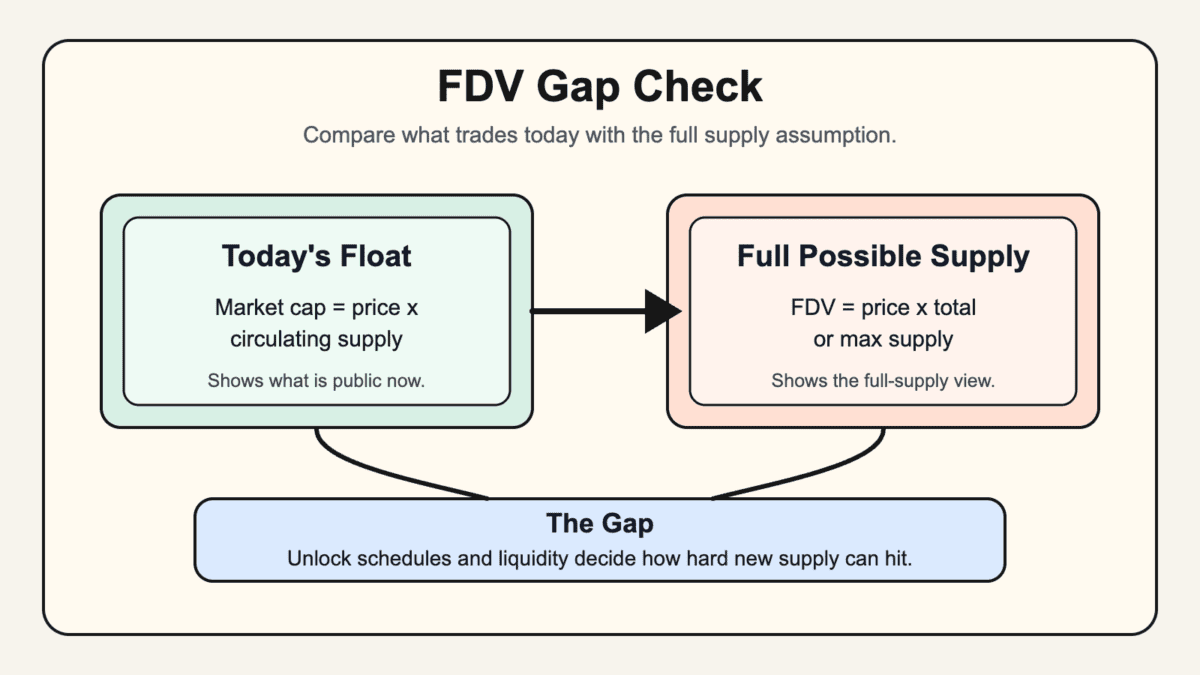
Market data pages often show FDV beside market cap because the two numbers answer different questions. Market cap looks at the tokens counted as circulating now. FDV looks at the full-supply assumption.
Read the two numbers together:
Use round numbers. If a token trades at $1 and has a max supply of one hundred million tokens, its FDV is $100 million. If only ten million tokens circulate today, its market cap is $10 million.
That gap is the point.
The project may look small by market cap, but the current price already implies a much larger full-supply valuation. Future tokens still have to meet real buyers when they unlock, emit, vest, or get claimed.
FDV does not predict future price. It also does not say every future token will sell immediately.
It shows the valuation implied by today’s price if the whole possible supply were counted. That makes FDV useful for new listings, presales, airdrops, DeFi tokens, and low-float launches.
You calculate FDV in crypto by multiplying the current token price by the token’s total supply or max supply. The tricky part is choosing the right supply input.
Total supply usually means tokens that exist now, minus any tokens that have been permanently removed if the data platform adjusts for burns. Max supply means the most tokens that can ever exist under the token’s rules.
Some tokens have both. Some have no fixed max supply.
Because the supply input can change, two dashboards may show different FDV figures. One may use total supply. Another may use max supply. A third may adjust for burned tokens, missing data, or unclear supply reporting.
Start with the inputs before trusting the output:
| Input | What To Check |
|---|---|
| Current price | Use the same market price source for market cap and FDV. |
| Circulating supply | Check what the dashboard counts as public float. |
| Total supply | Confirm whether burned or locked tokens are included. |
| Max supply | Check whether the token has a hard cap. |
| Unlock schedule | Match future supply with vesting, emissions, and claims. |
| Supply source | Prefer official tokenomics pages, explorers, and known data platforms. |
Now use the same hypothetical token from above. At $1, ten million circulating tokens create a $10 million market cap. With one hundred million max supply, FDV becomes $100 million.
The market cap / FDV ratio is one tenth, or 10%. The FDV is ten times the current market cap. That means most supply is still outside the counted float.
This does not make the token good or bad. It tells you what to inspect next: when the other supply arrives, who receives it, and whether liquidity can absorb selling without turning the chart into modern art.
FDV vs market cap in crypto compares the full-supply assumption with the supply that trades now. Market cap is today’s float. FDV is the whole possible supply valued at today’s price.
The gap between them can reveal future supply overhang. A small gap means most supply is already counted. A wide gap means future supply may still be waiting behind locks, vesting schedules, emissions, airdrop claims, or treasury releases.
| Metric | What It Tells You |
|---|---|
| Market cap | Current price multiplied by circulating supply. |
| FDV | Current price multiplied by total or max supply. |
| Market cap / FDV | The rough share of full valuation already circulating. |
| FDV / market cap | How many times larger the full-supply valuation is. |
| Unlock schedule | When missing supply may become sellable. |
| Liquidity | Whether buyers can absorb new supply. |
If market cap is close to FDV, most of the supply is probably already public. If FDV towers over market cap, the token may be priced on a small slice of supply. That can make early charts deceptive because a $10 million market cap can still carry a $100 million full-supply valuation.
Market cap is still useful because it shows the size of the tradable market today. If market cap itself still feels fuzzy, CryptoProcent’s broader crypto guides are a better detour than guessing from a dashboard.
FDV adds the second layer by asking whether today’s price still makes sense after the rest of the supply is counted.
High FDV can be risky because future supply may need new buyers at the same price. If demand does not grow with supply, the market has to absorb more tokens with the same or weaker bid depth.
The risk is not just dilution. It is sellable dilution, because locked tokens can become transferable through cliff unlocks, linear vesting, emissions, treasury releases, and airdrop claims.
Tokenomist’s 2025 Token Unlocks Review reported that 2025 saw $97.43 billion in total token unlocks across major sectors. The schedule behind an FDV gap can matter more than the headline number alone.
That is why the FDV gap deserves a closer look. A low market cap with a huge FDV often means only a small public float is trading. The chart may look early because the supply is early, not because the valuation is cheap.
The warning signs usually cluster:
This is where exit liquidity becomes more than a rude phrase. Late public buyers may be the demand that lets early recipients sell unlocked supply.
That does not make every high-FDV token a scam. A visible vesting schedule is different from a soft rug, where poor design or insiders slowly drain confidence without one dramatic theft. The outcome can still feel ugly if hype fades right as supply opens and holders become bagholders.
High FDV can be less concerning when future supply arrives slowly, demand is real, and liquidity is deep enough to absorb new tokens. The number needs context before it becomes a verdict.
Some projects carry high FDV because markets price future growth early. That can happen when the token has a strong use case, clear fees, active users, or a sector narrative pulling in sustained demand. Even then, a conviction play still needs supply math.
High FDV looks less alarming when several conditions line up:
Narratives can help demand, but they are not armor. A narrative coin can attract buyers for weeks, then lose support when attention rotates away.
So keep the bar high. The project needs enough future demand to justify the valuation and enough market depth to handle supply when it arrives. If that proof is missing, high FDV becomes a warning rather than a sizing input.
Low float, high FDV means only a small share of supply trades today while the current price implies a large full-supply valuation. It is one of the clearest warning phrases in crypto launch talk.
The phrase shows up often on CT because traders use it to describe launches where public buyers see a small market cap, but insiders, teams, treasuries, or airdrop allocations still hold much of the future supply.
That does not prove bad intent. It points to structure. A token can be venture-backed, launchpad-issued, or airdropped with a small float and still follow its published tokenomics, while buyers still miss how much supply can arrive later.
Use the language carefully:
| Phrase | What It Usually Means |
|---|---|
| Low float | Only a small share of supply is circulating. |
| High FDV | Today’s price implies a large full-supply valuation. |
| VC coin | A token with meaningful early-investor allocation. |
| Cliff unlock | A large batch of tokens releases at once. |
| Linear vesting | Tokens release gradually over time. |
| Exit liquidity | Public demand that absorbs someone else’s selling. |
In the trenches, the phrase also appears around meme coins and tiny launches. There, FDV needs to sit beside liquidity, holder concentration, contract permissions, and whether anyone can actually sell size without heavy slippage.
Low float, high FDV is not a magic short signal. It is a prompt to check the missing supply, when it arrives, who gets it, and whether the market can handle it.
Traders use FDV before buying a token to check whether the current price already prices in too much future supply. The goal is not perfect prediction. It is avoiding obvious supply traps.
Start with the dashboard numbers, then leave the dashboard. Market cap and FDV tell you there is a gap. The unlock schedule, recipient groups, and liquidity tell you whether that gap can hurt.
Before buying a high-FDV token, run the checks in order:
Recipient groups behave differently. Team tokens, investor tokens, treasury releases, airdrop claims, validator rewards, and liquidity incentives do not all hit the market with the same incentives.
Timing can make the risk sharper. A crowded launch can become a top signal if buyers chase a small float without checking the next supply event.
A weak market can create a bottom signal only when demand, supply, and sentiment start lining up again. Use a simple same-sector comparison before acting:
| Token Setup | FDV Read |
|---|---|
| Most supply circulating, steady volume, slow emissions | Same FDV can be easier to absorb. |
| Tiny float, near investor cliff, shallow liquidity | Same FDV carries sharper supply risk. |
Presales deserve extra caution. A presale page may show a low entry price and a low initial market cap, but the real question is the implied FDV and the release schedule after listing.
That is where unit-price traps appear. A token priced at fractions of a cent can still be expensive if the supply is massive. Some lottery-ticket trades are fine as small, speculative bets. They are dangerous when buyers mistake a tiny unit price for a cheap valuation.
The clean workflow is boring, which is why it works. Compare FDV with market cap, read the unlock schedule, check liquidity, compare peers, and size the trade around what can go wrong.
FDV mistakes usually start with using one number as a full answer. FDV is useful, but it cannot replace supply schedules, liquidity checks, sector context, or basic risk control.
The first mistake is treating FDV as a future price forecast. FDV does not say the token will reach a larger market cap later. It says today’s price implies that valuation if the full supply were counted.
Another mistake is comparing unrelated sectors. A DeFi token, an L2 token, a meme coin, and a gaming token can have different demand drivers, release schedules, and liquidity profiles. Watch for these common errors:
The rug label needs care. A hard rug involves abrupt theft, liquidity removal, or malicious control. High FDV is usually a visible tokenomics risk, not proof of that kind of attack.
FDV can still reveal predatory design. A token can be legal, documented, and still awful for late buyers if the float is tiny and future supply is pointed at public demand. If a token fails the FDV, market cap, unlock, liquidity, and recipient checks, you do not need a dramatic label.
Related FDV concepts help explain what the number can and cannot show. FDV is strongest when it sits inside supply, liquidity, and trader-language context.
Market cap gives the current valuation. Tokenomics explains where future supply comes from. Liquidity shows whether buyers can absorb that supply without heavy price impact.
Use these concepts around FDV:
| Concept | How It Helps With FDV |
|---|---|
| Market cap | Shows the value of circulating supply today. |
| Tokenomics | Maps caps, allocations, vesting, emissions, burns, and utility. |
| Circulating supply | Shows the public float behind market cap. |
| Unlock schedule | Shows when missing supply can become liquid. |
| Exit liquidity | Explains who absorbs selling when supply opens. |
| Holder concentration | Shows whether a few wallets can shape supply pressure. |
| Bagholder risk | Describes the holder outcome after hype fades. |
| Trader slang | Flags launch risks that supply data should confirm. |
The table is not a checklist to memorize. It is a way to avoid asking FDV to do every job.
If FDV looks stretched, move from the headline number to market cap, float, unlocks, liquidity, recipient incentives, and demand quality. That sequence explains more than any single ratio.
When one FDV number raises more questions, these pages fill in the missing pieces:
That keeps slang in its place. Social-trading language can warn you about a low-float launch, but the supply schedule decides whether the warning has teeth.
Start with FDV by comparing it with market cap before you buy, claim, farm, or hold a new token. The gap tells you whether current supply and future supply tell different stories.
Use FDV before the trade, not after a red candle forces the lesson. It gives you a slow step in a market that often rewards fast clicks until it suddenly does not.
Then turn that gap into actions:
The next step is not a venue choice. It is understanding the supply setup before choosing trade size, wallet path, or whether to skip the token.
If the answer looks messy, that is useful information. A skipped trade can be the cleanest trade when the supply math does not line up.
FDV is not there to scare you away from every new token. It is there to slow the click when the chart looks cheap but the full-supply valuation says, “maybe read the fine print first.”
FDV means fully diluted valuation in crypto. It estimates a token project’s market value if every token that can exist were counted at the current price.
A high FDV is not always bad, but it raises the burden of proof. You need to check circulating supply, unlock timing, recipient groups, liquidity, and whether demand can absorb future tokens.
FDV uses total or max supply, while market cap uses circulating supply. Market cap shows today’s tradable valuation, and FDV shows the implied full-supply valuation.
Token unlocks do not change FDV by themselves unless supply inputs or price change. They affect the risk behind FDV because locked tokens can become sellable and add pressure to the market.
Low float, high FDV means only a small share of tokens trades today, but the current price implies a large valuation for the full supply. It is a warning to check unlocks before trusting a low market cap.
Yes, use FDV before buying a presale token because initial market cap can hide future supply. Compare FDV with sector peers, read vesting terms, and check how much supply can unlock after listing.