Physical Address
304 North Cardinal St.
Dorchester Center, MA 02124
Physical Address
304 North Cardinal St.
Dorchester Center, MA 02124


A plain-English guide to AI meta, AI agents, AI tokens, and the risks behind the narrative.
AI meta in crypto is the market narrative around tokens, agents, memecoins, and infrastructure projects that connect artificial intelligence with blockchain.
The phrase is trader slang, not a product category with clean borders. It usually appears when AI-linked tokens, AI agents, compute networks, data projects, or agent-themed memecoins start pulling attention across X, Reddit, launchpads, exchange lists, and sector dashboards. That is why AI meta can help and hurt at the same time: it can point to a real theme, or dress a weak token in a shiny headline with a chart attached.
AI meta means the AI-focused market theme that crypto traders are currently watching, trading, and copying. In this use, “meta” means the dominant attention pattern, not the company behind Facebook.
Crypto traders use “meta” when a theme starts shaping what people buy, build, copy, and explain. AI meta narrows that idea to artificial intelligence and blockchain, which is why the label can cover serious projects and unserious launches in the same breath.
A decentralized compute network, an AI-agent platform, a data marketplace, and an AI-themed memecoin can all trade under the same loose label when the market is hungry for AI exposure.
Separate AI meta from these common false matches:
CryptoProcent’s guide to meta explains the parent slang. AI meta is the narrower version of that market shorthand.
So when someone says “AI meta is back,” they usually mean trader attention has returned to AI-linked crypto ideas. They are not saying every token in that theme has real demand, safe contracts, or a reason to exist.
The phrase should start a filter, not end one. First identify whether the project is an agent, token, memecoin, compute network, data tool, or payment system. Then test the claim behind the label.
AI meta became a crypto narrative because artificial intelligence already dominates wider tech talk, and crypto markets like themes that can be packaged, traded, and repeated. Once traders saw AI agents, compute markets, and AI-branded tokens moving together, the label became easy shorthand.
The outside AI story gives crypto a large halo. ChatGPT made AI feel mainstream, Nvidia made compute feel valuable, and crypto projects attached that energy to tokens, wallets, data, agents, and launchpad experiments. Market rotation did the rest: when capital leaves one hot sector and searches for the next one, traders often describe that move as rotation.
AI fits that pattern because the story is simple enough to spread and broad enough to contain many tickers.
The narrative also has many entry points. A user can find AI meta through a large-cap AI token, a Base agent token, a Solana memecoin, a DePIN compute project, or a trading tool that promises better screening.
A typical AI meta cycle looks like this:
That does not mean the narrative is fake. It means the narrative can move faster than product evidence. Crypto is very good at pricing a story before the receipts arrive.
The useful move is to separate the broad AI story from the specific token. A category can be hot while the token in front of you has weak liquidity, unclear supply, or no working product.
AI meta covers several layers, and each layer needs a different research check. A token tied to decentralized compute is not the same bet as an AI memecoin, and an agent with wallet access deserves more scrutiny than a simple analytics tool.
Use this map before chasing tickers. It keeps the category from turning into one giant bucket labeled “AI, probably.”
| Layer | What To Check |
|---|---|
| AI agents | What the agent can read, trade, sign, approve, or spend. |
| AI tokens | What the token pays for, secures, governs, or rewards. |
| AI memecoins | Whether value depends mostly on attention, culture, and launch timing. |
| Decentralized compute | Whether real users need the compute, storage, or inference market. |
| Data markets | Whether data quality, access rights, and paying demand are visible. |
| Security and research tools | Whether the tool improves scam checks, wallet monitoring, or market analysis. |
| Agent payments | Whether transactions need clear limits, logs, approvals, and controls. |
Some tokens in the AI meta are also narrative coin trades. Their demand depends heavily on the broader story, even when the project also has a product.
That split changes the risk. Narrative demand can vanish faster than technical progress. A project can keep building while its token cools. A meme can stay loud while its liquidity quietly dries up.
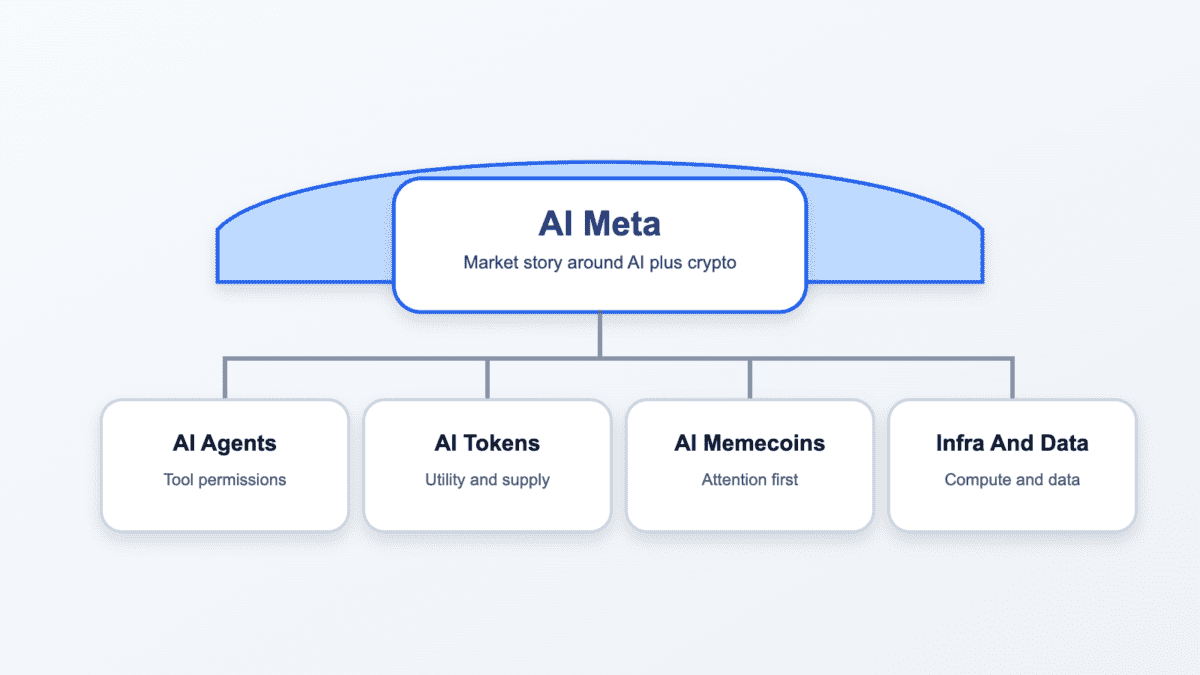
AI meta, AI agents, and AI tokens are related, but they are not the same thing. AI meta is the umbrella market story. AI agents and AI tokens are categories that can sit inside that story.
The confusion is normal because social posts often compress everything into one phrase. A trader may call an agent launch “AI meta,” a category page may list every AI token together, and a memecoin thread may use the same label for a mascot token with no real agent at all.
| Term | What It Means In Practice |
|---|---|
| AI meta | The broader crypto narrative around AI-linked projects, tokens, agents, and infrastructure. |
| AI agents | Software that can use tools, follow goals, and sometimes prepare or execute crypto actions. |
| AI tokens | Crypto assets tied to AI-related networks, services, data, compute, rewards, or governance. |
| AI memecoins | Attention-first tokens that use AI culture, AI personas, or agent stories as the hook. |
| DeFAI | A loose phrase for AI tools applied to DeFi research, automation, routing, or portfolio tasks. |
The cleanest question is what the thing actually does. If it is software acting with tools, inspect the agent. If it is a token, inspect the token role. If it is mostly a social mascot, inspect liquidity, holders, and launch mechanics first.
Blurring those terms helps hype travel. Separating them helps you avoid buying a word when you meant to buy a working system.
Traders chase the AI meta because it offers a clean story with fast social spread. A theme that combines artificial intelligence, crypto tokens, autonomous agents, and early-stage speculation is almost engineered to create FOMO.
There are rational reasons too. Early buyers sometimes want exposure before exchange listings, category dashboards, or larger accounts notice the theme. Builders may ship tools that solve real research, routing, or payment problems. Some traders simply follow where liquidity appears to be moving.
Much of the language spreads through CT, Telegram, Discord, Reddit, and launchpad communities. A few winning charts can turn into a market-wide label fast.
The chase usually has several fuel sources:
The trap is confusing attention with adoption. A token can trend because people expect other people to buy it. That loop can work for a while, then turn into a top signal when late buyers are mostly reacting to old momentum.
AI can be a real technology shift while a specific AI meta trade is still late. Both can be true. Rude, but useful.
The main AI meta risks are fake utility, thin liquidity, unsafe permissions, crowded trades, and projects using AI language to dress up weak token design. The label can make ordinary risk look more sophisticated than it is.
Agentic payments add another layer. Chainalysis reported that PayPal and OpenAI’s agentic checkout partnership connects tens of millions of merchants, a useful reminder that agent-led payments are moving toward mainstream checkout rails. For everyday crypto users, that means an AI agent should not get broad wallet power just because its dashboard looks polished.
Watch for these red flags before taking an AI meta token seriously:
Launchpad tokens can add more chaos. Bots may snipe early supply, insiders may exit into the first wave of buyers, and soft rugs can happen without one dramatic theft. Sometimes the team simply stops shipping while the chart keeps doing its little tragedy routine.
AI agents also fail in quieter ways. They can read bad data, follow spoofed liquidity, misread a wallet, overfit a signal, or recommend a position size that makes no sense. A confident answer is not the same as a safe action, especially when the tool can touch funds.
The takeaway is simple: AI meta risk is both market risk and software-permission risk. If a tool can only summarize public data, the downside is bad analysis. If it can touch funds, the controls need to be much tighter.
Researching an AI meta token starts with the token’s job. Before looking at a chart or social feed, ask what the token does that a normal app account, database, or subscription could not do just as well.
Then check whether the project has visible use. That can mean compute jobs, agent transactions, paying customers, active developers, data buyers, protocol fees, repeat users, or open product access. Vague “AI-powered” language is not evidence. It is seasoning.
Run these checks before money gets involved:
Position sizing belongs in the research process too. If the token is mostly narrative, small, illiquid, or unproven, it may belong in the same mental bucket as a lottery ticket, not a core portfolio position.
That does not make every small AI meta token worthless. It means the burden of proof rises when liquidity is thin, product evidence is weak, and the token depends on the crowd staying excited. Good research should slow the trade down.
If the only reason to buy is that the timeline is loud, the timeline has already done its job on you.
AI meta can be cooling in one corner of the market and still early in another. A launchpad microcap, an agent infrastructure project, and a decentralized compute network do not share the same timeline.
Focus on which evidence is improving and which evidence is fading. Price alone can show attention, but it cannot prove lasting demand.
| Signal | What It Suggests |
|---|---|
| Rising volume with deeper liquidity | Traders are paying attention, and exits may be less fragile. |
| More active users or paying demand | The project may have use beyond token holders. |
| Real fees or job flow | The network may be doing measurable work. |
| Credible integrations | Other teams may find the product useful. |
| Developer activity after hype fades | Builders may still be improving the product. |
| Large unlocks or concentrated wallets | Supply pressure could hit new buyers. |
| Social decay with weak product data | The narrative may be losing oxygen. |
| Broader risk-off markets | Even strong themes can struggle for liquidity. |
Those signals do not create a prediction. They help you sort three different states: a dead trade, a paused rotation, or a real product category still building through weak attention.
That distinction protects you from both lazy optimism and lazy doom. “AI meta is dead” can be as sloppy as “AI meta is the future” when neither claim names the token, the product, the liquidity, or the user demand.
AI meta sits beside a few other crypto phrases that shape how traders talk about attention. Knowing those terms helps you read market chatter without turning every phrase into a trade.
Meta is the parent slang for the market’s current playbook. Narrative coin describes tokens whose demand depends heavily on a story. Rotation explains how capital moves between hot themes. These terms give you cleaner language before the market turns one blurry label into six blurry trades.
Two related checks help most when the phrase starts showing up everywhere:
These terms are useful when they make you more precise. They are dangerous when they make a risky trade sound inevitable.
The clean habit is to translate each term into a check. If someone calls a token the AI meta, ask which layer it fits. If someone calls it a top signal, ask what late-stage behavior is visible. If someone calls it a lottery ticket, decide whether that risk belongs in your wallet at all.
Use them as labels, not permission slips. The label tells you what the crowd is watching. Your research still has to decide whether the token, tool, or agent deserves trust.
No. AI meta in crypto is trader slang for the AI-focused market narrative, while Meta AI is a consumer AI product from Meta.
The confusion comes from search results and the shared word “meta.” In crypto conversations, AI meta usually points to AI tokens, agents, memecoins, compute, data, and payment rails.
No. AI meta is broader than AI coins because it describes the whole market theme, not only the tokens inside it.
AI coins can be part of the AI meta. So can AI agents, AI memecoins, decentralized compute projects, data tools, and payment systems for agent activity.
Some AI meta coins are memecoins, but not all of them. The category also includes tokens tied to compute, data, agent networks, research tools, and payment rails.
The useful split is between attention and utility. If the project has no product, no token role, and no durable demand, the AI label may just be narrative paint.
Some AI meta agents can prepare or execute crypto actions, but you should start with read-only access, paper mode, transaction previews, and manual signing.
An agent that can trade needs tight limits. Check spending caps, allowed assets, route previews, revocation options, logs, and whether the agent can act without approval.
AI meta is not one market, so it cannot be judged with one verdict. Some AI-themed tokens may be exhausted while stronger infrastructure or agent projects keep building.
Check volume, liquidity, active users, fees, integrations, developer work, vesting releases, and social decay. Those signals are more useful than a blanket “dead” or “early” label.
Avoid AI meta scams by checking the contract, liquidity, holders, product access, token role, wallet permissions, and who controls supply before buying.
Be extra cautious when the project uses urgent language, hides contract details, pushes broad wallet approvals, or explains the token with buzzwords instead of a real user job.
Start with the layer before the ticker. Decide whether you are looking at an AI agent, AI token, AI memecoin, compute network, data tool, or payment-rail idea.
Then slow the trade down. The phrase “AI meta” tells you what the crowd is watching, not what your wallet should do next. If the project is an agent, begin with permissions. If it is a token, begin with token utility and supply. If it is a memecoin, begin with liquidity, holder concentration, and whether you can exit without begging the chart for mercy.
Use this sequence before acting:
Write the answer down before the trade. If your reason changes every time the chart moves, you are not researching the AI meta. You are negotiating with a candle. Keep the first move small if you still choose to act.
A test position, read-only agent setup, or watchlist can teach you more than rushing into a full thesis while the market is yelling.
The best use of AI meta is not prediction. It is filtering. Once you know what the label covers, you can separate useful tools from loud charts, weak tokens, and agents that want too much access.