Physical Address
304 North Cardinal St.
Dorchester Center, MA 02124
Physical Address
304 North Cardinal St.
Dorchester Center, MA 02124


A practical guide to community coins, hype, liquidity, and risk.
Community coin is a crypto asset whose value, promotion, governance, or survival depends heavily on an active holder community.
That label gets messy fast. It can describe a meme coin with loud holders, a social token, a governance asset, a token revived after a rug, or even a specific asset named Community Coin.
The real check is whether the community can create demand, coordinate useful work, and support enough liquidity for people to enter and leave without becoming the product.
A community coin in crypto is a coin or token whose value depends heavily on holders coordinating around it. The community may promote the asset, create memes, vote on proposals, fund marketing, moderate channels, or keep the project alive after the original team fades.
That makes community coin a loose label. It is not a single token standard, official category, or quality badge. Two projects can both use the phrase while having completely different contracts, chains, ownership, liquidity, and goals.
The phrase can point to several different things:
Community Coin as its name.That last meaning creates search confusion. If you are checking a real token, verify the ticker, chain, and contract address before assuming any explainer is talking about the same coin.
In plain use, the label usually points to a social claim: this asset has holders who care enough to promote it, defend it, build around it, or revive it. That claim can be useful.
It can also be marketing with a louder microphone. So read “community coin” as a starting point, not a verdict.
A community coin gets value when holders turn attention into demand. They may create memes, explain the token, onboard new buyers, build tools, vote on direction, fund liquidity, or keep public channels active when the original team goes quiet.
That is why community coins often overlap with narrative coin behavior. A story gives people a reason to care. The community repeats that story until it becomes market momentum or background noise.
The attention economy side is real. A token with no attention can sit untouched, even if the contract works.
Community value usually comes through a few channels:
But attention is not cash flow. A busy chat does not prove revenue, product use, treasury discipline, or safe exits. Community can support a market meta for a while, then fade when the next shiny thing starts yelling.
If the community cannot explain what it is doing besides posting, the value loop is thin.
The stronger signal is boring follow-through: clear documentation, transparent wallets, real moderation, open debate, and completed votes or promises. That work is harder to fake than a raid schedule, and much easier to check later.
Community coin, community token, meme coin, and social token overlap, but they are not identical. The difference changes what you should check before trusting the asset.
A community token often connects to membership, access, rewards, or governance. A meme coin may rely mostly on culture and attention. A social token often centers a creator, group, or community experience. A named Community Coin tracker page may refer to one specific token, not the whole category.
| Term | What To Check |
|---|---|
| Community coin | Check whether holders actually coordinate, fund, govern, or sustain the asset beyond promotion. |
| Community token | Check the access, rewards, issuer promises, and whether holders can use the token for anything specific. |
| Meme coin | Check whether culture is the main driver and whether liquidity can survive when attention drops. |
| Social token | Check who the token centers, what access it grants, and how dependent it is on one creator or group. |
| Governance token | Check whether votes can execute real changes or only create public polls with no power. |
| Named Community Coin asset | Check the exact ticker, chain, contract address, supply, markets, and whether trackers disagree. |
The table is not a ranking. It is a translation layer. A token can be more than one thing at once, and that is where users get caught.
For example, a meme coin can call itself community-driven, while a social token can also have governance features. The label matters less than the mechanics behind it. If the mechanics are vague, the community may be doing the work while insiders keep the control.
That is why a beginner should translate the label into a check. Ask what the token lets people do, who can change the rules, and what happens if the main promoter leaves.
A community coin can fail when social energy hides weak mechanics. The common problems are thin liquidity, concentrated wallets, unsafe contract controls, fake activity, and pressure to keep buying after the easy move is gone.
The sharpest risk is a hard rug, where insiders drain liquidity, dump heavily, mint new supply, or otherwise break trust quickly.
Low liquidity turns community hype into a trap. A token can look active on social channels while the pool is too thin for real exits. That is where late buyers can become exit liquidity for earlier holders. A slower soft rug can be just as painful when updates fade and holders are left defending a ghost.
Social hype can also do real damage. An April 2026 FTC Data Spotlight reported $1.1 billion in 2025 losses to investment scams that began on social media.
So community coin research should not treat posts, ads, or private groups as evidence until the token mechanics line up too.
Watch for social signals that look stronger than they are:
A real community can disagree without turning every seller into a villain. If every exit is mocked as jeets, the chat may be protecting bags more than building anything.
Momentum itself can become a warning. When every post says the same thing, every skeptic is banned, and every buyer thinks the next buyer is guaranteed, the crowd may be flashing a top signal rather than a healthy community.
None of this means every community coin is a scam. It means community can create pressure as well as value.
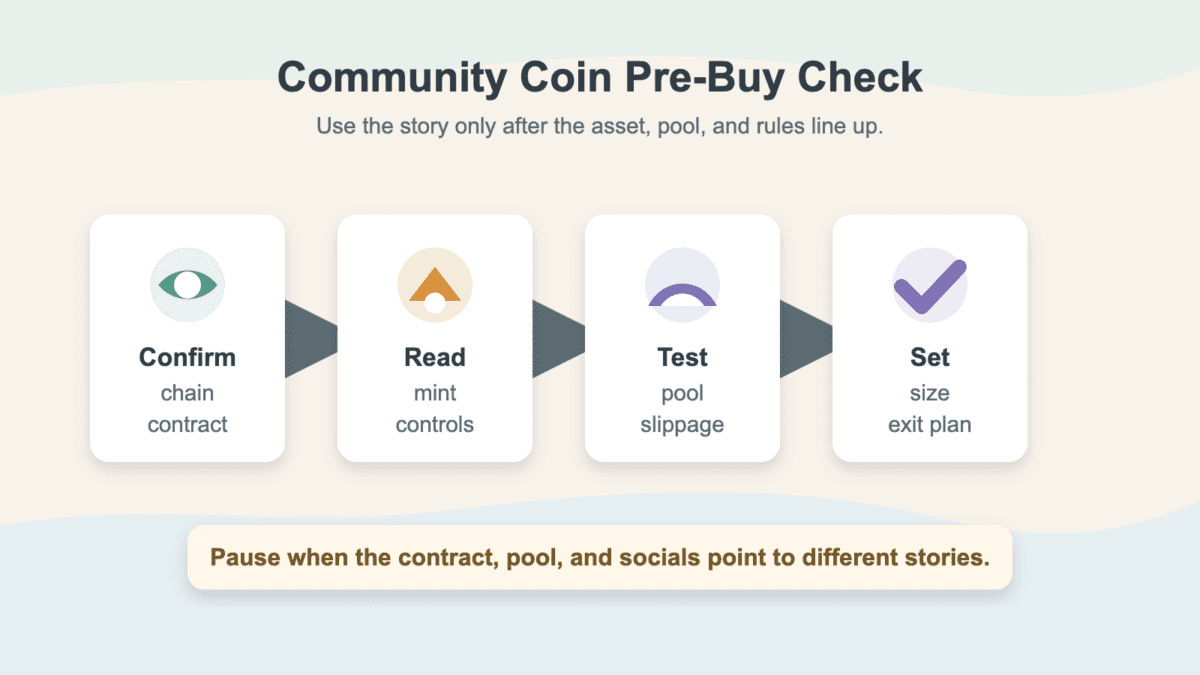
You check a community coin by verifying the asset first and the story second. Start with the exact chain, contract address, liquidity pool, holder spread, contract permissions, and wallet setup before reading another heroic Telegram thread.
Tiny assets can have messy data. Trackers may disagree on price, supply, volume, or even which token is being referenced. That is why the contract address matters more than the logo, ticker, or a screenshot from someone who joined the chat yesterday.
| Check | What It Tells You |
|---|---|
| Chain and contract address | Confirms you are looking at the right token, not a copy or old asset. |
| Liquidity depth | Shows whether buys and sells can happen without extreme slippage. |
| Holder distribution | Reveals whether a few wallets can move the whole market. |
| Dev and team wallets | Shows whether insiders still hold enough supply to crush price. |
| LP ownership or lock | Helps you see whether liquidity can disappear quickly. |
| Mint and blacklist permissions | Flags controls that can change supply or block transfers. |
| Transfer tax | Shows whether buying or selling carries hidden friction. |
| Social quality | Separates useful participation from bots, scripts, and recycled hype. |
| Governance evidence | Shows whether votes, treasury use, or proposals actually execute. |
| Personal custody plan | Confirms where you will hold the token and how you will protect the wallet. |
Liquidity deserves extra attention. A community coin can have thousands of messages and still have a tiny pool. If one medium-sized sell causes brutal slippage, the crowd cannot save your exit.
Holder distribution is the next reality check, especially when one wallet can dump into every bounce. Compare the top wallets with recent transfers, not only the holder count.
Custody is the unglamorous part. New community coins often trade on-chain before they reach major exchanges, so you may need a self-custody wallet. If you are not ready to manage seed phrases, approvals, and scam links, start with wallets before touching the token.
Then keep records of contract links, swaps, transfers, and notes, because rebuilding a meme season from chat logs is nobody’s idea of alpha.
When small-token data disagrees, handle the conflict before the buy:
Community takeover means holders try to run or revive a token after the original team abandons it, rugs it, or loses trust. In crypto slang, this is usually shortened to CTO.
A CTO can change the public face of a community coin. Holders may create new socials, replace broken links, update listing information, fund marketing, organize moderation, and coordinate new liquidity.
But a takeover does not magically fix the contract, old dev wallets, thin liquidity, tax settings, mint authority, blacklist controls, or holder concentration.
Use this quick filter before buying a CTO story:
The social layer often forms on CT, where memes and warnings spread fast. That speed helps good information travel. It also helps bad comeback stories look alive for a few hours.
Many CTO stories start near a dead coin. The community sees abandoned assets, broken trust, or a brutal selloff, then tries to rebuild. That can be genuine, but the trenches are full of second chances that became second traps.
If the answer is only “the chat is ours now,” you are still looking at an old token with new banners. A stronger takeover leaves receipts: public wallets, named moderators or accountable pseudonyms, visible treasury spending, clear listing updates, and honest discussion of what cannot be changed.
If old permissions remain, say so plainly in your notes. A community can own the story while someone else still owns the dangerous switch.
Community coins can be good trades for some users, but they are usually poor fits for money you cannot afford to lose. Their upside depends on attention, belief, timing, liquidity, and holder behavior, which can change brutally fast.
That does not make them useless. It makes them speculative, and speculation needs rules before the crowd supplies feelings. The downside is not only price loss. You can also lose time, wallet safety, and judgment when a group turns allocation into identity.
A strong community can support research, memes, liquidity, moderation, and persistence. It cannot remove smart-contract risk, wallet risk, whale exits, or the simple possibility that nobody cares next week. The practical test is whether your downside still makes sense if the chat goes quiet, liquidity thins, and the next buyer does not arrive on schedule. If the answer depends on everyone staying enthusiastic, your thesis is mostly social.
Community coins fit users who can set rules before the crowd gets loud:
Sizing and exits matter because community coins can move faster than your plan. If you buy only after a loud move, decide whether you are trading momentum, joining a long-term community, or just reacting to pressure.
A small position can still teach you plenty without turning every dip into a crisis. You do not need maximum exposure to learn whether a community can execute.
The social part is the hardest. A community can turn holding into identity, then make selling feel like betrayal. That is how a normal late buyer becomes a bagholder with better stickers. A researched conviction play is different from chat-room loyalty, because certainty is cheap in small-cap crypto and liquidity is not.
Community coin research gets easier when you know the nearby slang. These terms show up often in charts, chats, and risk discussions around community-led assets.
Use them as context, not as a second shopping list:
Those ideas are useful because community coins rarely move on one input. The same token can be a meme, a narrative, a social group, and a liquidity problem at the same time.
When several labels apply, slow down. The more stories attached to a coin, the easier it is for a weak setup to sound inevitable.
Start with identification. Find the exact community coin, ticker, chain, and contract address. Then compare that contract with official social links, DEX pages, trackers, and any community documents you can find.
Next, watch before buying. A real community can handle questions about liquidity, wallets, concentration, contract controls, and failed promises. A weak one turns every question into an accusation.
Set personal rules before the chat starts working on you:
Then check the market structure. Look at pool depth, slippage, recent volume, holder concentration, LP status, dev wallets, and transfer settings. If the token cannot support your planned exit size, your entry thesis is already worse than it sounds.
The final step is restraint. A community coin can be entertaining, profitable, educational, and still wildly unsafe. Let the community earn trust through evidence, not volume.
No, a community coin is not always the same as a meme coin. A meme coin usually depends on culture, jokes, and attention, while a community coin is any asset where holders drive promotion, governance, survival, or identity.
The two often overlap. Many meme coins are community coins because holder energy is the main reason anyone notices them.
But a community token tied to access, rewards, or governance can also fit the broader label. The mistake is assuming meme culture makes a coin unserious or community language makes it safer.
Yes, a community coin can have real utility if it gives access, rewards, governance rights, funding coordination, or useful participation inside a real community. The utility should be visible in behavior, not only promised in posts.
Look for things that actually happen: votes executed, funds tracked, tools built, access delivered, events organized, or rewards distributed. If the only utility is “the community is strong,” you are mostly looking at social value.
A clean test is whether someone would still use the token if the chart stopped moving for a month.
A community coin becomes risky when social proof hides weak liquidity, concentrated wallets, unsafe contract controls, or insider selling. The community can make people feel safer than the market structure deserves.
Other risks include fake activity, paid call groups, transfer taxes, blacklist functions, abandoned developers, and pressure not to sell. The worst setups make exiting feel disloyal while insiders quietly leave.
If you cannot find who controls permissions, liquidity, or major wallets, the community is not enough evidence.
Community takeover means holders try to run or revive a community coin after the original team leaves, rugs, or loses trust. In meme-coin slang, this is usually called CTO.
A takeover can improve socials, moderation, marketing, and coordination. It does not automatically change contract permissions, old dev wallets, liquidity depth, or holder concentration.
Ask what the community now controls before trusting the new banners.
Check community coin liquidity by looking at pool depth, recent volume, slippage, and whether sells of your likely size can clear without crushing price. A busy chat does not mean you can exit.
Also check whether liquidity is locked, who controls it, and whether the main pool is active on the chain you intend to use. Thin liquidity can make a small position feel trapped.
For tiny tokens, test likely exit size before entry.
Yes, a community coin can go to zero. If attention disappears, liquidity dries up, insiders dump, the contract breaks trust, or the community stops coordinating, the market may simply walk away.
That risk is part of the category. Community can keep a token alive longer than expected, but it cannot force buyers to appear forever.
Sometimes the crowd simply moves on, volume dries up, and the token becomes a leftover group chat with a chart.